
Volunteer Uniforms UK: The Complete Guide to Branded Clothing and ID

Outfitting a team of volunteers is a crucial task for any UK charity, community group, or non-profit organisation. Many UK voluntary organisations rely heavily on volunteers, with a large proportion operating without paid staff. In this context, a uniform is far more than just clothing; it’s a powerful tool for identification, team building, and public engagement. This guide provides a comprehensive overview of creating an effective uniform strategy, covering everything from durable garments and professional branding to practical ID solutions that accommodate volunteer turnover.
Whether you're organising a local park run, managing a nationwide fundraising appeal, or running a community support service, the right volunteer uniforms in the UK can help your team look professional, feel valued, and be instantly recognisable to the public they serve.
Why Professional Volunteer Uniforms Matter for UK Organisations
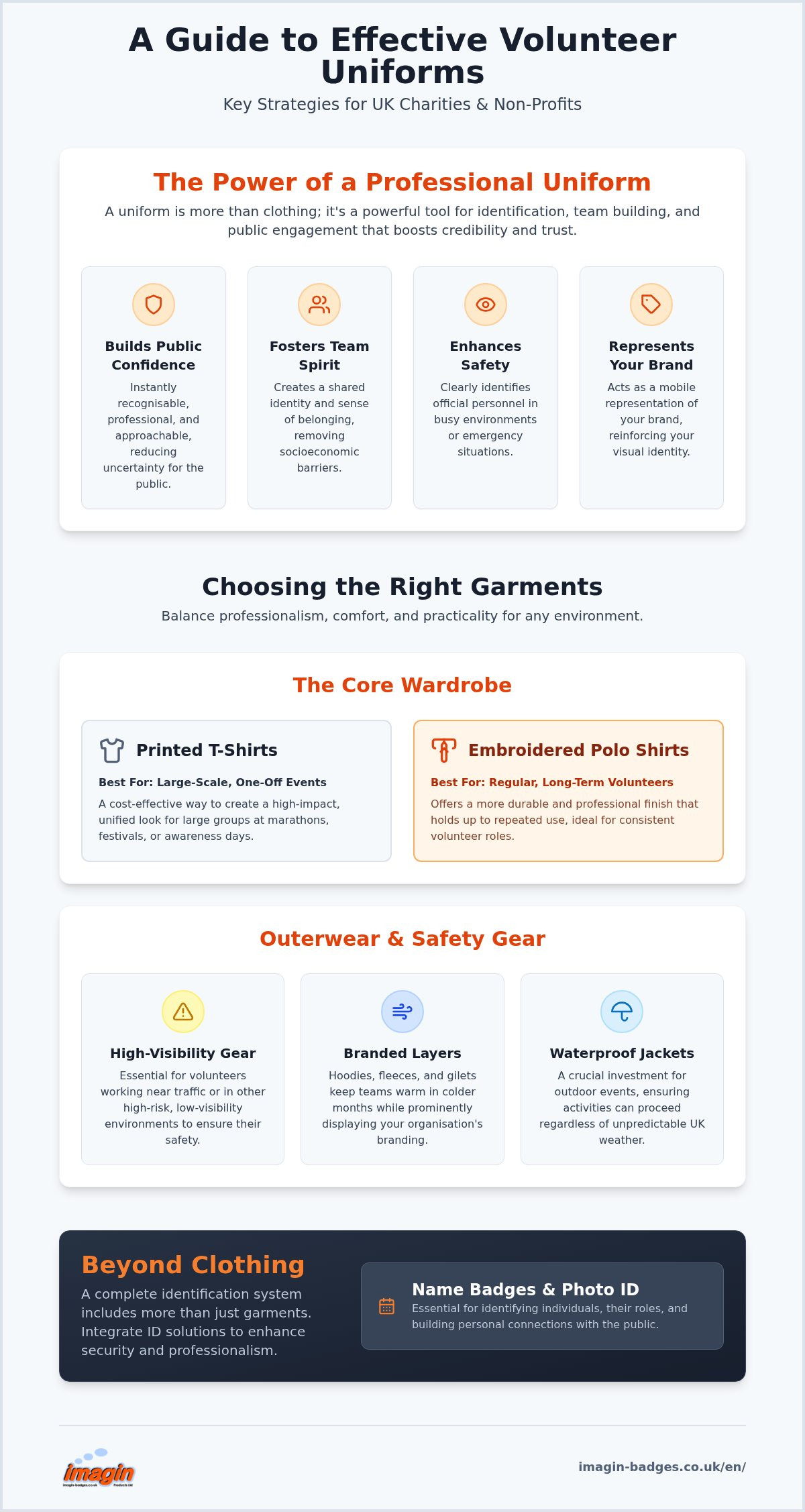
A volunteer uniform serves several vital functions: it identifies an individual as part of your team, signals a level of authority and responsibility, and acts as a mobile representation of your brand. A coordinated appearance helps create a positive first impression and can make your entire operation feel more organised and credible.
- Defining the role of a volunteer uniform: It combines identification, authority, and brand representation into one wearable solution.
- Building public confidence: Clear uniforms can help volunteers appear recognisable, professional and approachable to the UK public.
- Fostering team spirit: Consistent clothing can support team identity and a sense of belonging among volunteers from diverse backgrounds.
- Enhancing safety and security: In busy environments like festivals or emergency response situations, uniforms make official "adults in charge" easily recognisable.
Building Public Trust Through Identification
For service users, donors, or members of the public seeking help, being able to quickly identify an official volunteer reduces anxiety and builds confidence. When your team is clearly branded, it removes ambiguity and signals that they are a legitimate part of your organisation.
- Reducing uncertainty: Clear branding helps people in need find the right person to talk to without hesitation.
- Ensuring consistency: A uniform look across different volunteer roles reinforces your organisation's cohesive presence.
- Reinforcing your brand: Colour choices can reinforce your organisation’s visual identity while helping volunteers remain recognisable.
Fostering Team Unity and Equality
Beyond public perception, uniforms have a significant internal impact. They can act as a great leveller, creating a sense of unity among individuals who may come from very different walks of life but are united by a shared cause.
- Removing socioeconomic barriers: When everyone wears the same branded clothing, it removes potential distractions or judgments based on personal attire.
- Creating a shared identity: A uniform visually connects a diverse group of supporters, turning them into a visible, unified team.
- A volunteer uniform is a tool for both practical safety and organisational pride, helping individuals feel like a valued part of a collective effort.
Choosing the Right Garments for Your Volunteer Team
The ideal volunteer uniform balances a professional appearance with comfort and practicality. The garments you choose should be appropriate for the environment your volunteers will be working in and durable enough to withstand the demands of their roles.
- Selecting garments based on environment: Consider the needs of indoor roles versus the challenges of outdoor volunteering in the unpredictable UK weather.
- The versatility of polo shirts: Embroidered polo shirts offer a smart-casual look that suits a wide variety of roles and events.
- Comfort and practicalities: For active roles, prioritise breathable, flexible fabrics that allow for a full range of movement.
- Seasonal considerations: Plan for layering with branded fleeces, gilets, and softshell jackets to keep your team comfortable year-round.
The Core Wardrobe: T-Shirts and Polos
T-shirts and polo shirts form the foundation of most volunteer uniforms. While they seem similar, each has distinct advantages depending on the context of your activities.
- Printed t-shirts for large events: For large-scale, one-off events like marathons or awareness days, printed t-shirts are a cost-effective way to create a high-impact, unified look for a large group.
- Embroidered polos for regular volunteers: For long-term, regular volunteers, embroidered polo shirts often provide a more durable and professional finish that holds up well to repeated use.
- Fabric weight and durability: When selecting garments, consider the fabric's properties. GSM (Grams per Square Metre) indicates fabric weight, but durability also depends on fibre composition, construction, stitching and intended use. A heavier fabric isn't always the more durable option for every activity.
Outerwear and Safety Gear
For volunteers working outdoors, appropriate outerwear and safety gear are essential for their comfort and protection. This is particularly important for event marshals, fundraisers, and conservation teams who are exposed to the elements.
- High-visibility clothing: For volunteers exposed to vehicle movements, traffic or other visibility risks, a risk assessment may identify suitable hi-vis safety gear as necessary to keep them safe.
- Branded layers for warmth: Hoodies and sweatshirts are excellent for keeping volunteers warm during colder months while still prominently displaying your organisation’s branding.
- Waterproof options for UK weather: Investing in waterproof jackets ensures that fundraising activities and outdoor events can go ahead, whatever the British weather brings.
Integrating Name Badges and Photo ID Systems
Clothing is only one part of a complete identification system. Physical ID, such as a name badge or photo card, adds a crucial layer of security and approachability, making your volunteers more personable and accountable.
- The critical role of physical ID: A name badge or ID card confirms an individual's identity and their official connection to your organisation.
- Balancing security and friendliness: Using standard name badges with a first name and logo can make volunteers appear more approachable to the public.
- Photo ID for sensitive environments: Photo ID cards can be a valuable tool for volunteers working in roles that require a higher level of verification.
- Managing high turnover: For organisations with a frequent influx of new volunteers, reusable identification systems are a highly cost-effective solution.
Reusable vs Permanent Name Badges
Choosing the right type of name badge depends on your volunteer turnover rate and budget. Both reusable and permanent options offer distinct benefits for charity and non-profit organisations.
- Cost-effective flexibility: Reusable name badges feature a window for a printed paper or card insert, allowing you to instantly issue new badges on-site at no extra cost. This makes them ideal for managing a changing roster of volunteers.
- Recognising long-term service: For dedicated, long-serving volunteers or trustees, a premium or deluxe permanent badge can be a meaningful way to acknowledge their commitment.
- Choosing the right fastening: Consider the garments your volunteers will wear. Magnetic fittings can avoid the pinholes associated with traditional pin fastenings, while clips and pins offer a secure attachment on thicker outerwear.
Photo ID for Enhanced Security
In certain volunteer roles, a simple name badge may not be sufficient. Photo ID cards provide a higher level of verification that can be vital for safeguarding and access control.
- Verifying identity: In healthcare, education and other sensitive environments, organisations may require photo identification as part of safeguarding or access-control procedures.
- Professional accessories: Complete the look with lanyards and badge holders that match your uniform colours and branding. Some organisations use colour-coded lanyards to distinguish volunteers from staff, contractors or visitors.
- Maintaining an approachable feel: A well-designed ID system should look professional without feeling intimidating, using clear fonts and a friendly photo to maintain a welcoming image.
Designing Your Uniform: Branding and Logo Placement
Effective design is key to creating a volunteer uniform that is both functional and visually appealing. Strategic logo placement and high-quality application ensure your brand is seen and remembered.
- Best practices for logo placement: The left breast is the traditional and most common placement, but large logos on the back or smaller ones on the sleeve can also be highly effective.
- Choosing between embroidery and printing: The best method depends on your logo's complexity, the garment fabric, and your desired finish.
- Ensuring high contrast and readability: Your logo and any text should be clearly legible from a distance, which is especially important for assisting those with visual impairments.
- Managing brand guidelines: Maintain consistency by having clear guidelines for how your logo should be applied across different garment colours and textures.
Logo Application Methods
The two primary methods for applying logos to volunteer clothing are embroidery and printing. Each offers a different aesthetic and set of advantages.
- The premium feel of embroidery: Custom embroidery can provide a highly durable finish on suitable garments and is often well suited to workwear that undergoes repeated washing. It adds texture and a high-quality feel to polo shirts, fleeces, and jackets.
- Digital printing for complex logos: For intricate, multi-coloured charity logos or designs with gradients, digital printing (like DTF or screen printing) can replicate the detail with perfect accuracy. This method is often used for t-shirts for one-off events.
- Maintaining logo integrity: A professional supplier will ensure your logo is correctly scaled and digitised to look its best on every garment size, from XS to 5XL.
Practical Design Considerations
Beyond the logo itself, think about the overall design of the uniform and how it will function in a real-world setting.
- Choosing colours that stand out: Select uniform colours that contrast with typical event environments to ensure your volunteers are easily visible in a crowd.
- Incorporating "Volunteer" text: Clearly adding the word "VOLUNTEER" on the back or front of the garment helps the public immediately understand their role, which is especially useful in large teams where volunteers and paid staff work alongside each other.
- Complimentary creative assistance from your supplier can help refine a complex logo to ensure it translates perfectly into a clean, professional embroidered design.
Sourcing and Rollout: Implementing Your Uniform Policy
Once you've designed your uniform, the final steps are sourcing the garments and rolling them out to your team. Careful planning at this stage can save time, reduce costs, and ensure a smooth launch.
- Calculating quantities: Order enough sizes to fit your current team, plus a small buffer to accommodate new volunteers who join at short notice.
- The advantages of UK-based customisation: Working with a supplier that personalises garments in-house in the UK can offer faster turnaround times, which is critical for last-minute event support.
- Creating a "Uniform Agreement": For more expensive items like jackets, a simple agreement can clarify expectations for care and ensure garments are returned when a volunteer leaves the organisation.
- Getting volunteer buy-in: If you're transitioning to a new uniform, consult with your volunteers. Involving them in the selection process can generate excitement and a sense of ownership. For more tips, see our guide on how to introduce a new company uniform.
Bulk Ordering and Budget Management
For most charities and non-profits, budget is a primary concern. Smart ordering strategies can help you get the best value for your money.
- Understanding tiered pricing: Most suppliers offer tiered pricing, where the cost per item decreases as the order quantity increases. Consolidating your annual uniform needs into one or two large orders can maximise your budget.
- The benefit of "no minimum order": A supplier with a "no minimum order" policy is an invaluable partner for smaller volunteer groups or for when you just need a few top-up items.
- Planning for major events: Always factor in lead times for production and delivery, especially when ordering for major UK charity events or awareness weeks. Plan well in advance to avoid disappointment.
Why Choose Imagin Products Ltd
At Imagin Products Ltd, we specialise in helping UK non-profits create professional and practical identity solutions for their teams. We understand the unique challenges of outfitting a volunteer workforce.
- UK-based personalisation: Our Kirkcaldy production facility ensures all your garments and badges are printed and embroidered in Scotland, allowing for high-quality control and fast UK delivery.
- A comprehensive range: We offer everything you need to build a complete uniform, from button badges for fundraising appeals to professional outerwear for year-round activities.
- Expert support for UK non-profits: As a trusted partner since 1990, we provide expert guidance, complimentary creative assistance, and reliable service to help you make the best choices for your organisation.
Frequently Asked Questions (FAQs)
Should charities provide uniforms for their volunteers for free?
Most UK organisations provide uniforms free of charge as it ensures consistency and removes any financial barrier to volunteering. Some may ask for a small, refundable deposit for more expensive items like jackets. It's generally considered best practice to provide the necessary branded clothing and ID required for the role.
What is the most durable method for adding a logo to volunteer clothing?
Both embroidery and modern printing techniques can be very durable. Embroidery is known for its longevity on items like polo shirts, hoodies, and jackets. High-quality screen printing or DTF (Direct-to-Film) printing is excellent for t-shirts and can withstand many washes when cared for correctly.
How do we handle volunteer identification if we have a high turnover of people?
Reusable name badges are the most cost-effective solution for high-turnover environments. They allow you to print new names on paper inserts and reuse the badge holder, eliminating the cost and wait time associated with ordering permanent new badges for every new starter.
Are there specific health and safety regulations for volunteer uniforms in the UK?
While there is no general UK law requiring a standard volunteer uniform, organisations may have health and safety duties depending on the activities involved. Risk assessments should identify whether protective clothing or hi-vis equipment is required for a specific role, such as marshalling near traffic or working in low-light conditions.
Can volunteers claim tax relief on their uniform or laundry costs?
Volunteers generally cannot claim employee uniform or laundry tax relief because they are not employees. Charities can, however, reimburse reasonable out-of-pocket expenses incurred through volunteering, provided these reflect genuine costs rather than additional payment.
What are the best garment colours for making volunteers stand out at public events?
Bright, vibrant colours like red, royal blue, lime green, and bright yellow are highly effective for visibility in crowds. The best choice often depends on your charity's branding and the environment of the event. Contrast is key—choose a colour that will stand out against the background.
How can we ensure our volunteer ID cards are GDPR compliant?
To comply with GDPR, you must handle personal data securely and lawfully. Organisations must identify an appropriate lawful basis for processing personal information used on an ID card, including photographs, and must handle that data securely and transparently. This includes having a clear policy on data retention and secure destruction of old ID cards. For more details, read our guide to GDPR compliance for ID cards.
Do we need different uniforms for different volunteer roles?
This depends on your organisation's structure. It can be very helpful to use different coloured t-shirts or lanyards to distinguish between roles, such as "Team Leader," "First Aider," or "Information Point." This helps both the public and other volunteers quickly identify the right person to approach for specific needs.