
GDPR Compliance for Staff ID Cards: A 2026 UK Business Guide

Could your company's most basic security measure actually be its biggest legal liability? For many UK businesses in 2026, the humble photo ID remains a source of significant anxiety. You've likely found yourself questioning whether you need explicit consent for every staff photo or worrying about how your printing partner handles sensitive employee data. It's a valid concern, especially with the Information Commissioner’s Office (ICO) maintaining strict oversight under the Data Use and Access Act 2025.
We understand that you want a secure workplace without the looming threat of a compliance breach. This guide will help you master the essentials of GDPR compliance for staff ID cards, ensuring your identification system is both legally robust and operationally efficient. We'll walk you through a practical compliance checklist, explain how to choose a secure ID card supplier, and show you how to build a policy that protects your team. By the end, you'll have the confidence to turn your staff IDs from a risk factor into a professional asset that reflects your brand's commitment to privacy and craftsmanship.
Key Takeaways
- Understand your responsibilities as a Data Controller under the Data Use and Access Act 2025 to keep your identification system legally sound.
- Identify the correct legal grounds for processing employee data to ensure robust GDPR compliance for staff ID cards without needing constant explicit consent.
- Apply data minimisation principles to your card designs, ensuring only essential information is displayed to protect staff privacy and reduce security risks.
- Implement a secure data handling checklist when working with external partners, prioritising encrypted file transfers over vulnerable email communication.
- Discover how direct UK manufacturing provides end-to-end data sovereignty and professional design assistance for your organisation's security needs.
What is GDPR Compliance for Staff ID Cards?
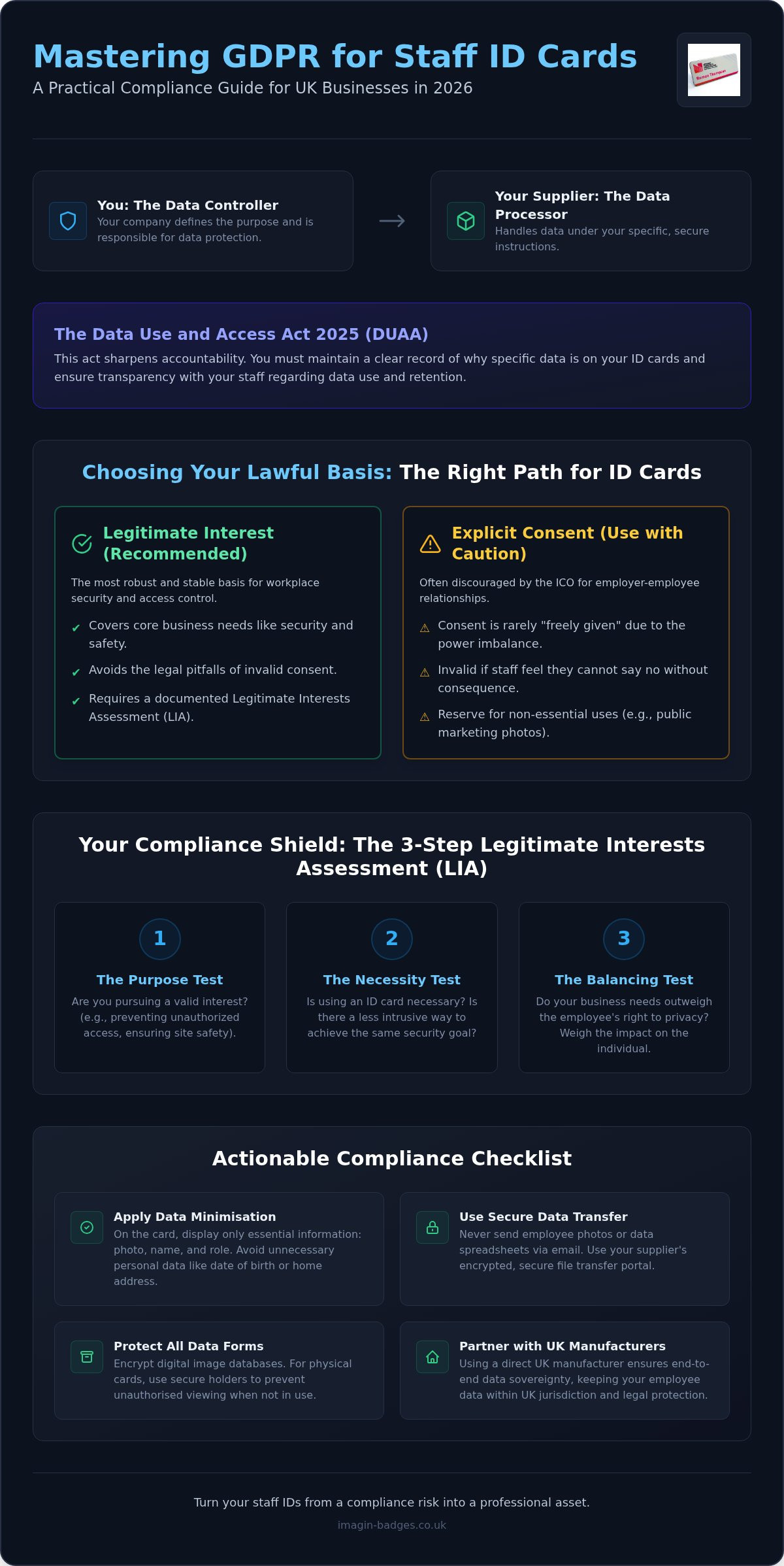
In the world of physical security, a staff ID card is more than a piece of plastic; it's a carrier of sensitive personal information. Achieving GDPR compliance for staff ID cards means ensuring that every stage of the card's life, from the initial photo capture to the final print, respects the privacy rights of your employees. In 2026, this requires a clear understanding of your legal role. As the employer, you act as the Data Controller. You define the purpose of the ID system and remain responsible for the data's protection. When you partner with a manufacturer like Imagin Products Ltd, we act as your Data Processor, handling that information under your specific instructions within our secure UK facility.
Is a Staff Photo Considered Personal Data?
A staff photo is a primary example of personal data because it identifies a living individual. While a standard headshot on an ID card is generally treated as personal data, it can be classified as sensitive biometric data if it's used for technical processing that allows for unique identification, such as automated facial recognition at a security gate. Even if you don't use high-tech scanning, storing digital images in a database carries higher risks than the physical card itself. You must ensure that digital files are encrypted and that the physical cards are protected by professional photo ID card accessories, like secure holders, to prevent unauthorised viewing when they aren't in use.
The Data Use and Access Act 2025 (DUAA) Explained
The regulatory environment shifted significantly with the implementation of the Data Use and Access Act 2025. This legislation was designed to streamline how UK businesses handle data while maintaining the high standards set by the original UK GDPR. For ID card systems, the DUAA 2025 introduced more flexible "smart data" schemes, making it easier for organisations to share necessary security data with trusted partners without drowning in paperwork. However, it also sharpened the requirements for accountability. In 2026, you're expected to maintain a clear record of why you've chosen specific data points for your cards. The focus is on transparency; your staff should know exactly how their image is being used and how long your supplier intends to keep their record on file.
Establishing a Lawful Basis for Processing Staff ID Data
Processing employee data isn't optional for most businesses, but you must identify which of the six lawful bases under Article 6 applies to your specific situation. For basic identification, many organisations initially look toward "Contractual Necessity". If an employee's contract requires them to wear identification for security or client-facing roles, processing their data becomes a requirement of the agreement. However, relying on a contract alone can be narrow and restrictive. Most robust frameworks for GDPR compliance for staff ID cards lean on "Legitimate Interest" to cover a broader range of security needs and facility management requirements.
Legitimate Interest vs. Explicit Consent
It's a common mistake to assume you need explicit consent for every staff photo. In fact, the Information Commissioner’s Office (ICO) often discourages relying on consent in the workplace. Because of the inherent power imbalance between employer and employee, consent is rarely considered "freely given". If a staff member feels they can't realistically say no without consequence, the consent is legally invalid. Legitimate interest is a more stable path for workplace security and access control. You typically only need explicit consent for uses that fall outside of core business operations, such as using a staff headshot in a public marketing brochure or on a promotional social media post.
Conducting a Legitimate Interests Assessment (LIA)
To use legitimate interest as your legal basis, you must document a Legitimate Interests Assessment. This isn't just a box-ticking exercise; it's your primary defence during a compliance audit. The assessment follows a three-part test that helps you justify your data use:
- The Purpose Test: Are you pursuing a valid interest? Examples include preventing unauthorised access to your facility or ensuring health and safety compliance on a busy site.
- The Necessity Test: Is the processing actually necessary for that purpose? You must consider if there's a less intrusive way to achieve the same security result.
- The Balancing Test: Do the individual’s interests, rights, or freedoms override your business interests? You must weigh the benefit of the ID card against the employee's expectation of privacy.
By documenting this process, you demonstrate proactive accountability. For instance, you might conclude that while a photo is necessary for visual verification, displaying a full date of birth on the card face is an unnecessary privacy risk. This is where professional design assistance helps you strike the right balance between high-security identification and employee privacy, ensuring your cards are both functional and legally sound.
Data Minimisation: Designing Compliant Photo ID Cards
Data minimisation is a cornerstone of GDPR compliance for staff ID cards. It dictates that you should only collect and display the absolute minimum amount of personal data required for the intended purpose. In 2026, the ICO prioritises "privacy by design," meaning your card layout should be scrutinised before the first batch hits the printer. If a piece of information doesn't directly help identify the person or grant them access, it has no business being on the card face.
Essential vs. Excessive Information on ID Badges
Start by categorising data. Essential items usually include the staff member's name, a clear photo, your company logo, and an expiry date. These provide immediate visual verification for security staff and colleagues. However, excessive data points often creep into designs out of habit rather than necessity. We recommend a strict audit of your current layouts to identify redundant fields.
- Essential: Name, professional headshot, organisation logo, and an expiry date to manage card lifecycles.
- Excessive: Full date of birth, home address, or National Insurance numbers. These are high-risk data points that could facilitate identity theft if a card is lost or stolen.
- Situational: Job titles and department names. These are useful for large organisations to direct visitors, but you must consider if they are strictly necessary for your security objectives.
A smart way to maintain high security while adhering to minimisation is using employee ID numbers, barcodes, or QR codes. These can be scanned by authorised systems to pull up records in a secure database. This approach allows you to verify credentials without displaying sensitive details to every passer-by in a public space.
The Role of Physical ID Accessories in Data Protection
Compliance doesn't end with the print process; it extends to how the card is worn and handled daily. Physical accessories play a vital role in your overall GDPR strategy. Using professional ID card holders helps protect the card's surface from wear, but it also serves as a first line of defence against "shoulder surfing" or accidental data exposure in public areas.
For staff in sensitive roles, such as those handling financial data or working in high-security environments, opaque holders or privacy shields are excellent solutions. These require the user to actively flip or remove the card for inspection. This ensures that personal data isn't visible to the general public during a commute or in a shared canteen. This physical layer of security demonstrates that your organisation takes data protection seriously. Our team provides creative assistance to ensure your layout works perfectly with these accessories, blending premium aesthetic quality with rigorous legal standards.
A Checklist for Managing ID Card Data with Suppliers
Managing the relationship between your organisation and your printing partner requires more than just a signed quote. To ensure full GDPR compliance for staff ID cards, you must verify that your supplier's internal processes match your own high standards for data protection. In 2026, the ICO expects data controllers to perform due diligence on every processor they engage. Use this five-step checklist to evaluate your current or prospective partner:
- Verify Data Policies: Ensure the supplier has a clear, UK-specific privacy policy that aligns with the Data Use and Access Act 2025.
- Mandate Secure Transfers: Never send employee data via email. Use Secure File Transfer Protocol (SFTP) or encrypted portals for all photo and text uploads.
- Formalise Retention: Agree on exactly how long the supplier will keep your data. Once a card is printed and delivered, the digital record should be purged according to a set schedule.
- Execute a Data Processing Agreement (DPA): This is a legal requirement. It defines the supplier’s obligations and protects your organisation in the event of a breach.
- Confirm Physical Security: Data isn't just digital. Ask if the production facility is secure and if staff are trained to handle sensitive print waste correctly.
Vetting Your ID Card Printing Partner
A significant risk in the industry is the rise of brokers who outsource printing to third parties. When you work with a direct UK manufacturer, you benefit from a shorter, more transparent supply chain. You should ask potential partners about their staff training programmes and how they handle 'spoils'; these are misprinted cards that still contain sensitive personal data. A secure partner will have industrial shredding protocols for all manufacturing waste to prevent information leaks.
Secure Data Transfer and Retention
Standard email is inherently insecure and leaves copies of sensitive data on multiple servers. We recommend setting up 'auto-delete' triggers. For example, once you confirm receipt of your order, the supplier should automatically delete the source files within 30 days. This lifecycle management reduces your 'data footprint' and limits the impact of any potential future security incident. It's a simple step that provides immense peace of mind.
By choosing a partner that operates their own production facility, you maintain end-to-end control over your employees' information. If you're ready to upgrade your security, you can start your compliant ID project today with a team that prioritises your data sovereignty.
Securing Your Workplace with Imagin Products Ltd
Maintaining a secure, compliant workplace shouldn't be a source of stress. When you partner with Imagin Products Ltd, you're choosing a veteran UK manufacturer with over 35 years of experience. Since 1990, we've operated our own production facility, which gives us total end-to-end control over the data you share with us. This is the definition of data sovereignty; your sensitive employee information never leaves our secure hands or passes through third-party brokers. It's a proactive approach that simplifies your path to GDPR compliance for staff ID cards.
We don't just print; we collaborate. Our team provides complimentary creative assistance to ensure your photo ID card layouts are both aesthetically premium and legally sound. We help you apply the principles of data minimisation discussed earlier, suggesting ways to use barcodes or employee numbers instead of excessive text. This security-first design philosophy ensures that your staff identification is a professional asset that protects your people and your reputation while helping you maintain GDPR compliance for staff ID cards throughout the production cycle.
Our Commitment to Professional Standards
Our heritage as a trusted manufacturer means we understand the technical finishing processes required for longevity. Whether we are producing a complex ID system or a single personalised name badge, our standards remain high. We treat every project as a distinct creative endeavour, ensuring that your branding is vibrant while your data remains private. Our facility is designed to handle sensitive corporate data with the utmost care, from secure digital intake to the industrial destruction of misprints.
Ready to Upgrade Your Staff ID System?
Starting a secure project is straightforward. Our approachable design partners are here to guide you through the technical specifications and data requirements. We provide a complete solution, integrating high-quality lanyards and secure holders that reinforce your physical security strategy. You'll receive rapid turnaround times without compromising on the meticulous attention to detail that our clients have relied on for decades. Contact us today to see how we can translate your digital concepts into a physical, compliant reality that builds immediate trust with your team.
Future-Proof Your Organisation's Security
Building a legally sound identification system doesn't have to be a complex burden. By prioritising data minimisation and establishing a clear legitimate interest for your records, you create a workplace that values both safety and privacy. Choosing the right partner is the final piece of the puzzle. Working with a direct UK manufacturer who maintains a secure production facility ensures that your sensitive data never leaves trusted hands.
Achieving total GDPR compliance for staff ID cards is easier with expert support. Since 1990, we've helped organisations translate their security needs into high-quality physical products. Our service includes expert creative assistance to help you refine your layouts for maximum compliance and professional impact. You can take the first step toward a more secure, legally robust identification policy right now. Order your secure staff ID cards from Imagin Products today and enjoy the peace of mind that comes from a truly professional partnership. We're ready to help you realise your vision with precision and care.
Frequently Asked Questions
Do I need explicit consent from employees to put their photo on an ID card?
You usually don't need explicit consent if you can demonstrate a legitimate interest, such as workplace security or access control. Relying on consent in an employment relationship is often legally unstable because of the power imbalance between employer and staff. Instead, document a Legitimate Interests Assessment (LIA) to justify the processing. This approach ensures your GDPR compliance for staff ID cards is robust and less susceptible to withdrawal of consent by individual employees.
How long can I legally store an employee’s photo for ID card purposes?
You should only store employee photos for as long as they are actively employed and require an ID. Once a staff member leaves, their digital record and photo should be deleted according to your data retention policy. We recommend setting a 30-day "auto-delete" trigger with your printing supplier after order fulfilment. This minimises your data footprint and ensures you aren't holding sensitive biometric information longer than strictly necessary for business operations.
What is the Data Use and Access Act 2025 and how does it affect ID cards?
The Data Use and Access Act 2025 is a UK legislative update that streamlines how organisations share security data while maintaining high privacy standards. It encourages "smart data" usage, making it easier to verify identities across different secure sites. For your ID system, it means you must be more transparent about how data is shared with processors. You must ensure your internal records reflect these 2025 updates to remain compliant in 2026.
Is it a GDPR breach if a staff member loses their ID badge?
A lost ID badge is considered a security incident and potentially a personal data breach if the card displays sensitive information. If you've followed data minimisation principles by omitting home addresses or dates of birth, the risk to the individual is significantly lower. You must log the loss in your internal register. If the risk to the staff member is high, you may need to report it to the ICO within 72 hours.
Can I include a staff member’s date of birth on their ID card?
Including a full date of birth is generally considered excessive and a violation of data minimisation principles. Unless there is a specific, documented legal requirement for age verification on the card face, you should omit this sensitive data. If you need to verify age for specific site access, consider using a secure QR code or an employee ID number that links to a protected internal database. This protects the employee from identity theft if the card is lost.
Do I need a Data Processing Agreement (DPA) with my ID card supplier?
Yes, a Data Processing Agreement is a mandatory legal requirement under UK GDPR whenever you share personal data with a third-party manufacturer. This document outlines the supplier's responsibilities, including how they store, process, and eventually delete your staff information. As a veteran UK manufacturer, we provide clear DPAs to ensure your organisation remains protected. This agreement is a vital component of your overall strategy for maintaining GDPR compliance for staff ID cards.
What should I do with staff ID cards when an employee leaves the company?
You must retrieve the physical card as part of your offboarding process and destroy it securely. Simply throwing a plastic ID card in the general waste is a security risk because it contains personal data. We recommend using an industrial cross-cut shredder designed for plastic. Once the physical card is destroyed, ensure the corresponding digital records are also purged from your database and your supplier's systems to fulfil your data deletion obligations.
Are QR codes on ID cards compliant with UK GDPR?
QR codes are fully compliant and often improve security by facilitating data minimisation. Instead of printing sensitive details on the card face, a QR code can link to a secure, encrypted portal that only authorised personnel can access. This ensures that personal information is only revealed when necessary. You must ensure the destination database is secure and that the code itself doesn't contain unencrypted personal data that anyone with a smartphone could read.