
Legal Requirements for Staff Identification in the UK

A staff badge is not a legal requirement for every UK workplace. What the law asks for depends on the role, sector and setting. No UK statute says every employee must wear or carry a visible ID card at work. Employers must check a person's right to work before they start. A staff badge is not proof of that check, and having one does not make an employer compliant with employment law.
Many business owners and HR managers find it hard to tell a statutory duty from regulator guidance or an internal policy. Some regulated settings, such as licensed security, civil aviation and certain clinical roles, have clear rules on identification. Many offices, hospitality venues and shops use badges for customer service, fire safety or visitor security. Those are employer policies, not national legal obligations.
This guide shows how to work out which staff identification rules apply to you. We cover how statutory duties differ from regulator standards and workplace policies across England, Scotland, Wales and Northern Ireland. We also look at UK GDPR when you collect photos or personal details, and how to build a proportionate policy. Name badges and photo ID cards help you put your policy into practice. The items alone are never legal compliance.
Key Takeaways
- UK law does not impose a universal requirement for all employees across all sectors to wear staff identification badges.
- The legal requirements for staff identification depend on the jurisdiction (England, Scotland, Wales, or Northern Ireland), your sector, the job role, and the setting.
- Always distinguish between legislation (binding statutory duties), regulatory frameworks, official guidance, and internal company policies.
- Recruitment identity checks and Right to Work verifications are entirely separate from workplace badge policies and should not be conflated.
- Under UK GDPR, you must ensure data minimisation: collect and display only the personal information strictly necessary for your stated operational purpose.
- Physical products like name badges or printed cards support your identification policy, but they do not guarantee legal compliance or grant access on their own.
Are Staff Identification Badges a Legal Requirement in the UK?
No. No single UK-wide statute obliges every employer to issue staff badges or requires all workers to wear visible identification. The legal requirements for staff identification depend on context. You need to check whether legislation or formal regulatory rules cover your sector or activities. Employers can bring in an ID badge through a dress code or security policy. That is an organisational choice, not a statutory mandate.
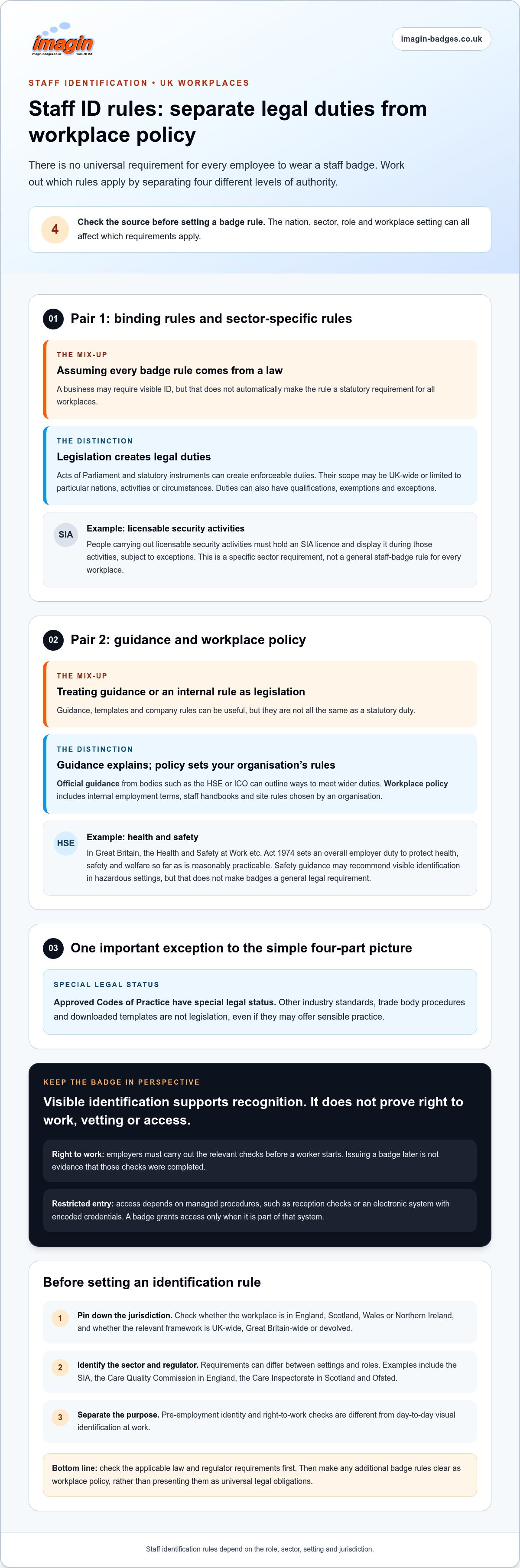
Keep four tiers of authority separate:
- Legislation: Acts of Parliament and statutory instruments that create enforceable legal duties across the UK or within specific devolved nations.
- Sector-specific regulations: Rules enforced by statutory regulators, such as the Security Industry Authority (SIA), the Care Quality Commission (CQC), or the Care Inspectorate in Scotland, which govern operating licences and sector standards.
- Official guidance: Advisory documentation issued by statutory bodies, such as the Health and Safety Executive (HSE) or the Information Commissioner's Office (ICO), which outlines approved methods to satisfy wider legal obligations without setting separate legislation.
- Workplace policy: Internal employment terms, staff handbooks, and site rules created by an individual business to maintain operational order, security, and brand identity.
Location matters too. Employment law is largely reserved to the UK Parliament for Great Britain. Education, healthcare and social care are devolved to the Scottish Parliament, the Welsh Parliament and the Northern Ireland Assembly. So a social care identification rule in Scotland may not apply to an employer in England.
What counts as a legal requirement, guidance or workplace policy?
Legislation creates legal duties, and breaching them can lead to penalties. Those duties can have qualifications, exemptions and exceptions, and penalties depend on the specific law. For example, people carrying out licensable security activities must hold a licence under the Private Security Industry Act 2001 and display it during those activities, subject to exceptions. Employers in that sector cannot treat visible identification as optional.
Official guidance shows how an organisation might meet wider legal duties. The Health and Safety at Work etc. Act 1974 requires employers in Great Britain to ensure, so far as is reasonably practicable, the health, safety and welfare of employees and visitors. In hazardous sites, safety guidance may recommend visible identification to keep unauthorised people out of dangerous areas. The guidance does not mandate badges. The underlying duty is overall safety.
Approved Codes of Practice have special legal status. Other industry standards, trade body procedures and downloaded templates are not legislation. They may be sensible practice, but treating a template as proof of a legal duty can lead to unnecessary or inaccurate rules.
Does a staff badge prove someone's identity?
No. A staff badge or photo ID card does not, on its own, verify someone's legal identity or show they are vetted to work. It helps people see who someone is through a name, role, department or photo. That supports everyday recognition. It does not replace formal identity checks.
When hiring, UK employers must verify a worker's right to work, following GOV.UK Right to Work checks. These involve original documents such as passports, or online share codes through the Home Office system. Issuing a badge later is not evidence that these checks were done properly. Showing a badge does not prove right to work to external authorities.
Cards also do not prevent unauthorised access by themselves. Restricted entry relies on managed procedures, such as staffed reception checking lists or electronic systems with encoded credentials. A badge only grants access if it is part of that system. In your handbook, explain that badges help colleagues recognise each other, while document checks and credential scanners handle security and compliance.
If your policy asks staff to show their names to colleagues and visitors, staff name badges are a practical way to do it.
How to Check Which Staff Identification Rules Apply
Start with the regulatory landscape, not badge designs. Work through four steps:
- Confirm the UK nation and jurisdiction: Identify whether your workplace operates in England, Scotland, Wales, or Northern Ireland. Verify whether the statutory framework governing your activities is UK-wide, Great Britain-wide, or devolved to a regional administration.
- Identify your sector and regulatory body: Determine whether your sector is subject to a statutory regulator (for example, the SIA for private security, the Care Quality Commission in England, the Care Inspectorate in Scotland, or Ofsted for education). Check the regulator's mandatory standards for site safety and staff identification.
- Define the explicit purpose of identification: Separate pre-employment verification from day-to-day visual identification on site. Determine whether the primary aim is safeguarding vulnerable service users, managing access to restricted areas, preventing contamination in sterile facilities, or simply assisting customer service.
- Audit primary legal and governmental sources: Review original source material directly. Check published statutory guidance on legislation.gov.uk and official guidance on GOV.UK. For health and safety questions, refer to the Health and Safety Executive, and review data processing standards with the Information Commissioner's Office.
Why sector and UK nation matter
Rules vary by sector and nation. In private security across England, Wales, Scotland and Northern Ireland, the Security Industry Authority requires licences to be displayed during relevant licensable activities, subject to exceptions such as covert operations. This is a binding requirement tied to personal licensing.
In retail or corporate settings, no such statutory duty exists. An office employer can require ID cards for building security, but that is internal policy. Copying rules from a high-security setting into an ordinary office can create disproportionate policies that clash with worker comfort or privacy.
Devolved nations also differ. In Scottish social care, services must follow the Health and Social Care Standards and the Scottish Social Services Council (SSSC) Codes of Practice, overseen by the Care Inspectorate. In England, the CQC regulates adult social care under the Health and Social Care Act 2008 (Regulated Activities) Regulations 2014. Both expect only authorised, verified people to deliver care, but the legal instruments and audits differ.
Identity checks are not the same as staff ID badges
People often confuse pre-employment identity checks with badge-wearing policies. Pre-employment checks confirm that a candidate is who they say they are, holds the right qualifications and can legally work in the UK.
For example, the NHS Employment Check Standards from NHS Employers set strict identity verification requirements for prospective NHS workers in England. They use a defined mix of photographic and address documents to prevent fraud and protect patients. This is not a rule that every business must issue ID cards. Once someone is hired, whether to require a visible badge is a matter of operational policy and local clinical guidelines.
Staff Identification in Healthcare, Care and Other Workplaces
The table compares statutory duties, regulatory guidance and employer policies across UK sectors:
| Sector or setting | Governing source to check | Primary identification purpose | Status: Legal duty or workplace practice? |
|---|---|---|---|
| NHS in England | NHS England identity guidelines | Public recognition, patient reassurance, infection prevention and site safety. | Operational guidelines and local trust policy. NHS England sets national branding and identity standards. Trusts enforce them through local policy, not a single UK statute. |
| NHS in Scotland (e.g., NHS Fife) | Health Board policies, such as the NHS Fife Staff Dress and Uniform Policy | Staff accountability, infection control, professional presentation and patient safeguarding. | Local health board HR policy. Boards require visible identification, and NHS Fife requires clip-on badges rather than lanyards in clinical areas. This is policy, not a statutory badge mandate. |
| Social care in England | CQC Regulation 19 (Fit and proper persons employed) | Only vetted, authorised staff provide care; client safeguarding. | Statutory duty to verify staff identity at recruitment. Regulators expect service users to recognise carers. A physical badge is the usual practice, not the statute itself. |
| Social care in Scotland | Care Inspectorate frameworks and SSSC Codes of Practice | Dignity, safety and professional accountability for people receiving care. | Regulatory framework and professional conduct rules. Providers must show safe staffing and accountability, usually through identification procedures. |
| Private security roles | Security Industry Authority (SIA) regulations under the Private Security Industry Act 2001 | Making sure people doing regulated security work hold valid licences. | Legal requirement across Great Britain and Northern Ireland. Licences must be displayed during relevant licensable activities, subject to exceptions. |
| Schools and colleges in England | Keeping Children Safe in Education (KCSIE) | Child safeguarding; telling authorised staff and vetted contractors from unvetted visitors. | Statutory safeguarding guidance. Schools must control staff and visitor access. Many schools use visible badges or colour-coded lanyards to do this. |
| Retail, hospitality and offices | Health and Safety at Work etc. Act 1974, employer risk assessments | Customer service, brand presentation, building security and fire evacuation tracking. | Discretionary employer policy, within equality and data protection laws. |
Healthcare and care settings
In healthcare, visible identification affects patient trust, safeguarding and clinical governance. In NHS England, the NHS England identity guidelines set visual standards for the NHS logo, staff titles and badge formats. Branding guidelines alone are not enough to require staff to wear badges. They need a workplace ID policy set by the relevant NHS Trust.
In Scotland, regional NHS health boards manage their own policies. The NHS Fife Staff Dress and Uniform Policy requires staff to display ID badges at all times at work. In clinical areas, it requires clip-on badges rather than lanyards, alongside "bare below the elbow" rules for infection prevention. These are binding employment expectations within that board, not a national badge statute.
For adult social care in England, CQC Regulation 19 requires registered providers to hold proof of identity, including a recent photograph, for every person employed. This is a pre-employment statutory requirement. In daily care, especially in people's homes, the CQC expects service users to be able to identify authorised care workers. A photo ID card is the usual way to meet that expectation, but the format is up to the provider. See our guide to healthcare worker ID solutions.
Schools, security, retail and other workplaces
In schools, the Department for Education's statutory guidance, Keeping Children Safe in Education, places a duty on schools and colleges in England to have clear safeguarding policies. Schools must control site access and make sure anyone working on site has had safer recruitment checks. Many schools require staff to wear visible ID badges and give visitors, volunteers and supply staff colour-coded passes. The badge system is an internal control that supports these safeguarding duties.
Private security is the clearest example of a direct statutory display requirement. Licensed operatives must display their licence during relevant licensable activities, subject to exceptions, so police, clients and the public can confirm their authorisation. An employer cannot waive this.
In commercial, retail and corporate workplaces, visible identification usually serves practical goals. Name badges make staff approachable, and photo cards help facilities teams monitor access in shared buildings. Unless specific risks or client contracts apply, it is the employer's choice.
How to Build a Proportionate Staff Identification Policy
A good policy sets clear expectations without demanding too much data. Start with the purpose. Is it to meet safeguarding rules, protect confidential information, satisfy insurers or help customer interactions? Writing down the reason keeps every part of the policy justifiable.
Your policy should cover:
- Scope of coverage: Explicitly state who is covered. Define rules separately for direct permanent employees, fixed-term staff, agency workers, sub-contractors, and short-term visitors.
- Display conditions: Specify when and where identification must be worn. Clarify whether badges must be visible at all times on site, or whether they should be removed when off-premises or working near active machinery to prevent snagging risks.
- Issuing authority and management: Identify the department or role responsible for verifying identity documents, taking photographs, issuing passes, and updating records (such as HR, security, or facilities management).
- Access control procedures: Clarify how visible badges interact with door access controls. Clearly explain that wearing a badge does not bypass staffed reception checks or electronic card readers.
- Return and revocation terms: State clearly that all issued badges, lanyards, and access credentials remain company property and must be returned upon termination of employment or completion of a contract.
Choose information and formats for a clear purpose
Under the UK General Data Protection Regulation (UK GDPR) and the Data Protection Act 2018, personal information displayed on a badge must comply with the principle of data minimisation. You should collect and display only the details necessary to achieve your stated purpose. Guidance from the Information Commissioner's Office on UK GDPR emphasizes that personal data must be adequate, relevant, and limited to what is necessary.
Carefully assess what details are essential on the visible face of a badge:
- First name vs full name: In customer-facing retail, hospitality, or dispute-resolution environments, displaying a first name alone often provides sufficient friendliness while protecting the worker from personal tracking or harassment outside of work. In clinical or legal settings, a full name and professional title may be required for formal accountability.
- Photographs: A photograph is justified when visual identity confirmation is needed to secure sensitive facilities, prevent pass-sharing, or protect vulnerable clients. If the setting is a low-risk open office, a simple name badge may suffice.
- Unnecessary personal data: Details such as home addresses, personal mobile numbers, national insurance numbers, or dates of birth should never appear on a visible staff badge or visitor pass.
- Data protection compliance: Ensure your employee privacy notice outlines the lawful basis for processing employee photographs and badge details (usually legitimate interests for site safety and operational management, or compliance with a legal obligation in regulated sectors).
Accessibility and safety also shape badge choices. Magnetic fixings are a practical alternative to pins that pierce fabric, but they are not suitable for people with medical implants such as pacemakers. Lanyards can be a hazard around machinery or in clinical settings. Breakaway clips may help, but do not assume they prevent entanglement. Your workplace risk assessment may conclude that lanyards should be avoided entirely. Clip-on badges are one alternative.
Set practical issuing, review and loss procedures
A policy only works if the procedures behind it are clear and followed. Say who handles card production, updates and replacements. If someone changes role, department or legal name, update their badge promptly.
Include a clear process for lost, damaged or stolen badges. Staff should report a missing badge straight away to their line manager or facilities security. If the card is also an electronic access credential, security staff must deactivate it promptly. A replacement badge does not restore digital permissions until the system administrator configures it.
Review the policy regularly, especially if you adopt hybrid working, move to a more secure site or take on contracts in regulated settings.
Choosing Staff Badges and Photo ID Without Overclaiming Compliance
Match the product to the purpose in your policy. A name badge suits approachable customer service and clear introductions. A photo ID card suits security checks or safeguarding, where the wearer's identity needs visual confirmation.
For a smart display of name and company logo, our name badge collection offers standard, premium and deluxe finishes. For individual photographic recognition, our photo ID cards are clear and durable.
When name badges and photo ID cards serve different needs
Different roles need different tools:
- Standard Name Badges: Rectangular aluminium badges with a clean, professional finish. They suit retail, hospitality, offices and reception teams.
- Reusable Window-Insert Name Badges: Where turnover is high or staff are seasonal, printing a badge for everyone is wasteful. Our reusable name badges have a branded upper section and a clear window below. The insert card can be printed or handwritten and replaced in seconds. They suit event teams, care homes and volunteers.
- Photo ID Cards: In schools, healthcare, distribution hubs and secure sites, a name is not enough. Photo cards let people check that the wearer matches the authorised record. See our guide on ID cards for secure facilities.
- Evaluating badge styles: Unsure between domed resin, framed metal or interchangeable formats? Our article on standard, premium, deluxe or reusable name badges covers durability, looks and maintenance.
A badge style does not confer legal compliance. A photo ID card supports safety only alongside proper pre-employment vetting, a clear policy and good management on site.
Put Your Identification Policy Into Practice
To test your policy, walk through one job role. Follow a typical shift. How is the employee's card validated on arrival? If they lose it mid-shift, who do they tell? Can visitors identify authorised staff? Do colleagues know when to ask for extra checks?
A walkthrough shows gaps before you publish, and keeps rules reasonable and easy to follow.
Keep a short record of why you chose your formats, which legal or regulatory standards you reviewed and your UK GDPR assessments. It gives you a solid base for future updates.
At Imagin Products, all printing is carried out on-site at our factory in Kirkcaldy, Fife. Orders are usually dispatched in 2 to 4 days with tracked delivery, and free standard delivery is available on orders over £150. Bulk pricing discounts apply across our badge and card collections. Speak directly to our team on 01592 653 865 or email sales@imagin-badges.co.uk to discuss your organisation's requirements, or visit Imagin Products to explore our complete range.
Frequently Asked Questions
Does UK law require every employee to wear a name badge?
No. UK law has no universal requirement for all workers to wear name badges. It depends on your sector, the role and frameworks such as SIA licensing or statutory child safeguarding guidance. In ordinary commercial, retail or office workplaces, it is a matter of employer policy.
Is an employer allowed to require staff to wear identification?
Yes. Employers can require identification if the policy is reasonable and follows employment, equality and data protection law. Consider individual circumstances and make reasonable adjustments for disabled employees, such as magnetic fixings instead of pins, or clip-on badges instead of lanyards. Displayed personal information must meet UK GDPR data minimisation.
Are contractors, agency workers and volunteers covered by staff ID policies?
Yes, if the policy defines the scope clearly. Contractors in restricted areas and agency workers delivering care should carry identification showing their status and authorisation. The policy should say who issues the credential, how verification works and how passes are collected afterwards.
Does the NHS identity-check standard apply to private-sector employers?
No. The NHS Employment Check Standards from NHS Employers apply to recruitment across NHS organisations in England. They are a useful model but have no statutory authority over private-sector employers. Businesses should set their own policies based on their risks, Right to Work rules and sector regulators.
Can a staff badge be used as proof of identity at a secure site?
Not on its own. A badge helps with day-to-day recognition, but it does not prove identity or site clearance. Secure sites need checks such as government-issued identity documents, verified visitor logs or electronic access credentials on a managed system.
What should staff do if an ID badge or access credential is lost?
Staff should report a lost or stolen badge straight away to their line manager or facilities security. If it holds an electronic access credential, security must deactivate it promptly. Issue replacements under set procedures, keeping electronic access separate from the physical card replacement.

Article by
Team Imagin :)
Team Imagin helps businesses look their best with quality name badges, photo ID cards, lanyards and branded workwear. Based in Kirkcaldy, Scotland, we combine friendly, personal service with professional printing and embroidery to bring your branding to life. From small teams to large organisations across Scotland, the UK, Europe and America, we help you boost your brand and build connections.
Disclaimer
This article provides general guidance only. Information was correct to the best of our knowledge when published, but product details, prices and regulations may change. Check current specifications and official guidance before making decisions.