
Healthcare Worker ID Solutions: A Comprehensive Guide to Staff Identification

Healthcare Worker ID Solutions: A Practical UK Guide to Badges, Lanyards and Workwear
Clear identification helps patients understand who is caring for them and helps colleagues recognise names and roles. For healthcare organisations, choosing suitable badges, photo ID cards and accessories also means considering staff privacy, cleaning requirements and the environment in which each item will be worn.
There is no single identification setup that suits every hospital ward, private clinic or community service. An accessory suitable for a reception team may be inappropriate during direct patient care or in an MRI department.
At Imagin Products Ltd in Kirkcaldy, Fife, we help organisations create personalised name badges, printed photo ID cards and branded workwear. This guide explains the practical choices involved, with an emphasis on clear design and selecting products around your organisation’s requirements.
Key Takeaways
- Start with your organisation’s uniform, infection prevention, security and staff safety policies.
- Make names and roles easy to read, with clear type and strong contrast.
- Distinguish a printed photo ID card from an electronic access credential.
- Do not assume that a breakaway lanyard is suitable for direct patient care.
- Choose cleaning methods and laundering processes that are compatible with the specific product.
- Treat staff privacy, MRI safety and implant-related precautions as separate considerations.
Why Clear Healthcare Identification Matters
Patients may meet several members of staff during one appointment or hospital stay. A clearly displayed name and job title can make it easier to understand who is providing care and whom to approach with a question.
NHS England’s uniform and workwear guidance recommends clear identifiers and recognises that patients want to know the names and roles of those caring for them. It also emphasises that clothing and accessories must not compromise care or staff and patient safety. [1]
The #hellomynameis campaign, co-founded by Dr Kate Granger and Chris Pointon, highlights the importance of introductions and compassionate care. A readable badge can support an introduction, but it does not replace speaking directly to the patient and explaining your role. [2]
Design for Readability
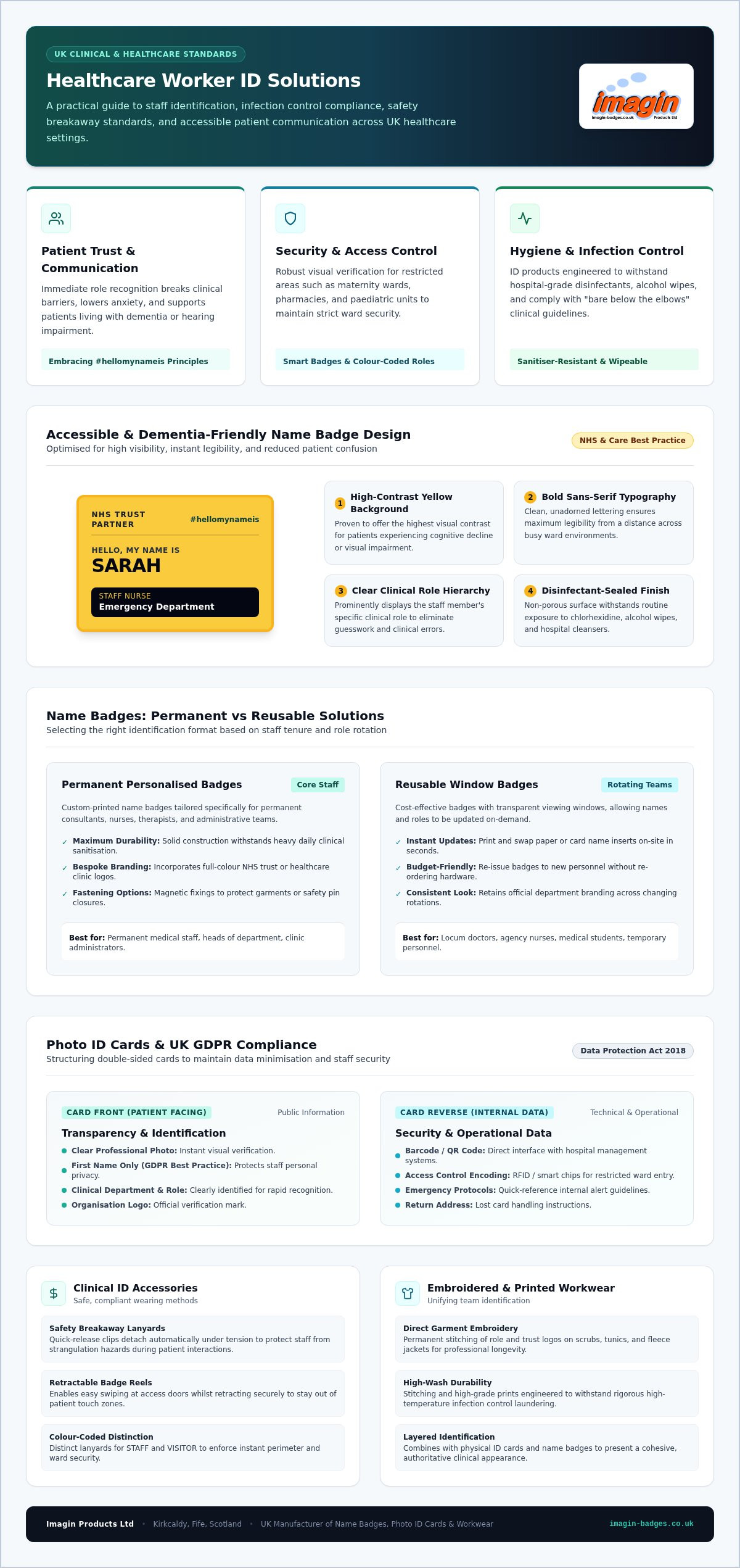
For patient-facing badges, give the name and role enough space to stand out. Keep logos and secondary information proportionate so that they do not overwhelm the text.
Useful design priorities include:
- Clear, simple lettering at a readable size.
- Strong contrast between the text and background.
- Short, recognisable job titles where appropriate.
- An uncluttered layout.
- A position that remains visible without interfering with care.
Some NHS organisations use bold black text on yellow badges to support readability for people with visual or cognitive impairments. This is a useful example, rather than a guarantee that one colour combination will meet every person’s needs. Where possible, ask patients and staff to review a sample before ordering. [3]
Colour coding can supplement a written role, but should not replace it. Follow the organisation’s existing scheme rather than introducing colours that may conflict with established meanings.
Explore our name badges for personalised identification options.
Choosing Photo ID Cards for Healthcare Staff
A photo ID card supports visual identification by showing a photograph alongside information selected by the employer. Depending on local policy, this may include a name, role, organisation, staff number or expiry date.
Use a recent, recognisable photograph and check that important details remain legible at the final printed size. Replace cards when the information becomes inaccurate, the photograph no longer provides reliable recognition, or the card is damaged.
Printed Identification and Electronic Access Are Different
A printed card does not automatically operate access-controlled doors. Electronic access requires a compatible credential and reader system, with permissions managed by the organisation.
If a card must combine printed identification with electronic access, confirm the technical requirements with the security or IT team before ordering. Do not assume that an ordinary plastic photo card includes a chip, magnetic stripe or other access technology.
Likewise, a printed QR code or barcode is not inherently secure. Any linked information or system needs appropriate access controls. Avoid placing confidential information directly into a code that anyone can scan.
Our photo ID cards provide options for printed staff identification. Discuss any additional technical requirements before choosing a product.
Single-Sided or Double-Sided Printing
Single-sided cards can work well when only a small amount of information is needed. Double-sided printing gives more room for details such as return instructions or an employer-approved contact number while keeping the front easy to read.
Information on the reverse is still accessible to someone holding the card. It should not be treated as private simply because it is less visible during everyday use.
Staff Privacy and Data Protection
Staff identification involves personal information. Under the UK GDPR’s data minimisation principle, organisations should use information that is adequate, relevant and limited to what is necessary for the purpose. [4]
That does not mean every badge must use a first name only. The appropriate details depend on identification needs, professional accountability, staff safety and the organisation’s policies.
For example, an employer may decide that a patient-facing name badge and a formal security ID card need different information. Any decision about displaying or omitting surnames should be agreed through the organisation’s relevant procedures.
Data protection also extends beyond the printed design. Employers should consider who can access staff photographs and ordering records, how those records are transferred to suppliers, how long they are retained and how they are deleted when no longer needed. A minimal badge layout alone does not establish GDPR compliance.
Permanent and Reusable Name Badges
Permanent and reusable formats serve different practical needs. The best choice depends on how often details change and whether the badge is suitable for the intended working environment.
Permanent Name Badges
Personalised badges can suit staff whose names and roles are unlikely to change frequently. A consistent layout helps the organisation present information clearly across departments.
Choose the finish, size and fastening around visibility, comfort, cleaning compatibility and local policy. A decorative finish is not evidence of clinical suitability, and no badge material should be assumed to withstand every disinfectant.
Reusable Window Badges
Reusable name badges allow the name insert to be changed while retaining the branded badge body. Imagin’s format includes branding on the upper section and a clear window below for the replaceable name.
This can be practical for temporary staff, students, locums or teams where details change regularly. Reusing the body may reduce the need to order a complete new badge each time, provided it remains in suitable condition.
Before choosing a window badge for clinical use, check how the window, insert and badge body should be cleaned. A reusable name badge also does not replace any separate photo identification or access credential required by the employer.
Lanyards, Reels and Fastenings in Healthcare
Start by asking which accessories are permitted for the role and setting. Clinical and non-clinical staff may need different arrangements, even within the same building.
Lanyards During Direct Patient Care
NHS England’s uniform and workwear guidance identifies wearing lanyards during direct patient care as poor practice. A breakaway fastening does not remove concerns about a hanging item coming into contact with a patient. [1]
Lanyards may be permitted in other settings, subject to local rules. Where they are allowed, the employer should assess snagging, pulling and other foreseeable risks, alongside cleaning requirements.
Breakaway mechanisms are intended to release under tension and reduce certain risks. They do not guarantee protection against injury or make an item suitable for every clinical environment. Product selection must reflect the local assessment, including any restrictions in mental health services or other higher-risk areas. CQC’s ligature guidance emphasises identifying and managing risks in the specific care environment. [5]
Retractable Badge Reels and Clips
A retractable reel can make it easier to present a card to a reader while keeping it closer to the body when retracted. A clip may also offer a practical attachment where local policy permits.
Neither option is automatically appropriate for every clinical task. Consider placement, the length and accessibility of any cord, ease of cleaning and whether the badge could contact the patient or interfere with care.
“Bare below the elbows” concerns access to the hands and forearms for effective hygiene. Choosing a reel does not, by itself, establish compliance with the organisation’s wider uniform or infection prevention requirements.
Magnetic Fastenings, Implants and MRI
Magnetic badge fastenings require particular consideration around implanted medical devices. Medtronic advises keeping magnetic name tags at least 15 cm away from its implanted heart devices. Staff should follow the relevant device manufacturer’s advice and their employer’s procedures. [6]
MRI safety is a separate issue. Pins, clips and reels can also contain metal, so replacing a magnetic fastening with a safety pin does not establish that a badge is suitable for an MRI environment. Only use identification and accessories accepted under the MRI department’s local safety procedures. [7]
Our photo ID accessories include options to discuss with your organisation’s purchasing, security and infection prevention teams.
Cleaning ID Cards and Holders
Cleaning advice should be specific to the item and the product used to clean it. Cards, printed finishes, holders, reels and textile lanyards may have different care requirements.
Before ordering, check that the proposed cleaning process is compatible with the manufacturer’s instructions. Follow the organisation’s approved method, including the disinfectant’s required contact time and any drying instructions.
Do not assume every hospital wipe contains alcohol. For example, the manufacturer describes Clinell Universal Wipes as alcohol-free, while other products in the Clinell range have different formulations. [8]
Hand sanitiser should not be treated as a substitute for a specified card or holder cleaning process. Avoid making promises about disinfectant resistance without evidence for the particular material and printed finish.
Rigid and flexible holders should be assessed on their actual design and care instructions. Neither category is automatically more hygienic in every situation. Similarly, an antimicrobial claim does not remove the need for cleaning or demonstrate that an accessory reduces healthcare-associated infections.
Inspect identification regularly and replace components that are cracked, damaged or no longer legible.
Coordinating Identification with Healthcare Workwear
Branded clothing can help create a consistent appearance, but healthcare workwear must first meet the employer’s requirements for the role.
An embroidered organisation logo can help identify the service. It will not identify an individual’s name or role unless those details are included, and it does not replace a required ID card.
When planning embroidered workwear, consider badge placement and branding together. Keep the person’s name and role visible and follow any applicable uniform and identity guidelines.
Embroidery, Printing and Laundering
Both embroidery and printing need to be selected around the garment and its intended care process. Durability depends on the fabric, thread or print system, construction and laundering conditions.
Do not assume that all embroidery is suitable for industrial washing, bleach exposure or repeated high-temperature cycles. Confirm that the garment and decoration are compatible with the required process before ordering.
NHS England’s guidance highlights the importance of choosing uniforms suitable for the necessary washing conditions and following local policy. [1]
For community teams, reception staff or other services, additional layers may be appropriate. Their suitability depends on duties and uniform rules, particularly when staff move between administrative work and direct care.
Planning an Order with Imagin Products Ltd
A clear brief helps us recommend relevant options and prepare artwork around your needs. Before ordering, confirm:
- Which staff groups need name badges, photo cards or both.
- The wording and personal information approved for display.
- The permitted fastenings and accessories for each setting.
- The intended cleaning or laundering process.
- Any technical, branding or purchasing specifications.
- How replacement cards and temporary staff identification will be managed.
Let us know about specialist requirements at the outset. Cleaning compatibility, electronic access features and suitability for restricted clinical environments must be confirmed for the particular product rather than assumed from its appearance or place of manufacture.
Whether you are organising identification for a small clinic or a larger team, we can help you explore name badges, printed photo ID cards and branded workwear. Contact Imagin Products Ltd to discuss your design and ordering requirements.
Frequently Asked Questions
Do healthcare workers have to wear ID badges by law?
There is no single universal UK rule prescribing an ID badge for every healthcare worker in every setting. Requirements depend on the service, applicable obligations and employer policies. The Health and Safety at Work etc. Act 1974 establishes general duties in Great Britain rather than a specific blanket badge requirement. CQC regulates health and adult social care in England, so its guidance should not be presented as a UK-wide rule. Staff should follow the identification requirements that apply to their workplace. [9][10]
What is the safest lanyard for a nurse?
First check whether a lanyard is permitted for the task. NHS England advises against wearing lanyards during direct patient care. Where permitted, the choice should follow the employer’s risk assessment and product requirements. A breakaway clasp does not guarantee safety. [1]
Are yellow name badges suitable for healthcare?
Black text on yellow is used by some NHS organisations to provide strong contrast. Readability also depends on text size, layout, viewing conditions and individual needs. Choose the design with patient accessibility and local policy in mind. [3]
Should staff surnames appear on badges?
There is no universal UK GDPR rule requiring surnames to be displayed or omitted. The employer should decide what information is necessary, considering identification, accountability and staff safety. [4]
Can I wear a magnetic name badge near an MRI scanner?
Follow the MRI department’s safety procedures. Magnetic fastenings and other badge components require assessment; ordinary metal clips or pins are not automatically suitable alternatives. [7]
How should I clean my ID card and holder?
Use the method approved by your organisation and compatible with the manufacturer’s instructions for each component. Follow the cleaning product’s directions and replace damaged or illegible items.
Are reusable badges suitable for temporary healthcare staff?
They can be useful where the employer permits them and their design meets the relevant cleaning and fastening requirements. They allow name details to change while retaining the branded body, but do not replace any required security ID or access credential.
Is embroidery suitable for healthcare uniforms?
It can be, provided the garment, thread and decoration are compatible with the required laundering process and local uniform policy. Suitability should be confirmed for the actual combination being ordered.
Sources and Further Reading
- NHS England: Uniforms and workwear guidance for NHS employers.
- Hello My Name Is: Campaign background and values.
- Herefordshire and Worcestershire Health and Care NHS Trust: Name badges to improve patient experience.
- Information Commissioner’s Office: Data minimisation.
- CQC: Reducing harm from ligatures in mental health wards and wards for people with a learning disability.
- Medtronic: Magnetic name tags and implanted heart devices.
- MHRA: Magnetic resonance imaging equipment in clinical use, safety guidelines.
- GAMA Healthcare: Clinell Universal Wipes and alcohol-free formulation.
- Health and Safety Executive: Health and Safety at Work etc. Act 1974.
- Care Quality Commission: About us.