
Custom Hi-Vis Vests UK: The 2026 Guide to Branded Safety Waistcoats

Why Custom Hi-Vis Vests are Essential for UK Businesses
In today's professional landscape, a custom hi-vis vest, or waistcoat, serves a dual purpose that extends far beyond simple visibility. It is a critical piece of Personal Protective Equipment (PPE) that safeguards your team, and a powerful branding tool that showcases your company's commitment to quality and safety. For UK businesses in construction, logistics, events, and security, branded hi-vis is no longer a luxury—it's a cornerstone of a professional identity.
The benefits are clear:
- Safety and Identity Combined: A custom hi-vis vest protects your staff from physical hazards while clearly identifying them as part of your professional organisation.
- Enhanced Team Cohesion: On a busy construction site or at a large-scale event, branded waistcoats create a unified look, making it easy to identify team members and fostering a sense of belonging.
- Meeting Safety Obligations: Under UK health and safety law, employers have a duty to protect their employees from workplace risks. A thorough risk assessment often identifies poor visibility as a significant hazard, making suitable high-visibility clothing a necessary control measure.
- Professional Standards: Standard, unbranded vests can look generic and temporary. A professionally branded waistcoat, featuring a crisp company logo, elevates your team's appearance and signals a higher standard of operation.
It's also crucial to source your PPE from a trusted supplier. Market surveillance by bodies such as the British Safety Industry Federation (BSIF) has consistently found high failure rates among PPE sourced from non-registered suppliers. Choosing a reputable UK-based partner ensures your garments are correctly certified and fit for purpose.
Beyond Compliance: Building Trust with Branded Safety Wear
A well-executed custom hi-vis vest does more than just meet safety requirements; it builds trust. When clients, partners, and the public see your team in professional, branded safety gear, it sends a powerful message of competence and reliability. This visual consistency reassures everyone that they are dealing with a serious, well-organised company that prioritises its people's safety.
This has a profound psychological impact on staff, too. A uniform fosters a sense of pride and responsibility, encouraging a more professional mindset. Furthermore, you can use different coloured vests or distinct branding to differentiate roles on site, such as identifying First Aiders, Fire Wardens, or Site Supervisors at a glance.
The Shift Toward Quality in Workwear
Modern UK businesses are increasingly moving away from cheap, disposable hi-vis vests that quickly fade, tear, or lose their reflective properties. The focus has shifted towards durable, high-quality garments that represent a better long-term investment. This means choosing vests with robust fabric, securely stitched reflective tape, and professional branding that is built to last.
A custom hi-vis vest should be seen as an integral part of your wider branded workwear strategy, working alongside polo shirts, jackets, and ID badges to create a cohesive and professional brand image across your entire operation.
Understanding UK Hi-Vis Safety Standards (BS EN ISO 20471)
When choosing hi-vis clothing, you will encounter the standard BS EN ISO 20471:2013+A1:2016. In simple terms, this is the recognised British and international standard for high-visibility clothing. It is not a law in itself, but it is the benchmark used to classify a garment's ability to make the wearer conspicuous in hazardous situations. The standard specifies the minimum areas of fluorescent background material and retroreflective tape a garment must have, as well as its design, to be certified.
Key points to understand include:
- What it means for you: Choosing a garment that conforms to this standard ensures it has been tested to meet specific performance requirements for visibility in daylight, low light, and at night.
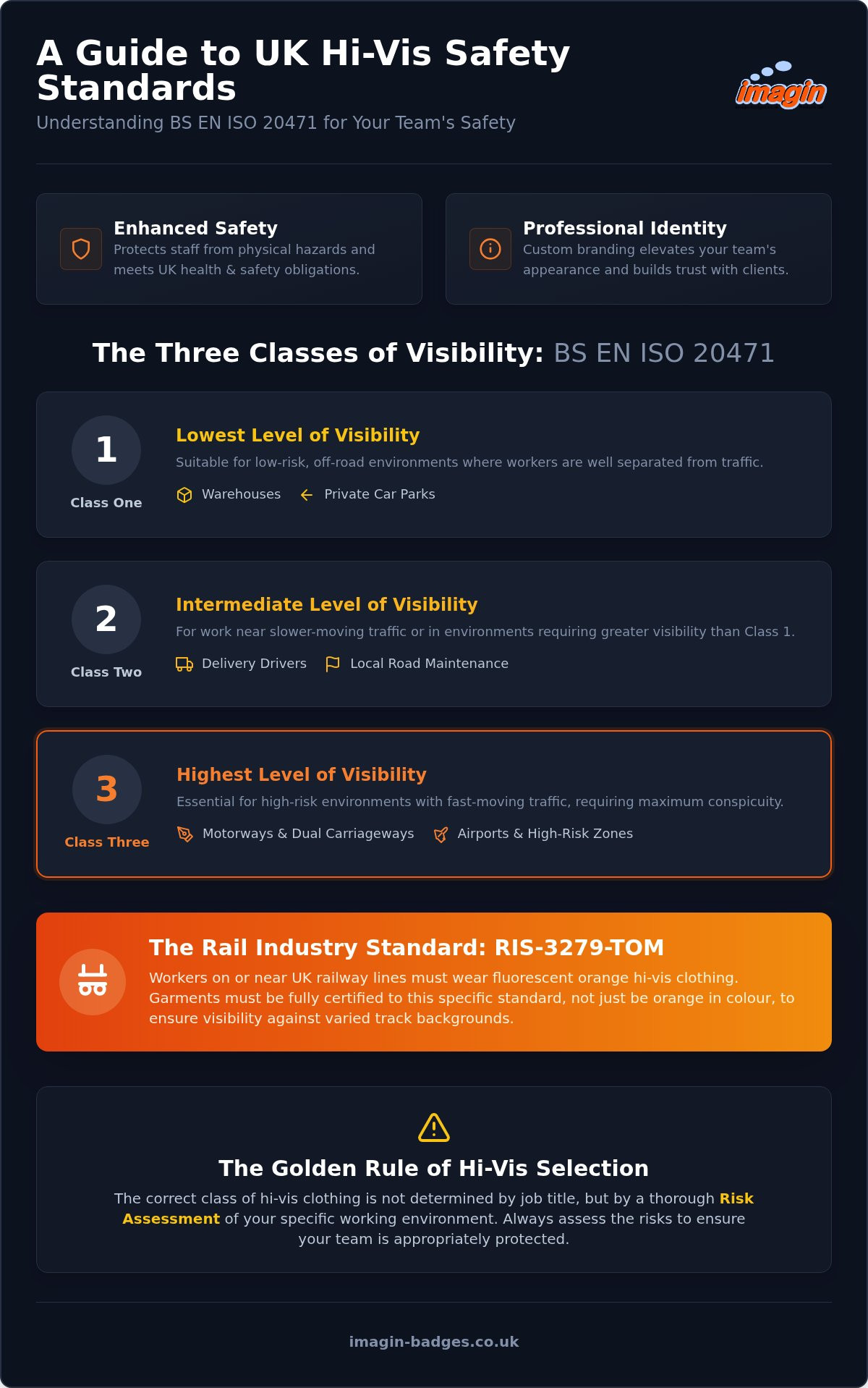
- The Three Classes: The standard is broken down into three classes, with Class 3 offering the highest level of visibility.
- Colour and Contrast: The standard dictates which fluorescent colours (such as yellow, orange, and red) are permissible and how they must contrast with the retroreflective tape for maximum effect.
Which Safety Class Does Your Team Need?
The appropriate class of hi-vis clothing depends entirely on a risk assessment of your specific working environment. The classes are not defined by job titles or specific speeds of traffic, but by the amount of visible material on the garment. The higher the risk, the more visible the wearer needs to be, and therefore a higher class is typically required. As general guidance:
- Class 1: Offers the lowest level of visibility. It is suitable for low-risk, off-road environments where workers must be visible but are well separated from traffic, such as in some warehouses or car parks.
- Class 2: Provides an intermediate level of visibility. It is often used where workers are near slower-moving traffic or in environments that require greater visibility than Class 1, such as local road maintenance, delivery, and refuse collection.
- Class 3: Delivers the highest level of visibility, with the largest minimum area of fluorescent and reflective material. It is intended for workers in high-risk environments, such as those working on or near high-speed roads like motorways or dual carriageways, where a risk assessment dictates the need for maximum conspicuity. For a deeper dive, read our guide on the difference between Class 1, 2, and 3 hi-vis.
Orange vs Yellow: The Rail Spec (RIS-3279-TOM) Distinction
While fluorescent yellow is the most common colour for general construction and road work, you will notice that workers on or near railway lines in Great Britain exclusively wear orange. This is due to a specific industry standard: RIS-3279-TOM (formerly GO/RT 3279).
It is crucial to understand that simply being orange does not make a garment compliant for rail work. The garment must be certified as meeting the full requirements of the RIS-3279-TOM standard, which dictates the specific shade of orange and other properties to ensure workers are clearly visible against the varied backgrounds of a railway environment. If your team operates near GB rail infrastructure, you must source garments that are explicitly certified to this standard.
Branding Methods: Embroidery vs. Printing for Hi-Vis
Once you've chosen the right safety vest, the next step is deciding how to apply your brand logo. The two primary methods are heat-transfer printing and embroidery, each with its own advantages for hi-vis waistcoats.
- Choosing a Method: Your decision should be based on your logo's complexity, your budget, the quantity you need, and how the vests will be used day-to-day.
- Impact on Longevity: A professional application, whether printed or embroidered, will enhance the garment's lifespan and appearance.
- Maintaining Breathability: For large back logos on lightweight vests, the branding method can affect airflow. Heat transfers are often preferred for this reason as they sit on top of the fabric.
Screen Printing and Heat Transfer: The Cost-Effective Choice
Heat-transfer printing is the most popular method for branding hi-vis vests. It involves applying your logo to the garment using heat and pressure, resulting in a sharp, vibrant finish. This method is ideal for large logos on the back of a vest and is highly cost-effective for bulk orders.
Modern, high-quality heat transfers are engineered for performance. When correctly applied by professionals and cared for according to instructions, they can provide a durable finish that is resistant to cracking and peeling. This makes them perfect for the lightweight polyester fabric of most hi-vis vests used for events, construction, or temporary work.
Embroidery: The Premium Choice for Executive Vests
Embroidery involves stitching your design directly into the fabric, creating a textured, high-quality finish with a tangible sense of quality. While less common on standard lightweight waistcoats, it is an excellent choice for branding thicker hi-vis garments like bomber jackets, fleeces, or premium waistcoats worn by management and client-facing staff.
The premium finish of embroidery pairs perfectly with other high-end identification products, such as our premium name badges, to create a cohesive and authoritative look for your senior team. When considering embroidery on waterproof outerwear, it's important to note that the process involves puncturing the outer fabric. Placement and technique should be carefully considered to minimise any impact on the garment's waterproof integrity.
The Golden Rules of Designing Custom Hi-Vis Vests
A successful custom hi-vis vest is a perfect balance of brand promotion and safety compliance. Following a few key design principles ensures your logo is clear and professional without compromising the garment's protective function.
- Logo Placement: The most common positions are the left chest for subtle branding and the upper back for maximum impact from a distance.
- Compliance is Key: Adding a logo or branding can affect a garment's conformity to BS EN ISO 20471 if it obscures the minimum required area of fluorescent or reflective material.
- Colour Matching: Consider how your brand colours will appear against a neon yellow or orange background. Simple, bold colours often work best.
- High-Resolution Artwork: Always provide your logo in a high-resolution vector format (like .AI, .EPS, or .PDF) to ensure the final print or embroidery is crisp and professional.
Logo Sizing and Positioning
To ensure your branding is effective and compliant, we follow industry best practices for sizing and placement. A typical left chest logo is around 90-100mm wide, offering clear identification without being overwhelming. For back logos, the goal is to maximise visibility while staying clear of the reflective safety tapes.
As a best practice design recommendation, we advise keeping all branding elements at least 2cm away from any reflective tape. This is not a formal requirement of the EN ISO 20471 standard, but it is a professional courtesy that helps ensure the tape's performance is completely unimpeded. Our complimentary creative assistance can help you refine your design to achieve this perfect balance. For more general advice, see our guide on choosing logo placement.
Common Design Pitfalls to Avoid
Even the best logos can run into trouble on hi-vis fabric. Here are a few common pitfalls to watch out for:
- Small, Intricate Text: Very fine lettering or complex details can be difficult to reproduce clearly on the textured polyester of a hi-vis vest, especially with embroidery.
- Too Many Colours: Logos with many different colours or gradients can be challenging and costly to print. A simplified, one or two-colour version of your logo often has a stronger impact.
- Poor Contrast: Ensure your logo's colours stand out against the bright background. A white or light grey logo, for example, may not be clearly visible on a yellow vest in bright daylight.
Ordering Your Custom Hi-Vis from Imagin Products
We believe the process of ordering professional safety gear should be simple, transparent, and reassuring. As a UK-based manufacturer with our own factory in Kirkcaldy, we have complete control over the quality and timing of your order, from the initial digital design to the finished physical product.
Our end-to-end service is designed to support UK businesses of all sizes, whether you need a few vests for a local event or are coordinating a bulk order for a national workforce. We can also bundle your hi-vis order with other essential items like photo ID badges and lanyards to provide a complete, branded solution for your team's safety and security.
Step-by-Step Ordering Guide
We've refined our process over 30 years to be as straightforward as possible:
- Select Your Garment: Browse our range of hi-vis vests, waistcoats, and jackets and choose the style and safety class that meets your risk assessment requirements.
- Upload Your Artwork: Send us your logo and any text you want to include. Our team will then provide complimentary creative assistance, advising on the best branding method and placement for your design.
- Approve Your Proof: We will send you a digital proof showing exactly how your finished custom hi-vis vest will look. We only proceed to production once you are 100% happy and have given your final approval.
Why UK Businesses Trust Imagin
For over three decades, businesses across the construction, healthcare, retail, and events sectors have trusted us to be a safe pair of hands for their branding needs. We are not just a supplier; we are a creative partner dedicated to translating your vision into high-quality, durable workwear.
Our proactive approach means we anticipate potential design challenges and solve them with you, ensuring a smooth process and a professional result. With reliable UK-based production and a commitment to excellent service, we deliver the peace of mind that your team's safety and your brand's reputation are in expert hands.
[Browse our range of custom hi-vis safety gear and request a quote today](https://imagin-badges.co.uk/collections/workwear/Hi-Vis)
Frequently Asked Questions (FAQs)
Do custom logos on hi-vis vests affect their safety rating?
Adding a logo can affect a garment's conformity if the branding is large enough to obscure the minimum required area of fluorescent or retroreflective material specified in BS EN ISO 20471. However, by working with an experienced supplier, you can ensure your logo is sized and placed strategically to maintain full compliance. We help you position your branding effectively without compromising safety.
What is the difference between Class 2 and Class 3 hi-vis vests?
The primary difference is the minimum required area of high-visibility materials. Class 3 garments have a greater area of both fluorescent background fabric and retroreflective tape than Class 2 garments, offering the highest level of conspicuity. The choice between them should be based on a thorough risk assessment of the working environment.
Can I have a full-colour logo printed on my hi-vis waistcoats?
Yes, modern heat-transfer technology allows for the application of full-colour and complex logos onto hi-vis fabrics. Our team can assess your artwork and advise on whether a full-colour print or a simplified version would provide the best and most durable result.
Is there a minimum order quantity for custom hi-vis vests in the UK?
At Imagin Products, we pride ourselves on flexibility. We do not have a rigid minimum order quantity, allowing us to cater to small businesses and large corporations alike. We also offer significant volume discounts for bulk orders.
How should I wash my branded hi-vis to ensure the logo lasts?
Washing instructions and the maximum number of permitted wash cycles can vary significantly between garments. Always follow the specific instructions on the manufacturer's care label inside the vest. As a general rule, wash at lower temperatures, avoid harsh biological detergents and fabric softeners, and do not tumble dry. Regularly inspect your vests for fading or damage to the reflective tape and replace them when their performance has deteriorated.
Can I get orange hi-vis vests that are suitable for railway work?
Yes, we can supply orange hi-vis garments. However, for a vest to be used in the GB rail environment, it must be certified to the RIS-3279-TOM standard. We can help you select a garment that is fully compliant with this specific requirement.
What is the standard turnaround time for custom workwear orders?
Our standard turnaround time is typically 7-10 working days from the approval of your digital proof. As a UK manufacturer, we can often accommodate tighter deadlines, so please contact us to discuss your specific requirements.
Do you offer VAT-free hi-vis vests for children or charities?
The VAT rules for clothing are specific. Some hi-vis garments designed for young children may qualify for zero-rating if they meet HMRC's conditions. For charities purchasing adult-sized PPE, VAT exemption is not automatic and depends on very specific circumstances. We recommend consulting HMRC's official guidance or a VAT specialist for definitive advice.