
Custom Hi-Vis Bomber Jackets: 2026 UK Buyer’s Guide

Why Custom Printed Hi-Vis Bomber Jackets are a Practical Choice for UK Winter Work
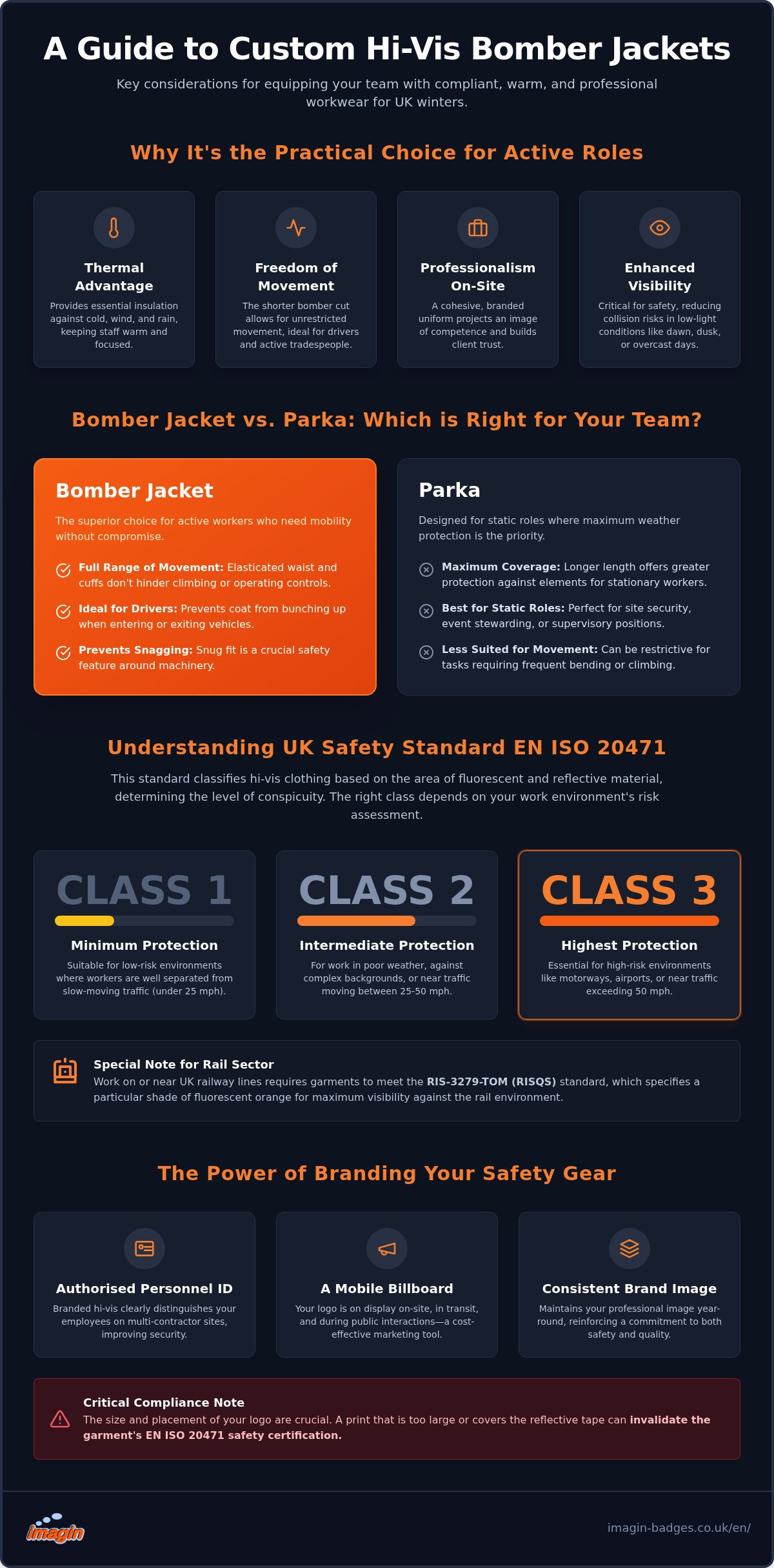
When the days shorten and the weather turns, equipping your team for outdoor work requires a careful balance of safety, warmth, and professionalism. For many UK businesses, the custom printed hi-vis bomber jacket has become a popular and effective solution. It offers a strategic blend of thermal protection, freedom of movement, and brand visibility that other forms of Personal Protective Equipment (PPE) can't match.
This guide explores why this specific garment is a standout choice for winter workwear and how to navigate the procurement process to ensure you receive durable, compliant, and professionally branded jackets for your team.
- The thermal advantage: A quality hi-vis bomber jacket provides essential insulation against the cold, wind, and rain common during UK winter months, keeping staff warm and focused on the task at hand.
- Mobility vs protection: The shorter, waist-length "bomber" cut offers greater freedom of movement compared to longer parkas. This is particularly valued by drivers, machinery operators, and active tradespeople who need to bend and move without restriction.
- Professionalism on-site: A cohesive, branded team uniform has a significant psychological impact. It projects an image of organisation and competence, building trust with clients and the public from the moment your team arrives. For more on this, see our guide on the strategic benefits of a company uniform.
- Enhanced visibility: High-visibility outerwear is a critical component of on-site safety, helping to reduce the risk of collisions and injuries in low-light conditions, such as dawn, dusk, or overcast winter days.
Bomber Jackets vs Parkas: Choosing the Right Style
While both bomber jackets and parkas provide warmth and high visibility, their design differences make them suitable for different roles. A parka's longer length offers maximum coverage and is ideal for static roles, such as site security or event stewarding. However, for active workers, the bomber jacket is often the superior choice.
- Range of movement: The bomber's elasticated waist and cuffs provide a snug fit that doesn't hinder movement, making it easier to climb ladders, operate controls, or work in confined spaces.
- Ideal use cases: Its design is perfect for drivers who need to get in and out of vehicles without their coat bunching up, and for machinery operators who require an unrestricted view of their feet and surrounding area.
- Practical advantages: The elasticated waistband helps to prevent the jacket from snagging on equipment or machinery, a crucial safety feature in busy industrial or construction environments.
The Importance of Company Branding on Safety Gear
Adding your company logo to safety gear does more than just promote your brand; it enhances on-site security and professionalism. A custom printed hi-vis bomber jacket ensures your team is easily identifiable, even when their standard uniform is covered by protective outerwear.
- Authorised personnel identification: On multi-contractor sites, branded hi-vis clearly distinguishes your employees from others, simplifying communication and improving site security.
- A mobile billboard: Every time your staff are on-site, travelling between jobs, or interacting with the public, your logo is on display. It's a powerful and cost-effective form of advertising.
- Consistent brand image: Branding your outerwear ensures your professional image is maintained throughout the year, reinforcing your company's commitment to both safety and quality.
Understanding UK Safety Standards: EN ISO 20471 and Beyond
When procuring any hi-vis clothing, understanding the relevant safety standards is non-negotiable. The primary standard for the UK and Europe is EN ISO 20471, which specifies the requirements for "high visibility clothing capable of visually signalling the user's presence." This standard dictates the minimum area of fluorescent material and retro-reflective tape a garment must have to be certified.
- Defining EN ISO 20471: This is the international standard governing high-visibility clothing. It classifies garments into three classes based on their level of visibility.
- The three classes of hi-vis safety are determined by the total area of fluorescent background material and reflective tape. Class 3 offers the highest level of visibility, while Class 1 provides the lowest.
- Logo impact on compliance: The size and placement of your custom print are critical. A logo that is too large or covers the reflective tape can invalidate the garment's safety certification.
- RISQS for the rail sector: For businesses working on or near UK railway lines, garments must also meet the Railway Industry Supplier Qualification Scheme (RISQS) standard (RIS-3279-TOM), which specifies a particular shade of fluorescent orange.
Hi-Vis Classes Explained: What Does Your Business Need?
The appropriate class of hi-vis clothing is not determined by job title, but by a thorough risk assessment of the working environment. This assessment should consider factors like traffic speed, visibility conditions (day/night, weather), and the complexity of the background environment. The goal is to ensure the worker is conspicuous against their surroundings.
- Class 1: Provides the minimum recognised level of protection. It is suitable for environments with low-speed traffic and where workers are well separated from moving vehicles.
- Class 2: Offers an intermediate level of visibility. It is required where workers need greater visibility in poor weather or against more complex backgrounds, and where traffic speeds may be higher.
- Class 3: Delivers the highest level of visibility. This class is necessary for workers in high-risk environments, such as near high-speed road traffic, on motorways, or in extreme weather conditions where visibility is severely impaired.
Waterproof Ratings and Breathability
For UK winter work, a hi-vis jacket must do more than just make staff visible; it must keep them dry and comfortable. The standard to look for here is EN 343: Protection Against Foul Weather. This standard rates garments on two key metrics: water penetration resistance and breathability (water vapour resistance).
- Understanding EN 343: This standard classifies a garment's performance with two numbers (e.g., 4:4). The first indicates its ability to resist water penetration, and the second its breathability, with higher numbers representing better performance.
- The importance of breathability: A jacket that isn't breathable will trap sweat, leaving the wearer damp and cold from the inside. For active workers, a high breathability rating is just as crucial as its waterproof capability.
- Taped seams: Look for jackets with "taped seams." This means a waterproof tape has been applied over the stitching on the inside of the garment to help prevent water entering through the tiny holes made by the sewing needle.
Choosing the Right Branding: Printing vs Embroidery for Outerwear
Applying a logo to technical waterproof fabrics requires specialist knowledge. The wrong method can not only result in a poor-quality finish but can also compromise the jacket's protective properties. For hi-vis bomber jackets, printing is almost always the recommended method over embroidery.
- The technical challenge: Waterproof jackets are typically made from polyester fabrics treated with a special coating. This surface can make it difficult for standard inks or threads to adhere correctly.
- Preferred methods: Modern heat transfer and screen printing are the industry-standard methods for branding waterproof hi-vis jackets, as they bond with the fabric's surface.
- The risks of embroidery: The embroidery process involves thousands of needle punctures. Each puncture creates a potential entry point for water, compromising the jacket's waterproof layer.
- Colour accuracy: Printing onto a fluorescent yellow or orange background requires expertise to ensure your brand colours are represented as accurately as possible.
Heat Transfer Printing: The Gold Standard for Hi-Vis
Modern heat transfer technology uses heat and pressure to apply specialist transfer materials to compatible garments. This method is ideal for the technical fabrics used in hi-vis bomber jackets, offering a durable and high-quality finish.
- Durable bonding: When professionally applied, heat transfers form a strong bond with the fabric, creating a logo that is designed to resist cracking and peeling when correctly applied and cared for.
- High-definition detail: This method is perfect for reproducing complex or multi-coloured corporate logos with crisp lines and vibrant colours.
- Washing resistance: High-quality transfers are built for durability and can withstand repeated washing when the garment's care instructions are followed, ensuring your branding remains intact.
Strategic Logo Placement for Maximum Visibility
Where you place your logo is as important as how you apply it. The placement must not interfere with the reflective tape, as this could compromise the garment's EN ISO 20471 compliance. A knowledgeable supplier can advise on the best placement for both visibility and safety.
- The "Left Chest" standard: This is the most common position for a primary company logo, offering clear brand identity without being overly intrusive.
- Large back prints: A larger logo printed on the back, between the shoulder blades, offers maximum brand exposure and is ideal for identifying staff from a distance.
- Avoiding "no-print zones": We can advise on suitable decoration areas while taking the manufacturer's guidance into account, ensuring your logo is placed in a way that respects the safety-critical reflective elements of the jacket. For more detailed advice, read our strategic guide to logo placement.
Key Technical Features to Look for in a Professional Bomber Jacket
Beyond the core safety and waterproof ratings, several "quality of life" features separate a basic jacket from a truly professional piece of workwear. These details contribute to the wearer's comfort, safety, and productivity throughout the working day. Our range of hi-vis safety gear is selected to incorporate many of these practical features.
- Storm flaps and chin guards: A storm flap is a piece of fabric covering the main zip to prevent wind and rain from penetrating. A chin guard at the top of the zip prevents chafing.
- Concealed hoods: A hood that can be rolled away into the collar provides flexibility, offering protection when needed without getting in the way when it's not.
- Elasticated or adjustable cuffs and hems: These features are crucial for trapping body heat and preventing cold drafts. They also ensure a secure fit that won't ride up or interfere with manual labour.
Storage and Utility: Pockets for the Modern Worker
A good work jacket needs to be practical. Ample and secure storage is essential for keeping tools, devices, and personal items safe and accessible. Look for a jacket with a variety of pocket options tailored to the needs of a modern worksite.
- Internal security pockets: An inside chest pocket, often with a zip, is perfect for storing a mobile phone, wallet, or ID card securely.
- External communication features: Features like radio loops on the chest or dedicated pen pockets on the sleeve are small but valuable additions for site communication.
- D-ring attachments: A D-ring on the chest or waist is a useful point for clipping keys or lanyard-based ID badges, keeping them accessible without needing to un-zip the jacket.
Fabric Durability and Maintenance
Hi-vis workwear is subjected to harsh conditions, so the fabric must be tough enough to withstand daily wear and tear. The right material, combined with proper care, will ensure the jacket remains effective and professional-looking for longer.
- Durable outer shell: Many high-quality bomber jackets use a 300D (Denier) Oxford Weave polyester. This is a robust fabric known for its excellent resistance to abrasion and tears.
- Stain-resistant finishes: Some jackets are treated with a finish that repels dirt and grime, helping to keep the fluorescent yellow and orange colours bright and effective for longer.
- Washing instructions: Always follow the manufacturer's care label, as permitted washing temperatures, detergents, drying methods and maximum wash cycles vary between garments. Proper care is essential for preserving the reflective properties of the tape and the integrity of the custom print.
How to Organise Your Custom Hi-Vis Order with Imagin Products
Choosing the right jacket is the first step. The next is ensuring your branding is applied perfectly to create a professional, durable, and compliant final product. As a UK-based manufacturer with decades of experience, we act as a creative partner, guiding you through the process from initial design to final delivery.
- Complimentary creative assistance: Our in-house experts help you optimise your logo for printing on technical outerwear, advising on placement, size, and colour to achieve the best possible result.
- Explore our full range: Beyond bomber jackets, you can explore our full waterproof outerwear collection for a variety of winter workwear options.
- The ordering journey: We've streamlined our process to be as simple as possible. From an initial enquiry to approving a digital proof and receiving the finished jackets at your door, we keep you informed every step of the way.
- Bulk ordering benefits: We offer tiered pricing to provide maximum value when you're equipping large teams or entire organisations, making it cost-effective to ensure everyone has the right gear.
Preparing Your Artwork for Production
Providing the correct type of artwork file is key to a high-quality print. Our team is here to help if you're unsure, but a little preparation can speed up the process significantly.
- File formats: For the best results, especially for large back prints, a vector file format (like .AI, .EPS, or .SVG) is ideal. Unlike standard image files (like .JPG), vectors can be resized infinitely without losing quality. A high-resolution raster file (e.g., .PNG, .PSD) can also be used.
- Colour matching: We work to represent your brand colours as accurately as possible, taking into account the fluorescent background colour of the garment.
- The proofing process: Before any production begins, you will receive a digital proof showing exactly how your logo will look on the jacket. We only proceed once you have given your final approval.
Reliability and UK-Based Quality Control
Working with a UK-based supplier offers significant advantages in consistency, speed, and communication. Our entire customisation process happens here, allowing for rigorous quality control and rapid response times, which is especially important when you need to order seasonal workwear.
- The UK advantage: In-house production means we can ensure consistent sizing, colour, and finishing across your entire order.
- Rapid turnaround: We understand the seasonal pressures of procuring winter workwear and are committed to meeting deadlines to ensure your team is equipped when they need it most.
- Final checklist: Before dispatch, we ensure your order meets your specifications and is ready to be deployed, helping you meet your site-specific safety regulations.
Frequently Asked Questions (FAQs)
- Can I have my logo printed on a hi-vis bomber jacket without losing its safety rating?
- Yes, provided it is done correctly. The key is to ensure the logo's size and placement do not obscure the minimum required area of fluorescent material or reflective tape as specified by the EN ISO 20471 standard. A professional supplier will advise on compliant decoration areas.
- What is the difference between Class 2 and Class 3 hi-vis bomber jackets?
- The difference lies in the amount of visible material. A Class 3 jacket has a larger area of both fluorescent background material and retro-reflective tape than a Class 2 jacket, offering the highest level of visibility. The correct class for your team depends on a risk assessment of their specific working environment.
- How do I choose the right size for my staff when they are wearing layers underneath?
- Check the manufacturer's size guide and allow for the layers staff will wear underneath. Avoid automatically sizing up, as excessively loose PPE can interfere with movement and become a snagging hazard.
- Will the custom print on my hi-vis jacket peel off in the rain?
- A professionally applied transfer designed for the specific garment should withstand normal wet-weather use. Modern heat transfers are formulated to bond strongly with waterproof polyester fabrics for excellent durability.
- Is embroidery or printing better for a waterproof hi-vis bomber jacket?
- Printing is strongly recommended. The embroidery process creates thousands of tiny holes in the fabric, which can compromise the waterproof barrier. Heat transfer printing applies the logo to the surface, avoiding the needle penetration associated with embroidery.
- How many times can a hi-vis bomber jacket be washed before it loses its visibility?
- Certified hi-vis garments may have a stated maximum number of wash cycles, which varies by product. Always check the individual garment label and manufacturer documentation. Washing degrades both the fluorescent material and the reflective tape over time.
- Do hi-vis bomber jackets come with a hood?
- Yes, many models come with a hood. Often, it is a "concealed hood" that can be rolled up and stored within the collar, providing flexibility for changing weather conditions.
- Can I get a discount for bulk ordering custom hi-vis jackets for my entire company?
- Absolutely. We offer tiered pricing structures, meaning the price per jacket decreases as the order quantity increases. This makes it highly cost-effective to outfit larger teams or your entire organisation.