
Branded Polo Shirts: 2026 Staff Comparison & Guide

Could the wrong choice of fabric be costing your business more than just the price of a shirt? It's a common frustration when a new order of branded polo shirts for staff arrives, only for the logos to start cracking or the fabric to lose its shape after the first few washes. You expect a uniform to act as a professional calling card, yet many teams end up feeling uncomfortable in heavy, non-breathable materials that look sloppy before the first quarter is even over.
We understand that a uniform is an investment in your brand's reputation and your team's daily comfort. This 2026 guide simplifies the selection process by comparing high-performance fabrics and durable branding techniques that survive the rigours of industrial laundering. You'll learn how to balance GSM weights with breathability and discover how our in-house UK manufacturing expertise can transform a digital concept into a garment your staff are actually proud to wear. From technical specifications to our complimentary creative assistance, we'll show you exactly how to choose a reliable, long-term uniform solution that keeps your team looking sharp.
Key Takeaways
- Learn why the polo shirt serves as the 'goldilocks' of modern workwear, balancing a professional aesthetic with the practical comfort your team needs.
- Compare the performance of 100% cotton against technical polycotton blends to ensure your uniform survives frequent industrial laundering without losing its shape.
- Understand the technical differences between embroidery and digital printing to select the most durable branding method for your 2026 staff requirements.
- Discover how to specify the correct fabric weights and features for different roles, ensuring your branded polo shirts for staff are fit for purpose in any industry.
- See how integrating your apparel with professional name badges creates a cohesive and trustworthy brand identity that resonates with your customers.
The Strategic Value of Branded Polo Shirts for Staff in 2026
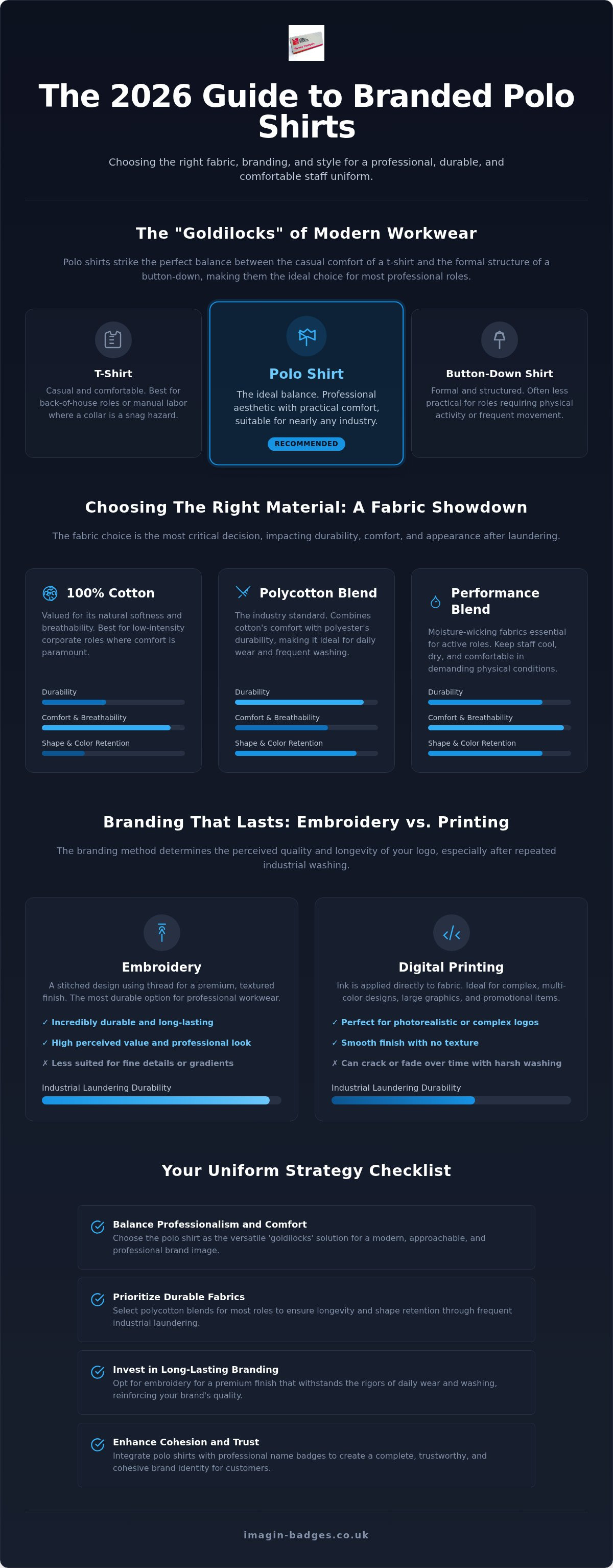
The UK business environment has shifted towards a more relaxed, yet strictly professional, aesthetic. High-quality branded polo shirts for staff have emerged as the 'goldilocks' solution for this era. They provide more structure than a standard t-shirt while offering significantly more practical movement than a traditional button-down shirt. This balance is vital for roles that require both physical activity and client interaction. A polo shirt signals that your team is ready to work, but also ready to represent the company at a high level.
Beyond the practical benefits, a consistent uniform builds instant customer trust. When a client sees a staff member in a clean, well-branded garment, it removes any ambiguity about who they are speaking to. It creates a sense of reliability. For the business owner, this ensures brand compliance across every department. You no longer have to worry about individual interpretations of 'business casual' that might lean too far into the casual side. Instead, you provide a high-quality foundation that looks professional from the start of the shift to the end.
Polo Shirt vs. T-Shirt: Which Suits Your Brand?
The choice between a collar and a crew neck often dictates how customers perceive your team's authority. A collar naturally frames the face and suggests a level of expertise that a t-shirt sometimes lacks. For client-facing roles, such as retail management, hospitality, or technical consulting, the polo shirt remains the superior choice. It bridges the gap between the boardroom and the shop floor.
T-shirts are often better suited for back-of-house roles or specific manual labour tasks where a collar might become a snag hazard or feel restrictive. However, the impact of the collar on perceived professionalism shouldn't be underestimated. By selecting branded polo shirts for staff, you ensure a consistent brand image that doesn't feel stiff or outdated. It's a modern standard that works across almost every UK sector, from logistics to high-end leisure.
The Impact of Uniforms on Staff Morale and Identity
A well-designed uniform does more than just display a logo. It significantly reduces 'decision fatigue' by removing the daily stress of choosing appropriate work attire. When staff wear garments that fit well and use premium fabrics, they feel valued by their employer. We've seen that employee 'buy-in' for a new uniform policy depends heavily on the quality of the apparel provided.
Poorly made, uncomfortable fabrics lead to complaints and a lack of pride in the workplace. Conversely, a garment with a high-quality embroidered finish fosters a sense of belonging and internal culture. It turns every employee into a confident brand ambassador. When your team looks like a cohesive unit, they're more likely to act like one. Providing branded polo shirts for staff that they are actually proud to wear is a simple but effective way to boost morale and reinforce your company’s professional standards.
Comparing Fabrics: 100% Cotton vs. Polycotton vs. Performance Blends
Choosing the right material is the most critical decision in the procurement process. It determines how the garment hangs, how it breathes, and how long it lasts. While 100% cotton is often praised for its natural softness and breathability, it's not always the best fit for high-intensity environments. Pure cotton tends to wrinkle easily and can lose its shape after repeated industrial washes. For corporate roles where comfort is the priority, it's an excellent choice. However, for a busy shop floor or field-based team, pure cotton may require too much maintenance to stay looking sharp.
For most UK businesses, polycotton blends (usually 65% polyester and 35% cotton) are the industry standard for a reason. These fabrics combine the comfort of cotton with the hard-wearing nature of polyester. They resist shrinking, hold their colour better, and dry much faster than pure natural fibres. If your branded polo shirts for staff need to withstand daily wear and frequent laundering, a polycotton blend offers the best return on investment. In 2026, we're also seeing a significant shift towards performance blends. These moisture-wicking fabrics are essential for active roles, keeping staff cool and dry in demanding conditions. Sustainability is also a key factor now, with recycled polyester and organic cotton becoming standard options for environmentally conscious brands.
Understanding GSM: Choosing the Right Fabric Weight
GSM, or grams per square metre, measures the weight and density of the fabric. It directly impacts how the shirt feels on the wearer. Lightweight fabrics (160 to 180 GSM) are perfect for summer events or indoor hospitality roles where heat management is vital. Conversely, heavyweight fabrics (220 GSM or higher) provide the ruggedness required for trades and construction. Choosing the correct weight ensures your team stays comfortable regardless of their environment. If you're unsure which weight suits your specific industry, our team can provide complimentary creative assistance to help you find the perfect balance.
Pique Knit vs. Jersey Knit: Texture and Durability
The knit style changes both the look and the performance of the garment. Pique knit is the classic 'honeycomb' texture. It's breathable, hides sweat well, and resists wrinkles, making it the go-to for professional workwear. Jersey knit is smoother and feels more like a standard t-shirt. While jersey offers a modern, soft finish, pique knit generally holds embroidery better over time because the thicker texture provides a more stable base for the stitching. This stability is crucial for maintaining a crisp logo after dozens of wash cycles.
Embroidery vs. Printing: Which Branding Method Lasts Longer?
Deciding how to apply your logo is just as important as the fabric itself. For branded polo shirts for staff, embroidery remains the premium standard for longevity. It involves stitching your design directly into the weave of the fabric, creating a three-dimensional, textured finish that won't peel or crack. Because the thread is colour-fast, it withstands the high temperatures of industrial laundering much better than most inks. It's the ideal choice for a professional, high-end look that needs to last for years rather than months.
Digital and screen printing offer different advantages. Screen printing is exceptionally cost-effective for large production runs, while digital methods are perfect for complex designs with gradients or photographic detail. Heat transfer is another versatile option, particularly for performance fabrics where traditional embroidery might compromise the garment's moisture-wicking properties. While modern inks have improved significantly, they generally have a shorter lifespan than embroidery, eventually showing signs of fading or 'distressing' after dozens of wash cycles. Evaluating the wash-fastness of your chosen method is essential to ensure your team doesn't end up with sloppy, illegible branding by the end of the year.
The Art of Logo Digitisation for Embroidery
A common mistake is assuming a high-resolution digital file will automatically look good when stitched. In reality, your logo must be 'digitised' or translated into a language that embroidery machines understand. This process determines the stitch path, the density of the thread, and the underlay required for stability. If the stitch density is too high, the logo becomes a heavy, uncomfortable 'badge' that pulls at the fabric and feels stiff against the skin. If it's too low, the shirt material shows through the design, making it look cheap. Imagin Products provides complimentary creative assistance to ensure your logo is perfectly digitised for a crisp, professional result that feels as good as it looks.
When to Choose Printing Over Embroidery
Embroidery is excellent for chest logos, but printing often wins for large-scale branding. If you need a massive logo across the back of a shirt, printing keeps the garment lightweight and flexible. It's also the superior choice for promotional events or short-term campaigns where the upfront cost of digitisation might not be justified. Printing allows for vibrant gradients and subtle colour shifts that thread simply cannot replicate. It's particularly useful for lightweight fabrics to avoid 'heavy' branding that can cause the shirt to sag or drape poorly. Choosing the right method depends on your staff's daily environment. A tradesperson needs the ruggedness of embroidery, while a brand ambassador at a summer festival might benefit more from a vibrant, printed design on a lightweight jersey knit.
Industry-Specific Selection: Tailoring Your Choice to Staff Roles
Choosing the right garment depends entirely on the environment your team operates in. A shirt that excels in a climate-controlled office will likely fail on a busy construction site or in a humid kitchen. For corporate and office environments, the focus is on 'luxury' blends. These often feature high-quality cotton with a touch of elastane for a superior drape. Branding in these sectors tends to be subtle, using tonal embroidery that whispers quality rather than shouting for attention. It's about projecting a sophisticated image that aligns with professional services while providing branded polo shirts for staff that feel like premium retail apparel.
Hospitality Uniforms: Balancing Comfort and Style
In the fast-paced world of restaurants and bars, uniforms face unique challenges. Spills, heat, and constant movement are the daily norm for your team. We recommend pique knits in darker shades like navy or charcoal to mask minor stains during a busy shift. Colour-fastness is non-negotiable here; your shirts must stay vibrant despite daily washing. Stretch fabrics are particularly beneficial for waitstaff and baristas who need a full range of motion. For more sector-specific tips, see our Hospitality Uniforms UK: The 2026 Guide to Branding & Staff Comfort.
Branded Workwear for Tradespeople: Built for the Site
Manual labour requires a completely different technical specification. Here, heavyweight polycotton is the gold standard for durability. It offers the snag-resistance needed when working with tools or in tight spaces. We focus on reinforced seams and 'work-dry' technology to ensure staff stay comfortable during outdoor tasks. UV exposure is another factor often overlooked in UK workwear. Using fade-resistant dyes ensures that your branded polo shirts for staff don't look washed out after a few weeks in the sun. You can also match these with branded uniforms for cleaning companies to ensure a cohesive professional look across all your service teams.
Healthcare and wellness sectors require even stricter standards to ensure safety and longevity. Uniforms in these industries often feature anti-bacterial finishes to maintain hygiene in clinical settings. They must also be capable of withstanding high-temperature washes to eliminate pathogens without losing their structural integrity. Whatever your sector, our role is to act as your creative partner, helping you translate these technical needs into a physical garment that performs. We pride ourselves on ensuring that every stitch serves a purpose for the person wearing it.
Ready to equip your team with high-performance workwear? Contact us today to start your uniform project with expert guidance and complimentary creative assistance.
Creating a Cohesive Uniform System with Imagin Products
Developing a professional image requires more than just picking a garment from a catalogue. To truly stand out, your workwear needs to function as a complete system. Integrating branded polo shirts for staff with other identification tools creates a seamless, trustworthy experience for your clients. Whether you're managing a single boutique or coordinating a national rollout across multiple sites, consistency is the foundation of brand authority. By centralising your production with a UK manufacturer, you eliminate the risk of colour drift between different garment types or branding batches. The deep navy of your polo shirt should perfectly complement your softshell jackets and embroidered hoodies, ensuring your team looks like a unified force regardless of the season.
At Imagin Products Ltd, our approach focuses on end-to-end involvement in your customer journey. We don't just take an order; we act as a creative collaborator to ensure every technical detail aligns with your vision. This proactive attitude reduces the stress of complex uniform rollouts. We understand the logistical challenges of keeping a large workforce equipped, which why we prioritise local production standards and rigorous quality control. From the initial thought to the finished item, we provide the guidance needed to build a uniform programme that survives the rigours of daily use while maintaining its premium aesthetic.
The Perfect Pair: Polos and Custom Name Badges
A name badge is the essential partner to a branded polo for any customer-facing role. It adds a personal touch that builds immediate rapport. However, the wrong choice of fastening can damage your investment. Traditional pins can leave visible holes or snags in pique knit fabrics over time. We often recommend magnetic fastenings for polo shirts as they provide a secure hold without piercing the material, preserving the longevity of the garment. Explore our The Ultimate Guide to Custom Name Badges for UK Businesses in 2026 to complete your uniform system with the right identification solutions.
Your Creative Partner in UK Manufacturing
Choosing a UK-based factory means you benefit from clear communication and rapid turnaround times. You aren't just a number in a global supply chain. You're a partner. Our in-house production facility allows us to oversee every stitch and print, ensuring that the high standards we've maintained since 1990 are met in every box we ship. We take pride in our craftsmanship and the heritage of British manufacturing, providing a safe pair of hands for organisations that cannot afford to compromise on quality. We're here to help you translate your digital concepts into physical objects that your staff are genuinely proud to wear every day.
Contact Imagin Products Ltd for a personalised quote on your staff polo shirts today.
Future-Proof Your Team’s Professional Image
Selecting the right branded polo shirts for staff is a vital investment in your company’s reputation and your team’s daily comfort. We've explored how technical fabric weights and the precision of logo digitisation ensure your uniform survives the demands of the UK workplace. From breathable pique knits for hospitality to the rugged polycotton blends required for site work, the correct specification makes all the difference in longevity and employee pride. A well-chosen uniform doesn't just display a logo; it builds a sense of belonging and professional authority.
At Imagin Products, we act as your creative partner to translate your digital vision into a high-quality physical reality. With over 30 years of experience and our own professional workshop, we provide the quality assurance and rapid communication that only a dedicated UK manufacturer can offer. Every order benefits from our complimentary creative assistance to ensure your branding is sharp, durable, and perfectly aligned with your brand identity. We're here to help you build a uniform system you can depend on for years to come.
Design Your Professional Staff Polo Shirts with Imagin Products
Frequently Asked Questions
What is the best fabric for branded polo shirts for staff?
Polycotton blends, typically 65% polyester and 35% cotton, are the industry standard for branded polo shirts for staff because they offer the best balance of comfort and durability. These fabrics resist shrinking and hold their colour better than 100% cotton through repeated industrial laundry cycles. For roles in climate-controlled offices, 100% cotton provides a softer, premium feel, but polycotton is the superior choice for active or manual environments where longevity is the primary concern.
Is embroidery or printing better for company logos on polo shirts?
Embroidery is generally superior for longevity as the design is stitched directly into the fabric, making it resistant to fading and cracking. It provides a professional, high-end texture that suits corporate environments perfectly. Printing is better reserved for large-scale back logos or designs featuring complex photographic detail that thread cannot replicate. If your staff work in physically demanding roles, embroidery will maintain its professional appearance far longer than any printed alternative.
How many polo shirts should I provide for each member of staff?
We typically recommend providing between three and five shirts for each full-time staff member. This allocation allows for one shirt to be worn, one to be in the wash, and at least one ready for the next shift. Providing an adequate supply prevents excessive wear on individual garments and reduces the pressure on employees to complete laundry daily. For part-time staff, a rotation of two to three shirts is usually sufficient for a professional appearance.
What does GSM mean when choosing a staff polo shirt?
GSM stands for Grams per Square Metre and refers to the weight and density of the fabric. A higher GSM indicates a thicker, heavier material that is typically more durable. For most staff uniforms, a weight between 180 and 220 GSM is the ideal standard for year-round wear in the UK. Lightweight fabrics under 160 GSM are better for high-heat environments, while heavyweight options above 250 GSM are built for rugged trades and outdoor work.
Can I mix and match different polo shirt styles in one order?
Yes, you can mix and match different polo shirt styles within a single order to accommodate different roles or preferences. For example, you might choose a heavyweight pique for your delivery drivers and a luxury cotton blend for your front-of-house team. This flexibility ensures every member of staff has a garment fit for their specific duties while maintaining a cohesive brand identity through consistent logo placement and colour matching across the different garment styles.
How do I ensure my embroidered logo doesn't fade or pucker?
To prevent puckering, it's essential that the logo is digitised with the correct stitch density for the specific fabric weight. Puckering often happens when the stitches are too tight for a lightweight material. We use high-quality, colour-fast threads to ensure your branding won't fade. To maintain the logo's integrity, we recommend washing garments inside out and avoiding excessively high temperatures in the tumble dryer, as extreme heat can eventually distort the embroidery threads.
Do you offer a logo digitisation service for staff uniforms?
We provide complimentary creative assistance for logo digitisation with every workwear order. Our experts translate your digital files into a specific stitch pattern that works perfectly with your chosen fabric. This isn't a simple automated conversion; it's a manual process where we adjust stitch paths and density to ensure a crisp, professional result. This service removes the technical stress from the ordering process and guarantees that your branding looks exactly as you intended on the finished garment.
How can I protect the fabric of our polo shirts when using name badges?
Using name badges with magnetic fastenings is the most effective way to protect your branded polo shirts for staff from damage. Unlike traditional pins, magnets don't pierce or snag the fabric, which prevents small holes from developing over time. This is especially important for pique knit materials where pinholes can grow into larger tears. Selecting a magnetic badge ensures your uniforms remain in top condition for much longer while still allowing for clear, professional identification.