
Branded Workwear UK: 2026 Cleaning Company Guide

Your uniform is a security tool that builds the trust necessary for service growth. In an industry where over 80% of the 78,915 UK cleaning businesses are micro-firms, standing out requires more than just a good reputation. Many owners face the frustration of staff looking unprofessional in mismatched gear or logos that peel after frequent high-temperature washes. Investing in high-quality branded uniforms for cleaning companies ensures your team looks like the experts they are from the moment they arrive at a client's door.
It's natural to worry when clients feel uneasy about "strangers" entering their homes or offices. You want your brand to provide immediate reassurance through a cohesive, recognizable appearance. This guide explains how to build that professional identity through a "Total Identification" approach, combining durable apparel with clear staff badges. We'll walk you through 2026 UKCA compliance, HMRC rules for tax-deductible branding, and the best fabric choices for longevity. You'll learn how to move from a basic kit to a polished, professional look that secures long-term client loyalty.
Key Takeaways
- Discover how branded uniforms for cleaning companies act as a security tool, building immediate client trust and justifying premium service rates.
- Learn why high-GSM fabrics and embroidery are the superior choices for garments that must withstand frequent industrial laundering and chemical exposure.
- Master the "Total Identification" strategy by combining embroidered polo shirts with professional name badges and photo ID cards for a cohesive team appearance.
- Understand current 2026 UK regulations, including HMRC tax relief rules for conspicuous branding and mandatory UKCA marking for safety gear.
- Streamline your replenishment process with UK-based manufacturing that offers rapid turnaround times and flexible order volumes for growing teams.
The Role of Professional Branded Workwear in the UK Cleaning Industry
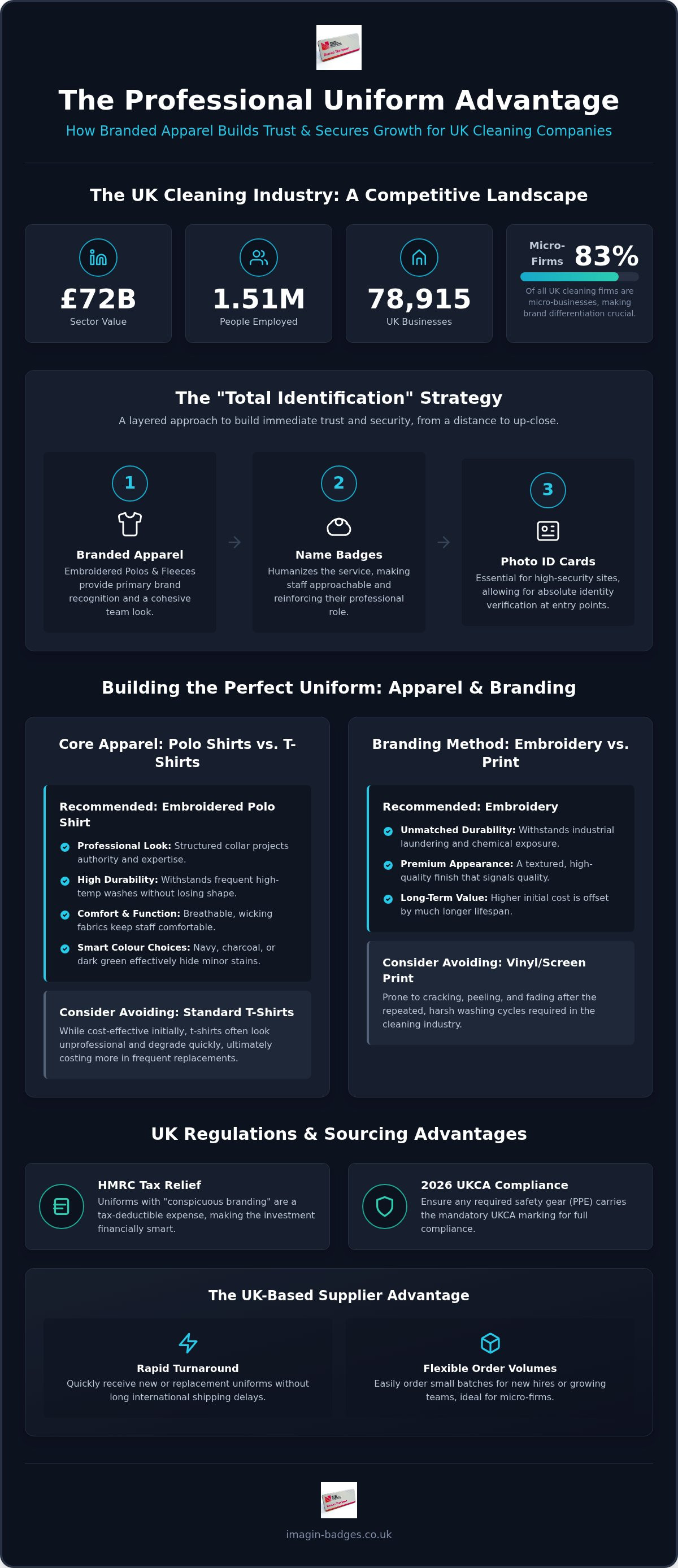
In a UK industry employing approximately 1.51 million people, standing out requires more than just excellent service. With the cleaning, hygiene, and waste sector valued at nearly £72 billion, the competition for local contracts is intense. Professional branded uniforms for cleaning companies serve as a visual handshake. They signal that your business prioritizes quality, safety, and accountability. Looking at the history and types of workwear, we see a clear shift from basic protective layers to sophisticated branding tools that define a company's market position. A polished appearance allows you to justify higher-tier service pricing. Clients naturally associate a cohesive team look with a more thorough, premium service, making the investment in apparel a direct driver of revenue.
Modern standards have evolved significantly to prioritize staff comfort alongside durability. While high-temperature washes and chemical resistance remain essential, there's a growing focus on breathable, flexible fabrics. A team that feels comfortable in their gear is more productive and takes greater pride in their work. This psychological shift from simply having a job to representing a respected brand is a powerful tool for staff retention in an industry where 83% of firms are micro-businesses fighting for talent.
Building Trust in Residential and Commercial Settings
Entering a private home or a high-security office requires a high degree of trust. A recognizable uniform immediately reduces client anxiety by providing a clear visual cue of who is at the door. In commercial environments, an embroidered polo or softshell jacket establishes authority, ensuring your staff isn't mistaken for unauthorized visitors. This professional presence doesn't just satisfy current clients; it acts as a passive marketing tool. When neighbors or nearby office managers see a well-presented team, it triggers word-of-mouth referrals based on perceived reliability and safety.
The "Total Identification" Concept
Apparel alone isn't enough to meet modern security expectations. We advocate for a "Total Identification" approach, which combines branded clothing with physical verification tools. This layered strategy ensures your team is identifiable from a distance and verifiable up close. It's about moving from a digital concept of a brand to a physical reality that clients can trust.
- Embroidered Polos and Fleeces: These provide the primary brand recognition and a cohesive team aesthetic.
- Standard or Premium Name Badges: These humanize the service, making staff approachable while reinforcing their role within the company.
- Photo ID Cards: Essential for high-security commercial sites where identity must be verified at every entry point to comply with modern safety protocols.
This comprehensive system protects the client and empowers your staff. It positions your business as a seasoned professional who knows exactly how to handle the complexities of both residential and institutional environments.
Essential Items for a Professional Cleaning Uniform
Building a functional wardrobe for your team requires a balance between aesthetics and utility. Selecting the right components for your branded uniforms for cleaning companies is about more than just picking a colour. It's about creating a kit that withstands the rigours of the job while maintaining a sharp, trustworthy image. From the initial site visit to the final walkthrough, every item your staff wears should reinforce your company's commitment to quality.
The Core Apparel: Polos vs. T-Shirts
Embroidered polo shirts are the gold standard for the cleaning sector. Polos provide a structured collar that instantly elevates the wearer's silhouette, offering a more authoritative look than standard t-shirts. While t-shirts might seem cost-effective initially, they often lose their shape after repeated high-temperature washes. We recommend breathable, high-cotton blends or technical "wicking" fabrics for high-intensity physical work. These materials keep staff cool and comfortable during long shifts. When choosing colours, consider navy, charcoal, or forest green. These shades are excellent at hiding damp spots or minor stains while providing a sophisticated backdrop for your embroidered logo.
Outerwear and Layering Strategies
Maintaining brand consistency during the winter months or during travel between sites is a common challenge. Branded fleeces offer excellent thermal properties for staff moving through cold office blocks or residential hallways. For exterior specialists, such as window or gutter cleaners, softshell jackets are the superior choice. These garments are water-resistant and windproof, providing protection without the bulk of a traditional coat. We ensure logo visibility by placing embroidery on both the chest and the rear of outerwear, so your brand is recognizable even when staff are busy on-site. Adhering to UK health and safety workwear regulations is particularly vital for commercial contracts where high-visibility safety gear must be integrated into the uniform to meet UKCA standards.
Identification Accessories
The final touch for professional accountability is clear identification. Apparel alone can be mimicked, but official badges provide a definitive layer of security. Standard name badges are available with pin or magnetic fastenings. Magnetic options are highly popular in the cleaning industry because they don't pierce or snag delicate uniform fabrics. For high-security environments, photo ID cards are essential. Modern ID cards can integrate QR codes, allowing clients to instantly verify a staff member's credentials via a smartphone. For a deeper dive into choosing fastenings and materials, see The Ultimate Guide to Custom Name Badges for UK Businesses in 2026. Our team can help you design a cohesive uniform bundle that combines these accessories with your apparel for a complete professional look.
Durability and Design: Selecting Fabrics for the Cleaning Sector
Cleaning work is notoriously tough on clothing. Between the constant physical movement and the inevitable exposure to aggressive cleaning agents, a standard retail garment simply won't last more than a few weeks on the job. Choosing high-specification branded uniforms for cleaning companies involves understanding the technical properties of the textiles you select. It's about ensuring your investment survives the rigours of the field while maintaining the sharp aesthetic your brand deserves.
The Science of Fabric Weights
GSM stands for Grams per Square Metre and serves as a technical measurement of a fabric's density and weight, directly influencing the garment's durability and drape. For cleaning polo shirts, the 180 to 220 GSM range is the ideal sweet spot. Fabrics in this weight category are thick enough to resist snagging and maintain their shape, yet they remain breathable during high-intensity summer shifts. If you drop below 160 GSM, the material often becomes translucent and prone to tearing. Conversely, anything above 250 GSM might feel restrictive and heavy when staff are performing repetitive tasks. We help you find that perfect balance, ensuring your team stays cool without sacrificing the professional silhouette that builds client trust.
Branding Methods That Last
The method used to apply your logo is just as critical as the fabric itself. While many suppliers offer various options, we focus on the techniques that survive industrial laundering and chemical exposure. This ensures your branded uniforms for cleaning companies remain a professional asset rather than a recurring expense.
- Custom Logo Embroidery: This is the premium choice for cleaning businesses. Because the logo is stitched directly into the fabric using high-tensile threads, it won't peel or crack when exposed to bleach or high-temperature washes. It offers the best long-term ROI.
- Heat Transfer Printing: This method is best reserved for hi-vis safety gear and waterproof softshell jackets. It allows for crisp detail on technical fabrics that might be difficult to embroider without compromising their water-resistant properties.
- Strategic Positioning: We recommend placing logos on the left chest and the upper back. This ensures maximum visibility whether your staff are facing a client or busy working on-site.
Longevity is also found in the small details. We look for garments with reactive dyes to ensure colour fastness, meaning your navy or charcoal gear won't fade to a dull grey after 50 washes. We also prioritize garments with reinforced stitching in high-stress areas like the shoulder seams and side vents. These technical finishing processes prevent the common "uniform fatigue" that leads to unravelling and mismatched team appearances. By treating your workwear as a physical object that requires engineering, we help you create a kit that looks as good in six months as it does on day one.
Setting Up Your Company Uniform Policy: A Step-by-Step Guide
Implementing a successful wardrobe strategy requires more than just a bulk order. It involves creating a structured policy that ensures consistency, safety, and financial efficiency. For the 83% of UK cleaning firms operating as micro-businesses, a clear policy prevents the "mismatched gear" pain point that often undermines professional credibility. Establishing these rules early transforms your branded uniforms for cleaning companies from a simple expense into a managed business asset. It provides your team with clear expectations while ensuring your brand remains a mark of quality in the field.
The Rollout Process
A smooth transition to a new uniform starts with a practical audit. Don't guess sizes; conduct a physical fitting to ensure staff feel comfortable and professional. We recommend a three-step approach to move from digital concept to physical reality.
- Step 1: Staff Audit and Fabric Trials: Test different garment weights in active shifts. While 180-220 GSM is ideal for most, your specific environment might require lighter technical fabrics.
- Step 2: Cohesive Branding Package: Design your apparel and identification tools simultaneously. Ensure your embroidered logo on a softshell jacket doesn't clash with the fastening or placement of your premium name badges.
- Step 3: Care and Replacement Schedule: Define how often items are replaced. A typical weekly uniform for one employee includes five polos, two sweatshirts, and one jacket. Establishing a "fair wear and tear" rule helps manage replenishment costs.
Legal and Financial Considerations
Understanding the regulatory landscape is vital for UK business owners. To ensure your workwear is a tax-deductible expense and not a taxable "benefit in kind" for employees, the company logo must be permanent and conspicuous. This makes the clothing unsuitable for everyday wear in the eyes of HMRC. Small, removable badges alone are often insufficient for tax relief; the branding must be a fixed part of the garment, such as embroidery. When standardizing the look, you can legally require specific trousers or footwear to complement your branded tops, provided these requirements are clearly documented in your staff handbook.
Safety and data privacy are equally important. Ensure all garments avoid loose elements that could become trip hazards or catch on equipment during physical tasks. If you utilize photo ID cards as part of your "Total Identification" approach, you must comply with GDPR standards regarding the storage and display of staff personal data. This proactive attitude builds immediate trust with both your employees and your clients. If you are ready to begin your rollout, you can start your uniform design journey with our creative team today for expert guidance on every technical specification.
Custom Branding Solutions for Cleaning Businesses
Choosing the right partner to realize your vision is the final step in building a professional identity. At Imagin Products Ltd, we don't just supply gear; we act as your creative collaborator throughout the entire journey from digital concept to physical object. We understand that for the 78,915 businesses in the UK cleaning sector, every pound spent on workwear must deliver a return in durability and brand recognition. Our "Total Identification" approach ensures that your apparel and identification tools work in harmony to project an image of dependable expertise.
We take immense pride in our craftsmanship and the longevity of the products we manufacture. Whether you are an independent operator or managing a national franchise, we treat every project as a distinct creative endeavour. Our voice is one of a seasoned professional who has handled thousands of designs, positioning us as a safe pair of hands for your organizational needs. We avoid marketing hype, focusing instead on genuine helpfulness and technical precision to reduce the stress of the ordering process.
Why Choose In-House UK Production?
Operating from our own UK facility allows us to maintain a level of quality control that outsourced suppliers simply cannot match. This regional heritage is a shorthand for reliability and accessible, human-to-human communication. When you work with us, you are speaking directly with the craftsmen making your gear.
- Rapid Turnaround: In-house manufacturing means we can respond quickly when you hire new staff. You don't have to wait weeks for overseas shipping to get a new team member into a professional kit.
- Consistent Quality Control: We oversee every stitch of our embroidered polo shirts and every detail of our photo ID cards. This ensures your brand colours and logo placements remain identical across every item.
- Direct Communication: You get clear guidance from experts who know exactly how to translate your digital logo into a high-tensile embroidery pattern or a crisp badge design.
Getting Started with Your New Uniform
We offer complimentary creative assistance to help you perfect your logo placement and badge design. This service serves as a cornerstone of our brand identity, ensuring that even small businesses have access to professional design standards. We understand the challenges of the cleaning industry, from rising National Insurance contributions to the need for UKCA-compliant safety gear. That's why we offer no minimum order options, providing the flexibility growing teams need to scale without heavy upfront costs.
Our team is ready to guide you through the technical specifications of fabric weights and fastening options. We move steadily from inspiration to specification, ensuring you feel supported at every stage. If you're ready to move beyond mismatched gear and fading logos, Explore our range of branded workwear for cleaning companies and see how we can transform your team's appearance into a powerful tool for client trust.
Future-Proof Your Cleaning Business Identity
Professionalism in the cleaning sector is built on more than just the quality of your work; it's defined by the trust you establish at the doorstep. By selecting high-GSM fabrics and permanent embroidery, you ensure your branded uniforms for cleaning companies remain a durable asset rather than a recurring cost. Integrating apparel with clear name badges and photo ID cards provides the "Total Identification" that modern residential and commercial clients demand for their security.
With over 30 years of branding expertise, Imagin Products Ltd is your dedicated creative partner. Our UK-based manufacturing facility ensures rapid turnaround times, while our complimentary creative design assistance helps you translate your digital vision into a polished physical reality. We're here to help you navigate 2026 UKCA standards and HMRC rules with confidence. It's time to move beyond mismatched gear and invest in a look that reflects your team's hard work.
Request a custom quote for your cleaning company uniforms and take the first step toward a more cohesive, trusted team appearance today.
Frequently Asked Questions
Are branded uniforms tax-deductible for cleaning companies in the UK?
Yes, branded workwear is a tax-deductible business expense provided the logo is permanent and conspicuous. HMRC rules in 2026 specify that the branding must make the clothing unsuitable for everyday wear. Using embroidered logos ensures your apparel meets these requirements, whereas removable items like pins might not qualify for the same relief. It's a proactive way to reduce your tax liability while building a professional brand.
How many uniforms should I provide for each cleaning staff member?
We recommend a weekly allocation of five polo shirts, two sweatshirts or fleeces, and one technical jacket per person. This allows staff to wear a fresh, clean set every day, which is essential given the physical nature of the work. Providing enough sets reduces "uniform fatigue" and prevents garments from wearing out prematurely due to daily washing at the high temperatures required for hygiene.
What is the best branding method for cleaning workwear: embroidery or print?
Embroidery is the gold standard for the cleaning sector because it survives exposure to bleach and aggressive chemicals. High-tensile threads are stitched directly into the fabric, so they won't peel or crack over time. Heat-transfer printing is better suited for hi-vis safety gear or waterproof softshell jackets where embroidery needles might compromise the garment's protective UKCA-rated water resistance.
Do my cleaners need to wear name badges as well as branded shirts?
Adding name badges to branded uniforms for cleaning companies is highly recommended for security and trust. This "Total Identification" approach humanizes your team and provides immediate reassurance to clients, especially in residential settings. While a shirt shows who they work for, a badge confirms who they are, creating a much stronger professional identity that justifies premium service rates.
What fabric weight (GSM) is best for durable cleaning polo shirts?
A weight between 180 and 220 GSM is the ideal specification for cleaning apparel. This density provides enough durability to resist snags and maintain a sharp silhouette after 50 or more washes. If you choose a fabric lighter than 160 GSM, it often becomes translucent and loses its shape, while anything over 250 GSM can feel too restrictive for staff performing high-intensity physical tasks.
Can I order branded workwear with no minimum order quantity?
Yes, we offer flexible ordering with no minimum requirements to support the 83% of UK cleaning firms that operate as micro-businesses. This allows you to kit out a single new hire with the same professional quality as a national franchise. You can scale your team at your own pace without the stress of holding expensive excess stock in your office or storage facility.
How do I ensure my staff ID cards are GDPR compliant?
Compliance starts with a clear data policy that explains how you store and use staff photos and personal details. Only display essential information on the card, such as the person's name, role, and a clear photo. We can help you design cards that include QR codes for instant verification, ensuring your identification process is secure, modern, and respects the privacy of your 1.51 million industry colleagues.
Will magnetic name badges damage the fabric of cleaning tunics?
Magnetic fastenings are actually the best choice for protecting your uniform investment. Unlike traditional pins, magnets don't pierce the fabric or leave permanent holes that can lead to fraying. They provide a strong, reliable hold on everything from light tunics to heavy fleeces without snagging the threads. This keeps your team's gear looking newer for longer, maintaining that vital professional first impression.