
Winter Workwear Layering: The UK Guide to Staying Warm

Imagine your team arriving at a site visit on a biting January morning, only to find their professional identity buried under a mismatched collection of personal hoodies and heavy, non-uniform coats. It's a common frustration for UK managers when the temperature drops. You want your staff to stay warm, but you also need them to look like a cohesive, professional unit. Learning how to layer workwear for winter shouldn't mean choosing between staff comfort and your brand's visibility. We agree that a bulky coat shouldn't be the reason your company logo disappears for four months of the year.
This guide will show you exactly how to master the technical three-layer system to keep your team warm, dry, and perfectly branded. We'll explore how to combine breathable embroidered polo shirts with insulating fleeces and durable, weather-resistant softshell jackets. You'll learn how to create a versatile uniform that handles the unpredictable British weather whilst ensuring your logo remains visible and at the centre of your professional image. From our Kirkcaldy factory to your front line, we're here to help you build a durable winter wardrobe that meets safety standards and maintains a premium aesthetic throughout the coldest months.
Key Takeaways
- Master the science of the three-layer system to trap warmth effectively and regulate body temperature during unpredictable UK weather.
- Discover how to layer workwear for winter by combining breathable polo shirts with insulating fleeces and weather-resistant softshell jackets.
- Maintain a consistent brand identity by ensuring every layer features a high-quality embroidered logo for visibility when staff remove outer coats.
- Tailor your team’s kit to their energy levels to prevent overheating during physical tasks whilst ensuring compliance with hi-vis safety standards.
- Keep your team recognisable and professional by integrating name badges and photo ID cards that remain accessible even in the coldest conditions.
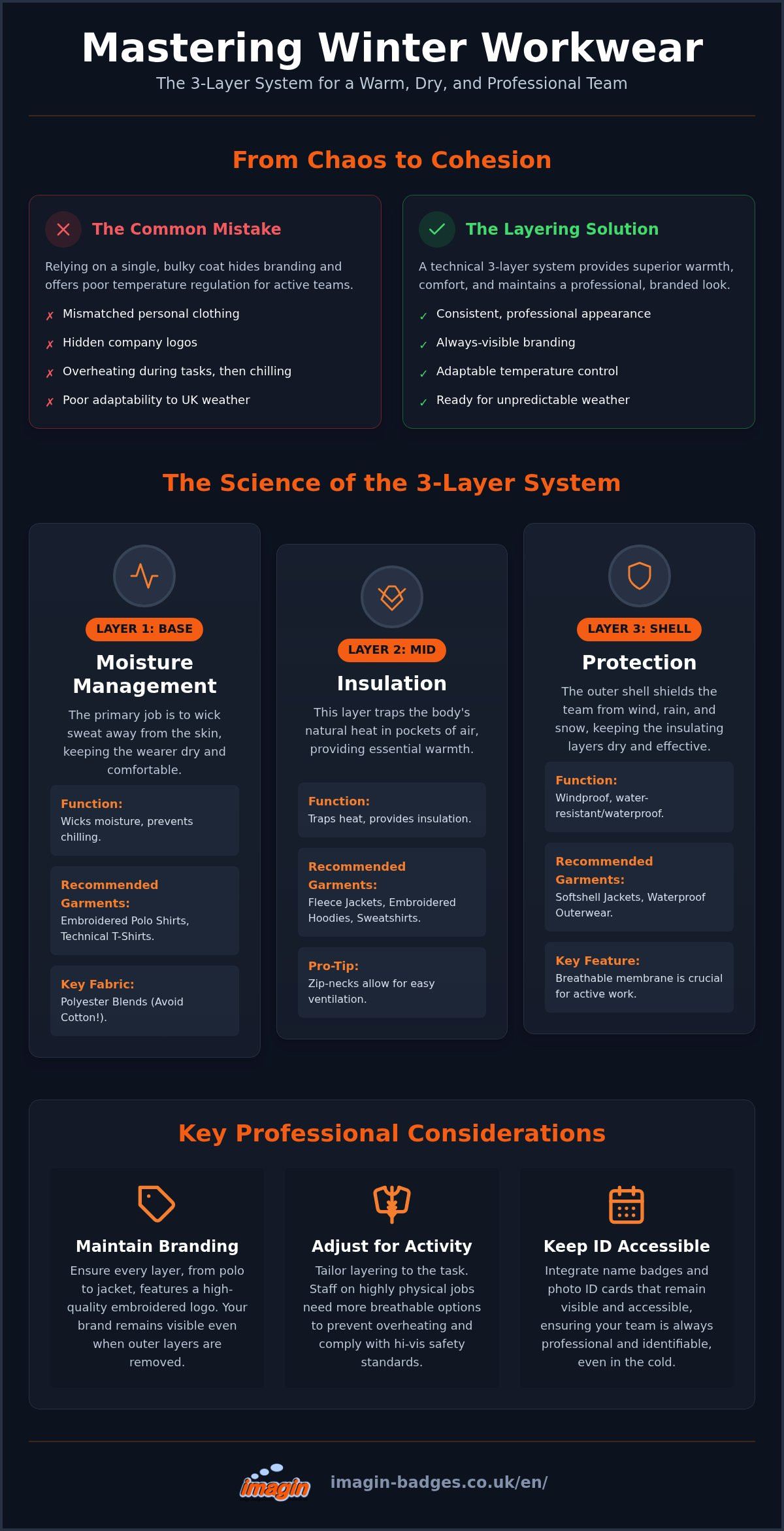
The Science of the Three-Layer System for Workwear
Many people believe a thick, heavy parka is the best defence against a British winter. However, relying on a single bulky garment is often a mistake for active teams. When you understand how to layer workwear for winter, you realise that warmth isn't just about the thickness of the fabric. It's about air. Multiple thin layers trap pockets of still air between them, which acts as a highly effective thermal barrier. This system offers far better temperature regulation than one heavy coat. If a staff member moves from a cold van to a physical task on-site, they can simply remove one layer to stay comfortable instead of sweating in a heavy jacket and then catching a chill once they stop moving.
The unpredictability of UK weather demands this flexibility. One hour it's drizzling in Kirkcaldy; the next, the sun is out but the wind is biting. A layered approach allows your team to adapt instantly. Crucially, you must avoid cotton as a primary winter fabric. Cotton is highly absorbent; it soaks up sweat and moisture from the air, holding it against the skin. Once wet, cotton loses its insulating properties and takes a long time to dry, which can lead to a rapid drop in body temperature. Instead, look for synthetic blends or technical fabrics that manage moisture effectively whilst maintaining their shape.
The Base Layer: Managing Moisture
The base layer is the foundation of your team's comfort. Its primary job isn't warmth, but moisture management. As staff work, they naturally perspire. A high-quality base layer, such as a technical embroidered t-shirt or polo shirt made from polyester blends, wicks this sweat away from the skin. This keeps the wearer dry and prevents the "clammy" feeling that leads to shivering. For the best results, this layer should be snug against the body without being restrictive, allowing it to move with the wearer whilst they perform their daily tasks. This ensures that even the most active staff stay dry and comfortable from the start of their shift.
The Mid Layer: Trapping Vital Heat
Once moisture is moved away from the skin, the mid layer takes over to provide insulation. This is where you trap the heat your body naturally produces. Versatile options for this role include:
- Fleece Jackets: Highly breathable and excellent at trapping air within their lofted fibres.
- Embroidered Hoodies: A popular, comfortable choice that provides warmth and a casual yet professional look.
- Sweatshirts: Durable and easy to layer under heavier outerwear.
We often recommend zip-neck styles for mid layers. They allow staff to manually ventilate if they start to overheat, providing a quick way to dump excess warmth without removing the entire garment and losing their professional, branded appearance. This keeps the corporate identity at the centre of the uniform, regardless of the temperature.
Choosing the Right Fabrics for the UK Winter Climate
The British winter is famously damp. While temperature is a factor, moisture is often the bigger challenge for outdoor teams. Choosing the right materials is the next step in mastering how to layer workwear for winter. You'll need to distinguish between water-resistant and fully waterproof garments. Water-resistant fabrics, often treated with a Durable Water Repellent (DWR) coating, allow rain to bead off the surface. They're excellent for short exposures. However, for staff working outside for hours, a fully waterproof shell with a breathable membrane is essential to keep the internal layers dry.
When selecting mid layers like fleeces or embroidered hoodies, pay attention to the GSM, or Grams per Square Metre. This number tells you the weight and density of the fabric. A higher GSM, typically around 300 or more, indicates a thicker, warmer garment. Breathability ratings are equally vital. These are measured by how much moisture vapour can pass through the fabric over 24 hours. If your staff are physically active, high breathability prevents sweat from being trapped inside their clothes, which is the primary cause of post-activity chills.
Fleece vs Softshell: Which is Better?
Fleece is a fantastic insulator for dry, cold days. It's lightweight and creates those essential air pockets we discussed earlier. Most modern fleeces use synthetic polyester fibres because they're durable, quick-drying, and hold their shape after repeated industrial washes. Softshell technology, however, has become the preferred middle ground for many UK businesses. A softshell jacket provides superior wind protection and a higher level of water resistance than a standard fleece. It offers a sleeker, more professional silhouette that works well for staff who move between site visits and office environments. Explore our range of durable softshell jackets to find a versatile option for your team.
Outer Shells and Waterproofing
For the outer layer, the technical details make the difference between a dry employee and a miserable one. Look for garments with taped seams, where the stitched areas are heat-sealed with waterproof tape to prevent leaks. Storm flaps over zips are another simple but effective feature for blocking wind and driving rain. You might choose a lightweight rain shell for staff who are constantly moving, or a heavy-duty bomber jacket for those in more static roles. Explore our range of waterproof outerwear to ensure your team remains protected regardless of the forecast. Understanding these technical specs is vital when deciding how to layer workwear for winter effectively.
Maintaining Professionalism: Branding and ID in Winter
A common pitfall when businesses plan how to layer workwear for winter is focusing solely on warmth and forgetting about visibility. When your team puts on a heavy, unbranded coat over their uniform, your company's professional image effectively disappears. This "hidden branding" can make staff look like members of the public, which is a significant issue for security and client trust. To solve this, every element of the uniform should be part of your brand identity. Whether it's a base layer polo, a mid-layer fleece, or the final outer shell, each piece should carry your company logo.
Maintaining a unified team look is easier when you treat the three-layer system as a single branded kit. Some staff members might run hot and only need a hoodie, whilst others might require a full waterproof parka. By ensuring the embroidery is consistent across all garments, your team remains recognisable regardless of how many layers they choose to wear. We also recommend considering logo placement carefully. If your staff frequently wear backpacks or tool belts, a standard left-chest logo might be obscured. In these cases, adding branding to the sleeves or the upper back ensures your company stays at the centre of the client's attention from all angles.
Embroidered Logos on Outerwear
For winter garments, embroidery is almost always the superior choice over heat-pressed printing. Winter fabrics like heavy fleeces and softshells have textured surfaces that don't always bond well with vinyl. Embroidery is stitched directly into the material, providing a durable and premium finish that lasts for multiple seasons. When you customise your team hoodies and sweatshirts, choose high-contrast thread colours. Bright whites or yellows stand out sharply against the dark blues and greys typical of winter outerwear, ensuring your logo is legible even on gloomy afternoons.
Staff Identification and Security
Identification is just as vital as branding, especially for staff working in public-facing roles or on secure sites. Standard lanyards can sometimes get lost amongst bulky layers. Consider using heavy-duty badge reels that can be clipped to the outer storm flap of a jacket instead. For those wearing technical waterproofs, magnetic fasteners are a brilliant solution. They provide a secure hold for professional name badges for every season without piercing the fabric's waterproof membrane. This protects the integrity of the garment whilst keeping staff names and ID cards clearly visible at all times. Knowing how to layer workwear for winter properly includes these small details that reinforce the professional standards of your organisation.
Activity-Based Layering Strategies for UK Staff
The logic of how to layer workwear for winter changes depending on whether your team is stationary or on the move. It's about movement. When staff move from a high-intensity task to a period of standing still, their body temperature can plummet if they aren't prepared with the right garments. We suggest an "active insulation" approach. It's often better to start a task feeling slightly cool, knowing you'll warm up, rather than starting warm and ending up drenched in sweat. This prevents the moisture build-up that leads to a deep chill during downtime.
If your team's work is "stop-start", such as site inspections or loading deliveries, they face a unique challenge. During physical exertion, the body generates significant heat. When they stop, that moisture cools rapidly. The solution is to have a mid-layer, like an embroidered hoodie, ready to put back on the moment the activity ends. Don't forget the extremities either. Incorporating branded headwear and ensuring staff have appropriate thermal protection for their feet can make a massive difference to their overall comfort and morale during a cold snap.
Safety is another critical factor to organise. When layering for site work, Hi-Vis gear must remain the outermost layer to comply with safety standards. You shouldn't simply throw a non-compliant heavy coat over a safety vest. This looks unprofessional and can hide reflective strips. Instead, use a Hi-Vis softshell or bomber jacket as the final layer to maintain both warmth and compliance.
For Tradespeople and Outdoor Workers
Outdoor workers face the harshest conditions and need the most durable kit. We recommend combining a moisture-wicking base layer with a heavy-duty softshell jacket for maximum wind resistance. On darker winter days, visibility is just as important as warmth. A Hi-Vis bomber jacket provides excellent insulation whilst ensuring staff remain visible to plant machinery and vehicles. These jackets are designed with enough room to fit over hoodies or fleeces without restricting movement. High-visibility safety gear for UK sites ensures your team stays safe and warm simultaneously.
For Retail, Hospitality, and Office Roles
Staff in retail or hospitality often deal with micro-climates, moving from a draughty shop entrance to a heated stockroom. For these roles, heavy outerwear is often too much. A lightweight fleece jacket or a smart softshell provides enough warmth to take the edge off a draught without causing overheating indoors. This approach also helps manage the "commuter chill". Staff can wear their branded outerwear to and from work, maintaining a professional appearance even off-site. View our range of professional outerwear to find the right fit for your customer-facing team and ensure they know exactly how to layer workwear for winter.
Building Your Winter Workwear Kit with Imagin Products
Organising a seasonal uniform rollout is a significant undertaking that requires careful coordination. At Imagin Products Ltd, we act as a creative collaborator to reduce the stress of this transition. We guide you through the process of selecting a cohesive kit, ensuring that the garments you choose work together as a functional system. Our team possesses deep expertise in how to layer workwear for winter, and We apply this knowledge to help you choose the right mix of softshell jackets and insulating mid-layers. By managing both your apparel and your professional identification products in one place, we guarantee that your corporate colours and logo quality remain consistent across every item.
We also provide a tiered pricing structure where bulk orders receive significant volume discounts, making it a cost-effective solution for growing teams. Whether you are a small business or a large institution, our facility is equipped to handle your requirements with the same attention to detail. Choosing a UK-based manufacturer means you benefit from direct communication and a partner who takes genuine pride in the final aesthetic result of your team's uniform.
End-to-End Customisation Service
Our involvement begins at the design stage with complimentary creative assistance. We don't just apply a standard logo; we digitise your artwork specifically for the textured fabrics in your winter kit. Technical materials like high-GSM fleeces and weather-resistant softshells require specialised embroidery techniques to ensure the stitching remains sharp without compromising the fabric's performance. Because we manufacture at our Kirkcaldy factory, we oversee every stage of the technical finishing and hardware application. This hands-on approach ensures that your brand looks premium and remains durable through the toughest British weather conditions.
Ready to Prepare Your Team for Winter?
Transitioning to a winter uniform should be a seamless experience. Our UK-based production facility allows for rapid turnaround times, ensuring your team is equipped before the first frost arrives. We provide clear, reliable lead times and proactive updates throughout the entire ordering process, from the initial thought to the finished item. Contact us to design your professional winter uniform and let our seasoned experts translate your digital concepts into high-quality physical garments that your staff will be proud to wear.
Equip Your Team for a Productive British Winter
Mastering how to layer workwear for winter ensures your team stays comfortable, safe, and professional throughout the coldest months. Adopting a technical three-layer system provides staff with the flexibility to manage their own temperature whilst keeping your company identity at the forefront. Whether they're on a high-intensity site or in a customer-facing role, a cohesive kit of embroidered hoodies, fleeces, and softshells makes a genuine difference to team morale and brand perception.
Since 1990, Imagin Products has provided expert UK manufacturing for organisations across the country. From our Scottish factory, we offer rapid turnaround and complimentary creative assistance to ensure your logo looks premium on every garment. We're here to translate your vision into a durable, high-quality uniform that stands up to the elements. View our full range of professional branded workwear today and prepare your team for the season ahead. We look forward to being your creative partner for a warmer, more professional winter.
Frequently Asked Questions
What is the best base layer material for winter workwear?
Polyester blends are generally the best choice for a professional base layer because they actively wick sweat away from the skin. Whilst natural fibres like merino wool are excellent for insulation, synthetic fabrics are often more durable for daily industrial washing. You should avoid 100% cotton garments for the base layer. Cotton absorbs moisture and stays damp, which can lead to staff feeling cold and uncomfortable once they stop moving during their shift.
How do I keep my company logo visible when staff are wearing heavy coats?
To maintain brand visibility, you should apply your company logo to every garment in the uniform. This ensures that when a staff member removes a heavy outer coat indoors, their embroidered polo shirt or hoodie still carries the corporate identity. Strategic placement on the sleeves or the nape of the neck can also help keep branding visible if employees are wearing tool belts or safety harnesses that might obscure a traditional chest logo.
Is fleece or softshell better for outdoor work in the UK?
Softshell jackets are usually the superior choice for the unpredictable UK climate because they offer wind resistance and water-repellent properties. A fleece jacket is an excellent insulator but lacks protection against rain and biting winds. If your team works primarily outdoors, a softshell provides a professional silhouette that handles light showers effectively. However, a fleece remains a popular mid-layer choice for staff who require extra warmth beneath a fully waterproof outer shell.
What does GSM mean when choosing hoodies or sweatshirts?
GSM stands for Grams per Square Metre and refers to the weight and density of the fabric used in your workwear. When you are deciding how to layer workwear for winter, look for a higher GSM, typically 300 or above, for hoodies and sweatshirts to ensure better heat retention. A lower GSM indicates a lighter fabric that is better suited for summer shirts or breathable base layers that focus on moisture management rather than insulation.
Can I use magnetic name badges on thick winter jackets?
Yes, magnetic fasteners are an ideal solution for thick winter outerwear. Unlike traditional pins, magnets provide a secure hold without piercing the fabric. This is particularly important for technical garments like softshells or waterproof parkas, where a pin would damage the internal waterproof membrane and allow leaks. Our premium name badges use high-strength magnets that remain firmly in place even through heavy fleece or layered winter fabrics, maintaining a professional look.
How many layers should my staff wear for outdoor work?
The most effective approach is the technical three-layer system, consisting of a moisture-wicking base, an insulating mid-layer, and a weather-resistant outer shell. This setup allows staff to add or remove garments as their activity levels change. For example, a team member might remove their fleece jacket during heavy physical work to prevent overheating, then put it back on during a break to trap heat and avoid catching a chill in the damp air.
How do I care for and wash embroidered winter workwear?
To keep your embroidered workwear looking its best, we recommend washing garments at a maximum temperature of 40 degrees Celsius. Always turn items inside out before washing to protect the embroidery threads from abrasion against the machine drum. Avoid using bleach or strong biological detergents that can fade the thread colours. For the best results, air dry your winter gear rather than using a tumble dryer, as high heat can damage technical fabric coatings and shrink synthetic fibres.
Are there specific safety standards for winter Hi-Vis clothing?
Winter Hi-Vis clothing must comply with the EN ISO 20471 standard, which categorises garments into three classes based on the area of reflective tape and fluorescent material. When planning how to layer workwear for winter on a construction site, ensure the outermost layer meets the specific class required for that environment. It's also vital to check that any heavy parkas or bomber jackets don't obscure the reflective strips on the layers beneath them during use.