
Tax Implications of Providing Staff Uniforms in the UK: A 2026 Employer Guide

Tax Implications of Providing Staff Uniforms in the UK: A Practical 2026/27 Guide
Providing staff uniforms can help customers recognise your team and give your business a consistent, professional appearance. But the tax treatment depends on what you provide, how you pay for it and whether the clothing qualifies as a uniform or necessary protective clothing. A dress code does not automatically create a taxable benefit. Simply asking employees to wear black trousers and a white shirt is different from buying those clothes for them or reimbursing their purchases. However, requiring employees to pay for work clothing can affect National Minimum Wage calculations, even when that clothing does not qualify as a uniform for tax purposes. At Imagin Products Ltd in Kirkcaldy, we help businesses choose branded workwear, name badges and identification products. This guide explains the main clothing tax rules, the role of permanent branding, employee laundry relief and the practical points to consider before ordering. This guide reflects guidance checked on 21 September 2026. It provides general information; your accountant or payroll adviser can confirm how the rules apply to your arrangements.
Key Takeaways
- Recognisable uniforms and necessary protective clothing generally receive favourable tax treatment, subject to the applicable conditions.
- Permanent, conspicuous branding may help ordinary clothing qualify as a uniform, but it does not guarantee exemption.
- HMRC does not prescribe a minimum logo width. Recognised occupational uniforms can qualify without a logo.
- Eligible employees may claim relief on qualifying uniform maintenance expenses. The general £60 flat-rate expense amount is a deduction, not a £60 cash payment.
- Mandatory clothing costs can reduce pay for minimum wage purposes. Necessary PPE must be provided free of charge.
- VAT recovery depends on the business’s circumstances and VAT scheme.
Understanding HMRC Rules on Staff Uniforms
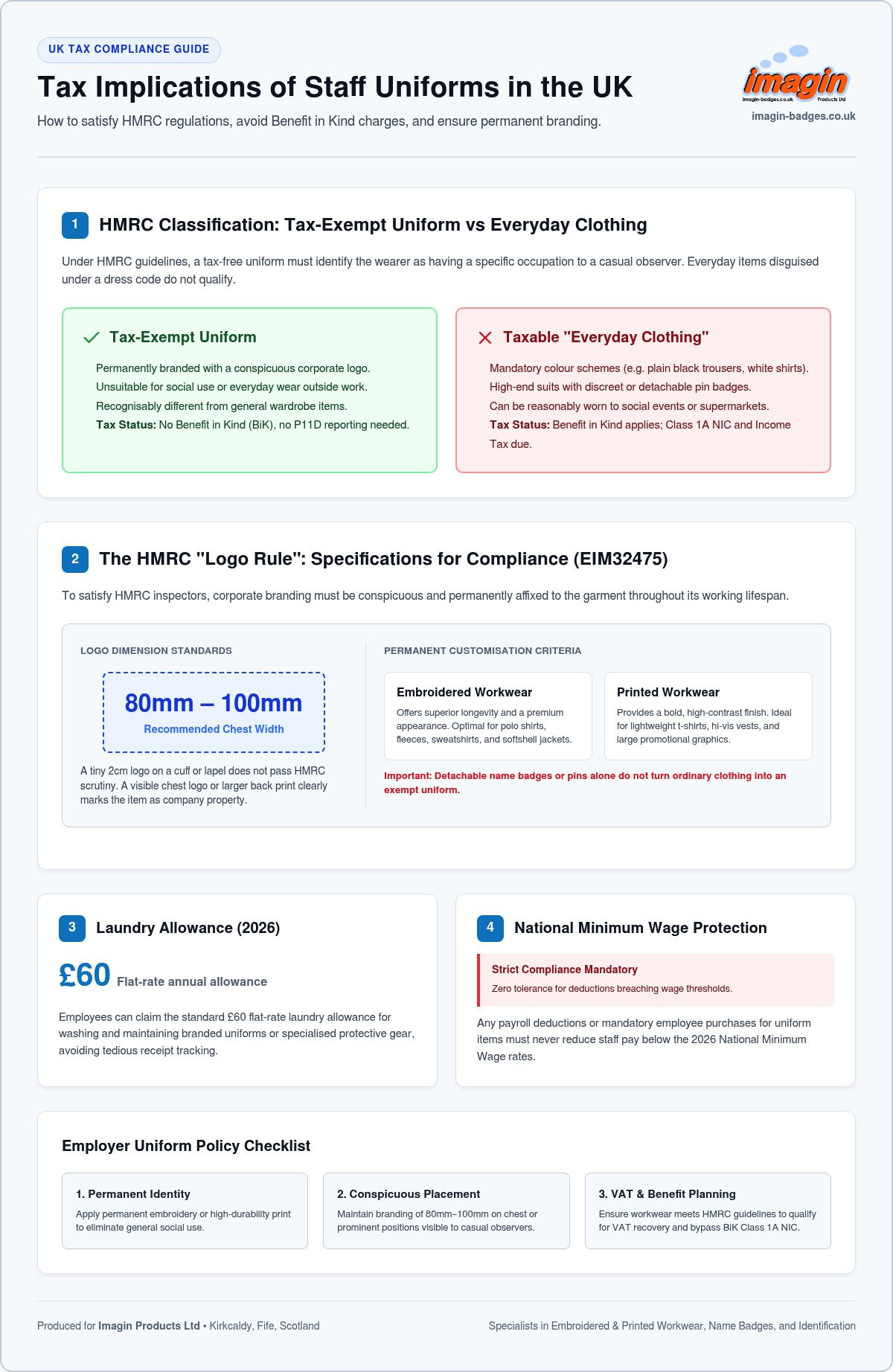
HMRC distinguishes recognisable uniforms from ordinary clothing worn at work. Its Employment Income Manual describes a uniform as specialised clothing that identifies the wearer as having a particular occupation. Traditional nursing and police uniforms are examples. Having everyone wear the same colour or style is not enough by itself. A business might require navy jumpers to create a consistent appearance, but those jumpers can still be ordinary clothing for tax purposes. The essential question is whether a member of the public would readily recognise the clothing as a uniform. Permanent, conspicuous branding can help, but HMRC considers each case on its merits.
Providing clothing and requiring clothing are different
If employees wear their own everyday clothes to meet a dress code, the dress code alone does not create an employer-provided clothing benefit. Employees generally cannot claim tax relief for maintaining ordinary clothing, even where a particular colour or design is compulsory. If the employer buys, lends or reimburses ordinary clothing, tax and National Insurance obligations may arise. These need to be considered separately from minimum wage rules.
Benefits in Kind and reporting
HMRC’s guidance says most uniforms and protective clothing do not attract tax and National Insurance, although reporting requirements can still arise. Where an applicable expenses exemption covers the arrangement, end-of-year reporting may not be required. For non-exempt ordinary clothing bought or lent by an employer, HMRC generally requires P11D reporting and Class 1A National Insurance on the benefit. If an employee buys ordinary clothing and the employer reimburses them, the reimbursement generally goes through payroll with PAYE and Class 1 National Insurance instead. Specific exceptions exist, so payroll treatment should follow the actual arrangement. Clothing provided through a salary sacrifice arrangement must be reported to HMRC. Ask your payroll adviser to confirm the applicable tax and National Insurance treatment.
Permanent Branding and Recognisable Uniforms
A permanent company logo can make a polo shirt, sweatshirt or jacket clearly associated with a business. HMRC says attaching a permanent and conspicuous badge to otherwise ordinary clothing may be sufficient to make it a uniform. The word “may” matters. Branding supports the assessment; it is not an automatic approval or a substitute for considering the clothing as a whole.
There is no official minimum logo size
HMRC does not specify that a chest logo must be 80mm, 100mm or any other particular width. Its test concerns whether the clothing is recognisably a uniform. When planning branded workwear, consider the logo’s visibility, contrast, position and clarity. A discreet mark hidden inside a garment is unlikely to serve the same identifying purpose as a clear external company logo. However, no particular measurement guarantees a tax outcome.
Embroidery, printing and permanent badges
Embroidery, durable printing and permanently attached badges can all provide lasting identification. The best method depends on the garment, artwork, working conditions and care instructions. For example, embroidery may suit polos and fleeces, while printing may suit some lightweight garments or larger designs. Decoration on protective clothing requires additional checks against the manufacturer’s instructions. Choose a method that remains legible through normal use and appropriate washing. Replace or repair damaged branding when necessary to maintain the team’s appearance and identification. There is no published HMRC rule that a logo fading after a specified number of washes automatically changes the garment’s tax status.
Name badges and ID cards have a separate purpose
A removable name badge does not turn ordinary clothing into a uniform for tax purposes. Likewise, adding an ID card does not establish a tax exemption for the clothes worn with it. Personalised name badges help customers identify staff, while photo ID cards can support workplace identification procedures. Those are useful benefits in their own right. Individual clothing items still need consideration. A qualifying branded top does not automatically bring ordinary trousers, shoes or other everyday items within the same tax treatment.
Protective Clothing and Safety Gear
Necessary protective clothing is treated differently from ordinary clothing. Items such as safety helmets, protective gloves and safety footwear may be required because of the risks involved in the work. A company logo is not required to establish their protective function. HSE guidance says employers must provide PPE free of charge where a risk assessment shows it is needed. Required PPE should not be treated as an ordinary uniform purchase that workers can simply be charged for, even where their pay is above minimum wage. Employer-provided necessary protective clothing generally receives favourable tax treatment. Keep records of what is supplied and why it is needed, and check any unusual payment or salary sacrifice arrangements with your adviser.
Hi-vis clothing and branding
High-visibility clothing can be necessary PPE where workers need to be seen around vehicles or other hazards. Selection should follow the risks and requirements of the job, including the appropriate garment specification and visibility class where relevant. Avoid assuming that anything sold as “hi-vis” automatically establishes the correct safety standard or tax treatment for every situation. Adding a logo can help identify your business, but it must not undermine the garment’s protective performance. Logos can cover fluorescent background material as well as affect reflective areas. Follow the manufacturer’s permitted decoration areas and size limits, taking account of the garment size and required classification. Ordinary printed branding is not inherently reflective and should not be described as providing low-light safety visibility. A company logo also does not replace access controls or checks on whether someone is authorised to enter a site.
Healthcare and hospitality clothing
Some medical and catering garments may be recognisable occupational uniforms or specialist protective clothing. Their design, purpose and use matter more than a blanket assumption that everything worn in an industry qualifies. A traditional occupational uniform may qualify without branding. An ordinary shirt worn by someone working in the same sector does not necessarily receive the same treatment. Always check the garment’s care instructions. Suitability for high-temperature or industrial laundering is a product specification, not something to assume from the words “uniform” or “workwear”.
VAT on Staff Workwear
Many adult workwear purchases carry VAT at the standard rate of 20%. VAT on uniforms and protective clothing used by employees in their duties can normally qualify as input tax. Whether the business can recover that VAT depends on the normal recovery rules, including VAT registration, taxable business activities, supporting invoices and any relevant restrictions. Partial exemption can limit recovery. Businesses using the VAT Flat Rate Scheme generally cannot reclaim VAT on ordinary purchases such as workwear, although the scheme has specific exceptions for certain capital assets. Keep suitable VAT invoices and records of the business purpose. Do not assume that an Income Tax exemption and VAT recovery are the same test.
Protective boots and helmets
Certain qualifying protective boots and helmets for industrial use can be zero-rated when the conditions in VAT Notice 701/23 are met. This is not a general zero-rating for all safety footwear or PPE. Supplies to an employer for use by employees are excluded from that zero-rating. Any VAT recovery then depends on the employer’s normal entitlement, rather than being guaranteed simply because the items are safety equipment.
Employee Laundry and Maintenance Tax Relief
Employees who pay qualifying costs of cleaning, repairing or replacing a uniform or specialist work clothing may be able to claim tax relief. Wearing a uniform does not, by itself, establish eligibility. HMRC’s employee expenses guidance excludes the initial purchase of work clothing from this relief. HMRC offers agreed flat-rate expense amounts for certain jobs and industries. Where a qualifying employee’s industry and job are not listed, the general flat-rate expense amount is £60 per tax year.
What does a £60 deduction actually save?
The deduction reduces taxable employment income; it is not a £60 payment from HMRC. If the full £60 receives relief at 20%, the tax saving is £12. At 40%, it is £24. Scottish employment-income tax rates differ: relief at the Scottish higher rate of 42% would give a £25.20 saving on the same deduction. The actual saving depends on the employee’s tax position. Someone who has not paid Income Tax cannot receive an Income Tax refund simply because they wash a uniform.
Employer contributions and free laundry services
Employees cannot claim relief for expenses fully paid by their employer. Where the employer contributes, that contribution must be taken into account. Employees also cannot claim for laundering their own uniform where the employer offers a free laundering service and they choose not to use it. Ordinary everyday clothing remains outside the relief, even when required by a dress code. Employees cannot claim tax relief for PPE under HMRC’s employee expenses guidance. If PPE is required for the job, the employer should provide it free or reimburse its cost.
How employees can claim
Employees can use HMRC’s online service to check eligibility and make a claim. Those completing Self Assessment must claim through their tax return instead. HMRC also provides guidance on postal claims where appropriate. Eligible claims can cover the current tax year and the four previous tax years. Receipts are not required for the agreed flat-rate expense claim, but claims for actual spending require supporting evidence. For this guide, the relevant tax year is 2026/27, running from 6 April 2026 to 5 April 2027.
Uniform Costs and the National Minimum Wage
Uniform and dress-code costs can affect minimum wage compliance even where the clothes are ordinary clothing for tax purposes. The two systems use different tests. If workers must buy specified clothing for their job, relevant payments to the employer or a third-party shop can reduce their pay for minimum wage calculations. Payroll should assess those costs under the rules for the relevant pay reference period. From April 2026, the hourly rates are:
| Category | Minimum hourly rate |
|---|---|
| Age 21 and over | £12.71 |
| Age 18 to 20 | £10.85 |
| Under 18, where entitled to the minimum wage | £8.00 |
| Qualifying apprentices | £8.00 |
The apprentice rate applies to apprentices under 19, and those aged 19 or over in the first year of their apprenticeship. Older apprentices who have completed their first year are entitled to the rate for their age.
Agreement does not override minimum wage rules
A worker agreeing to pay for a required uniform does not remove the employer’s minimum wage obligations. A clothing charge can cause underpayment even if the stated hourly wage meets the legal rate. Wage deductions also need a lawful basis, such as an appropriate contractual term or the worker’s prior written agreement. Staying above minimum wage does not, on its own, authorise a deduction. Providing ordinary uniforms free can reduce the risk of clothing charges causing underpayment. Necessary PPE must be supplied free regardless of whether a worker earns above the minimum wage.
Choosing Workwear and Identification
Start with what your team needs to do its job. Consider comfort, fit, working conditions, washing requirements and any protective specifications before deciding where to place the logo. For everyday roles, polo shirts and T-shirts can provide a practical base for business branding. Outerwear may suit teams moving between indoor and outdoor work. Check waterproof and other performance claims at product level, including whether the chosen decoration method is suitable. A useful uniform policy should explain which items are required, who pays for them, how replacements are arranged and who is responsible for cleaning. Keep supplier invoices, garment specifications and relevant payroll records together. Imagin Products Ltd can help you choose workwear and identification products that present your business clearly. Your accountant or payroll adviser can then assess the tax and reporting treatment of the arrangement you put in place. Explore branded workwear from Imagin Products Ltd
Frequently Asked Questions
Does adding my logo make clothing tax-exempt?
Not automatically. A permanent, conspicuous logo may help clothing qualify as a recognisable uniform, but HMRC considers each case on its merits. Some recognised occupational uniforms qualify without a logo.
Is a removable name badge enough?
No. A detachable badge does not, by itself, turn everyday clothing into a uniform for tax purposes. Name badges remain useful for identifying staff and improving customer service.
How large must a uniform logo be?
HMRC does not publish a minimum width. The relevant question is whether the clothing is readily recognisable as a uniform. Treat suggested logo dimensions as design advice, not a guaranteed tax threshold.
Can I deduct uniform costs from wages?
A deduction needs a lawful basis and must comply with minimum wage rules. Mandatory clothing costs can reduce pay for those calculations even where the worker agrees to them. Required PPE must be provided free.
Do uniforms have to be reported on a P11D?
Applicable exemptions may remove reporting requirements, but the answer depends on the clothing and how it is provided or paid for. Non-exempt employer-provided ordinary clothing generally involves benefit reporting and Class 1A NIC, while reimbursements generally have different payroll treatment. Clothing provided through salary sacrifice must be reported to HMRC; ask your payroll adviser to confirm its tax and National Insurance treatment.
Is the laundry allowance £60 in 2026/27?
The general flat-rate expense amount is £60 for eligible employees whose job and industry do not have a different agreed amount. It is a deduction from taxable income. The saving is £12 at a 20% tax rate, with other outcomes depending on the employee’s tax position.
Can staff claim if we already pay for cleaning?
They cannot claim for costs fully covered by the employer. Employer contributions must be accounted for, and employees cannot claim home laundry costs if they choose not to use an available free employer laundering service.
Is hi-vis clothing always tax-free?
Necessary protective clothing supplied for work generally receives favourable tax treatment, but the label “hi-vis” alone does not determine the outcome. Its purpose and the provision arrangements matter. VAT is a separate question.
Can we reclaim VAT on branded workwear?
VAT on staff uniforms can normally qualify as input tax, but recovery depends on the business’s VAT position. Partial exemption and the Flat Rate Scheme can restrict recovery. Keep valid invoices and check the applicable rules.
Sources
- HMRC: Clothing expenses and benefits
- HMRC: Clothing exemptions
- HMRC: Clothing reporting and payment rules
- HMRC: Definition of uniforms, EIM32475
- HMRC: Employee relief for uniforms, work clothing and tools
- HMRC: Flat-rate expense amounts
- GOV.UK: Scottish Income Tax rates
- GOV.UK: Minimum wage rates
- HMRC: Uniform costs and minimum wage, NMWM11220
- Acas: Deductions from pay and wages
- HSE: Personal protective equipment at work
- HMRC: VAT input tax on clothing, VIT43800
- HMRC: Protective equipment, VAT Notice 701/23
- GOV.UK: VAT Flat Rate Scheme
- GOV.UK: VAT exemption and partial exemption
- Strauss: Printing on high-visibility clothing