
Sustainable Event Badge Solutions: A Practical Buying Guide

A badge described as recyclable isn’t, on its own, proof of a better choice. Practical sustainable event badge solutions depend on the format, how it will be used and what happens to it after the event.
It’s possible to reduce avoidable waste without making registration or attendee identification harder to manage. Reusable badges may suit events where names change and there’s a workable collection and reuse process. Conference Cards may fit a different event format. Either way, assess environmental claims against product-specific evidence, and plan how badges and accessories will be handled after use.
This guide compares reusable and event-specific options, explains how to check sustainability claims and sets out practical questions to consider before ordering. Our event identification range includes Reusable Window-Insert Name Badges, Conference Cards and plain lanyards. We offer real customer service, so you can talk to us rather than machines while you work through your requirements.
Key Takeaways
- Assess sustainable event badge solutions by considering product evidence, event requirements and end-of-event handling together.
- Compare Conference Cards with Reusable Window-Insert Name Badges based on name changes, event duration and whether your team can collect items for reuse.
- A reusable format isn’t automatically the better choice. Consider whether repeated use is practical, as well as product composition and end-of-life plans.
- Review attendance, allow for registration changes and decide how badges will be handled before confirming quantities and artwork.
- Imagin Products supplies event identification options and offers real customer service, so you can talk to us rather than machines about your requirements.
What makes an event badge solution more sustainable?
There isn’t one badge format that’s automatically the most sustainable for every event. A sound assessment considers what the product is made from, how it will be used and what will happen to it afterwards. A reusable format has the potential to be used again, but that alone doesn’t show that it will be reused or prove a lower environmental impact.
Separate product facts from assumptions. If a supplier describes a badge as reusable, recyclable or made with a particular material, look for evidence that relates to that specific product and claim. Disposal also depends on the collection and processing options available where your event takes place. These checks help you compare sustainable event badge solutions without assuming there’s one best choice for every event.
Badge decisions form part of wider sustainable event management, which considers environmental, social and operational factors across an event. That broader perspective can help frame your decision, but it isn’t evidence of an individual badge’s environmental performance.
Which sustainability questions should organisers ask first?
Start with how your event runs. Is it a one-off gathering, or will you need the same badge format at recurring events? Are names and other attendee details likely to change between events, or close to the event date? Your answers will help you decide whether fixed, named badges or a format that accommodates changing names is more practical.
Then assign responsibility for the work. Decide who will distribute badges, collect them at the end, sort them, store them between events and prepare them for another use. A reuse plan needs people and a process behind it. Choose a collection point that fits the venue and attendee route, and make sure collected badges can be kept together and found when needed again.
How can you avoid unsupported environmental claims?
Match each statement to evidence about the product. Depending on the claim, that could include documentation about a badge’s composition, recycled content or end-of-life handling. Evidence about one product or component shouldn’t be treated as proof about a complete badge system, including its lanyard or holder.
- Don’t present “reusable” as proof that a badge will be reused.
- Don’t assume “recyclable” means local collection and processing facilities will accept the item.
- Don’t describe an option as low-waste or environmentally better without evidence to support the comparison.
Before publishing environmental statements, check the wording and supporting evidence against current authoritative UK guidance. Be clear about what the evidence covers and leave out claims you can’t substantiate. We can help you consider event identification formats and requirements, with real customer service from people you can talk to rather than machines.
How to compare event badge formats for your event
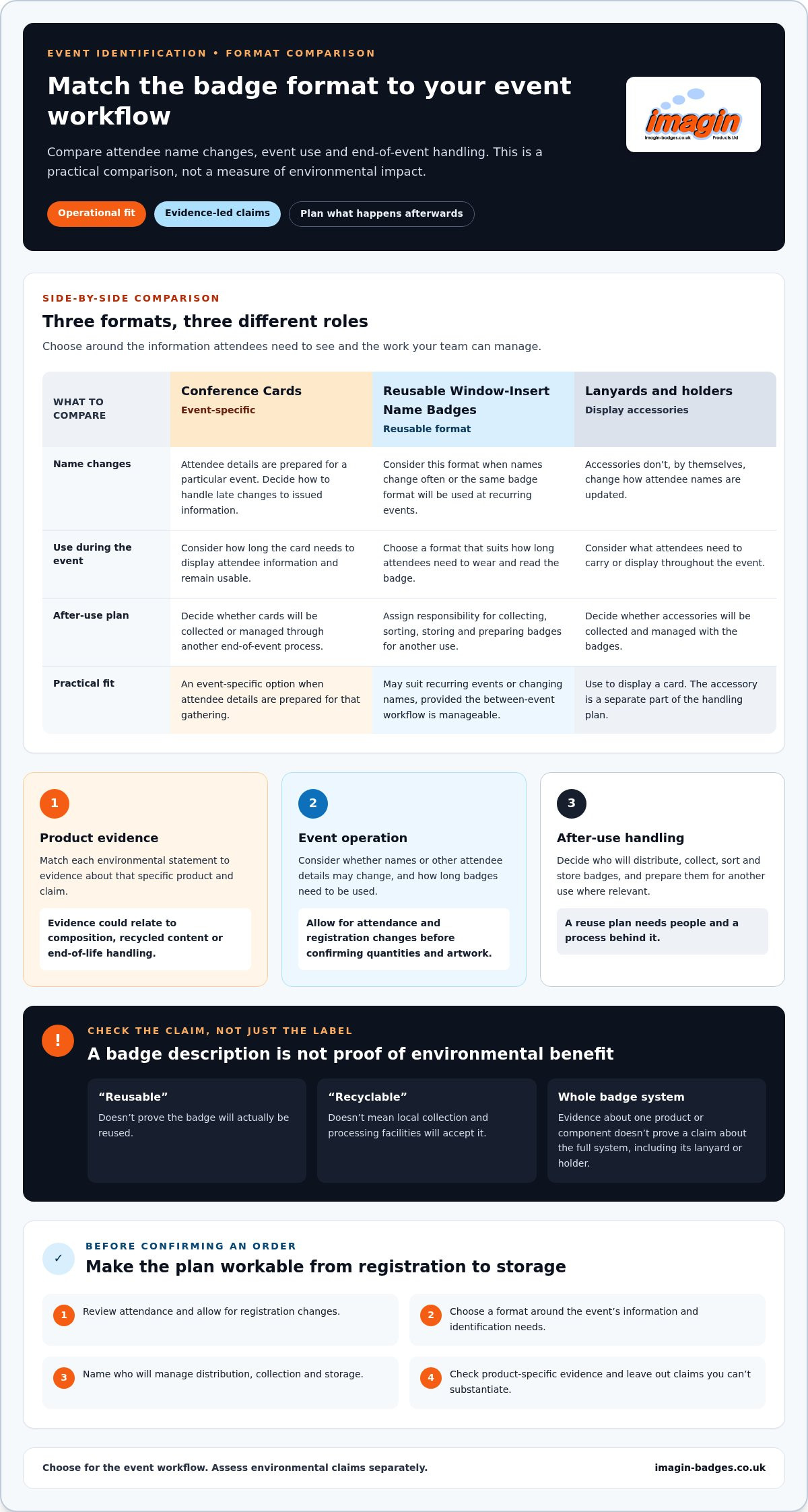
Compare formats against the practical tasks your event needs badges to perform. Consider whether attendee details must change, how long the badges will be used and what will happen to them afterwards. The comparison below focuses on operational fit, not assumed environmental effects.
Event-specific Conference Cards
Name changes: Consider these when attendee details are prepared for a particular event. Decide how your team will handle late changes to the information being issued.
Event duration: Think about how long the cards need to display attendee information and remain usable.
Handling plan: Decide whether cards will be collected after use or managed through another end-of-event process.
Reusable Window-Insert Name Badges
Name changes: Consider these when names change often or the same badge format will be used at recurring events.
Event duration: Choose a format that suits how long attendees need to wear and read the badge.
Handling plan: Assign responsibility for collecting, sorting, storing and preparing badges for another use.
Lanyards and holders
Name changes: Choose accessories to suit how badges are displayed. They don’t, by themselves, change how attendee names are updated.
Event duration: Consider what attendees need to carry or display throughout the event.
Handling plan: Decide whether accessories will be collected and managed with the badges.
When might reusable window-insert badges suit an event?
They may suit recurring events or situations where attendee names change, provided your team can manage the badges between uses. Plan a return point, name who will sort the badges and decide where they’ll be stored. Imagin Products’ Reusable Window-Insert Name Badges are one format to assess against that workflow. Illustrations are indicative only, and actual products may vary.
When are event-specific cards or accessories more practical?
Choose a format around the information attendees need to see and how identification will work on the day. Conference Cards provide an event-specific option. Plain lanyards can be used to display a card. Neither a particular card format nor an accessory proves an environmental benefit, so check any relevant product evidence and include each item in your handling plan.
The useful comparison for sustainable event badge solutions is one your team can put into practice. We offer event identification options and real customer service, so you can talk to us rather than machines as you work through the details. Explore our event identification options.
Are reusable event badges always the more sustainable choice?
No. A reusable badge only has the potential to be used again. That depends on attendees returning it and your team having a workable process to collect, sort, store and redistribute it. If badges are taken home, left at the venue or not needed again, the planned reuse may not happen.
Consider four separate questions: is the badge suitable for its intended use, is it designed to be reused, what is it made from, and what happens to it at the end of its useful life? Evidence for one point doesn’t prove the others. A badge described as durable, for example, isn’t automatically reusable. A reusable design doesn’t establish its material composition or end-of-life options either.
Don’t calculate environmental savings from reuse without reliable, product-specific evidence and clear assumptions. A comparison needs to define what’s being compared and account for relevant factors. For organisers assessing sustainable event badge solutions, an accurate explanation of the evidence and the event’s actual process is more useful than a broad claim that one format is always better.
What needs to happen for a reuse plan to work?
Give someone responsibility for collection and post-event sorting. Choose a return point that fits the venue and attendee route, and include it in the event close-down plan. Decide where collected badges will be stored and who will prepare them for another event. If names or other details need updating, allow time for that work. Without these steps, a reusable format may still be used only once in practice.
What evidence supports an environmental claim?
Keep a record of the exact product, the claim you’re considering, the evidence supporting it and what that evidence covers. Don’t infer recycled content, recyclability or compostability from a badge’s appearance. These are different claims and each needs evidence relevant to the product and its components.
For public-facing environmental claims, review the wording against current authoritative UK guidance, including the Competition and Markets Authority’s Green Claims Code. Make the statement clear and support it with evidence. Don’t imply that evidence about one component applies to a complete badge and its accessories. If you can’t substantiate a claim, leave it out. A precise description of the format and your actual reuse or disposal arrangements is more responsible than an environmental promise without supporting evidence.
How to plan and order badges with less avoidable waste
A clear ordering process helps match badge quantities and personalisation to the event you’re planning. Start with current registration information, select a format that suits the details attendees need to display, confirm the artwork and decide how badges will be handled after use. Keep a record of the product selected and the evidence behind any environmental statement you plan to make.
What should you plan before placing an event badge order?
Use the latest attendee information to estimate quantities. Rather than adding an arbitrary surplus, consider what you know about registrations, deadlines and how late additions will be handled. If names or other details may change, decide how you’ll manage updates before artwork is finalised. Checking spellings and attendee details before approval can help avoid producing badges with information that’s already out of date.
Before ordering, agree the practical details with your event team:
- Attendance: Review current registrations and set a date for confirming the quantity.
- Format and details: Decide what information attendees need to display and whether it could change before the event.
- Artwork: Check names, spelling, layout and other details before approving personalised artwork.
- Handling: If you plan to reuse badges, assign responsibility for distributing, collecting, sorting and storing them.
Plan for late registrations too. Decide whether your process can accommodate updated attendee details or whether additions need to be handled separately. This helps the people managing registration distinguish the main order from later changes.
How should teams review the results after the event?
Record what happened rather than relying on the plan alone. Note how many badges were distributed, returned, stored for another event or left unaccounted for. Compare those records with the original order and reuse arrangements. If collection proved difficult, consider whether a different return point or clearer staff responsibility would make the process more workable next time.
Keep your records together: the product and quantity ordered, the process used, the outcome and the source for any environmental claim. That gives your team a practical basis for refining future sustainable event badge solutions. It also separates observed results, such as the number of badges collected, from environmental benefits that need additional evidence.
Event-day and follow-up checklist
- Set up a clear badge distribution point.
- Make badge returns easy to find at the end of the event.
- Sort and store collected badges according to your plan.
- Record quantities distributed, returned and unaccounted for.
- Review what worked before placing the next order.
Choosing event badge solutions with Imagin Products
The right format depends on the information attendees need, whether names may change and how your team will manage badges during and after the event. Our event identification options include Conference Cards, Reusable Window-Insert Name Badges and lanyards. Any environmental statement about a product needs evidence specific to that product and claim.
Which Imagin Products options could fit your event?
Conference Cards are an option for event-specific attendee information. Reusable Window-Insert Name Badges are worth considering if names change or your team has a practical plan to collect and prepare badges for another use. Reuse potential alone doesn’t establish an environmental benefit.
Lanyards can be paired with badges when attendees need a way to display them. Choose accessories around your identification and handling requirements, rather than assuming they improve environmental performance.
What should organisers do next?
Before ordering, note your event format, the information attendees need to display, likely name changes and how badges will be distributed and handled afterwards. If you plan to reuse them, build collection and storage into the process. Keep any product evidence alongside the exact wording of environmental claims you intend to make.
Our team can help you work through your event identification requirements. You can talk to us rather than machines and discuss how the available formats fit your event plan.
Explore plain lanyards for events
Choose a badge plan you can put into practice
Good sustainable event badge solutions start with your event’s practical requirements and evidence you can stand behind. Choose a format that displays the information attendees need, and make sure any reuse plan fits your team’s event-day process.
Imagin Products supplies Conference Cards and Reusable Window-Insert Name Badges. Before making an environmental claim, check that the supporting evidence applies to the specific product and claim.
Explore our Conference Cards to find an event identification option for your requirements.
Frequently Asked Questions
Are reusable event badges more sustainable than single-use badges?
Not automatically. A reusable badge needs to be collected, stored and used again for its reuse potential to matter. If attendees take it home or it isn’t needed at future events, the plan may not work as intended. Compare the specific products and handling arrangements, and don’t claim environmental savings unless reliable evidence supports the comparison and its assumptions.
What is the most sustainable badge for a conference?
There isn’t one format that’s right for every conference. Start with the information attendees need to display, whether names may change, how long badges will be used and what will happen to them afterwards. Then assess product-specific evidence for any environmental claim. Choose a format your event team can manage and describe accurately, rather than relying on a sustainability label without supporting evidence.
Can event badges be reused at future events?
Yes, if the format and event process make reuse practical. Decide who will collect, sort and store badges, and who will prepare them for the next event. Consider whether attendee names or other details will need updating. Imagin Products supplies Reusable Window-Insert Name Badges, but the reusable format alone doesn’t prove an environmental benefit.
How can event organisers reduce badge waste?
Use current registration information to guide quantities, and plan how late registrations or name changes will be handled before artwork is finalised. Avoid adding an arbitrary surplus. If you intend to reuse badges, assign responsibility for collection and storage, and make returns straightforward at event close. Afterwards, record what was distributed, returned and left unaccounted for to improve the next event’s plan.
What should I check before making a sustainability claim about event badges?
Check that the evidence relates to the exact product and supports the specific claim, such as composition, recycled content or end-of-life handling. Don’t infer these attributes from appearance or treat evidence about one component as proof about a badge and its accessories. Keep a record of the wording, evidence and scope, then review public claims against current authoritative UK guidance.
Are Conference Cards and lanyards sustainable event badge solutions?
They’re event identification options, but the format alone doesn’t establish sustainability. Assess Conference Cards and lanyards against what attendees need to display, how the items will be used and how they’ll be handled afterwards. Any environmental statement about either product needs evidence specific to that item and claim. A clear event plan is a sounder basis for explaining your choice than an unsupported label.

Article by
Team Imagin :)
Team Imagin helps businesses look their best with quality name badges, photo ID cards, lanyards and branded workwear. Based in Kirkcaldy, Scotland, we combine friendly, personal service with professional printing and embroidery to bring your branding to life. From small teams to large organisations across Scotland, the UK, Europe and America, we help you boost your brand and build connections.
Disclaimer
This article provides general guidance only. Information was correct to the best of our knowledge when published, but product details, prices and regulations may change. Check current specifications and official guidance before making decisions.