
Sustainable Branded Merchandise UK: The 2026 Guide to Eco-Friendly Branding

Discover how to transition your business to more sustainable branded merchandise that can reduce waste, support UK customisation, and enhance your brand reputation.
The Evolution of Sustainable Branded Merchandise in the UK
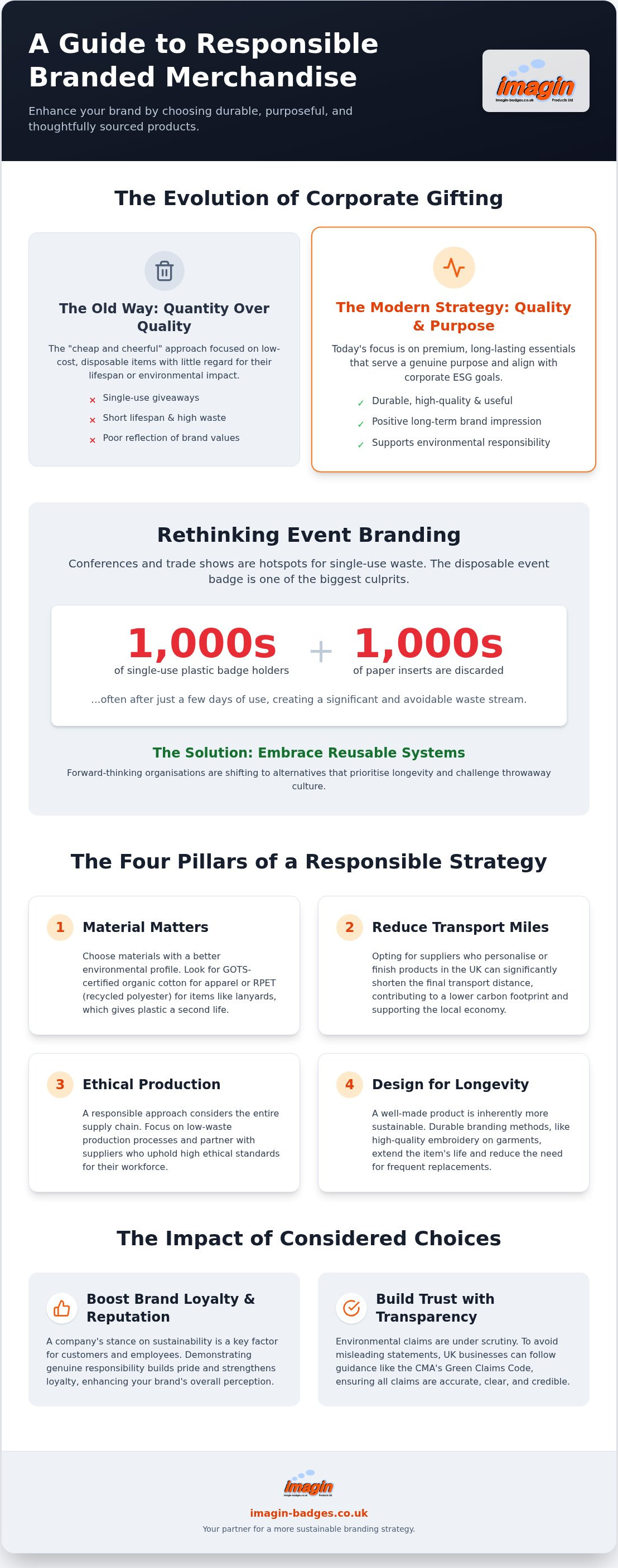
In 2026, the conversation around branded merchandise has moved far beyond simply choosing a pen made from recycled plastic. For UK businesses, procurement decisions are now a direct reflection of corporate values. The focus has shifted from cheap, disposable giveaways to high-quality, durable essentials that serve a genuine purpose and last for years. This evolution is driven by a growing awareness of environmental impact, the desire to reduce waste, and the increasing importance of Environmental, Social, and Governance (ESG) targets in corporate strategy.
Organisations are increasingly looking for branded workwear suppliers UK businesses can trust to provide items that are not only well-made but also sourced and produced with greater consideration for their environmental footprint. This means moving away from a reliance on long-distance supply chains and embracing partners who can offer transparency and quality closer to home.
- Defining responsible branded merchandise: In a modern corporate context, it's about longevity, utility, and the product's entire lifecycle—from material sourcing to end-of-use.
- The shift in mindset: Businesses are moving from a "cheap and cheerful" approach to a "quality and durable" strategy, recognising that a premium, long-lasting item offers better value and a stronger brand impression over time.
- Reducing carbon footprints: Sourcing from suppliers who personalise items in the UK can help shorten transport distances for the final leg of the product's journey, contributing to ESG goals.
- The role of ESG: Modern procurement is about more than just cost. It involves assessing suppliers on their environmental impact, ethical standards, and contribution to the local economy.
Why Making Considered Choices is No Longer Optional
In today's market, a company's stance on sustainability is a key factor in how it is perceived by customers, employees, and potential new hires. Environmental claims are under scrutiny, and businesses must be prepared to substantiate them. To avoid misleading statements, UK businesses can refer to guidance like the Competition and Markets Authority's (CMA) Green Claims Code, which helps ensure claims are accurate, clear, and supported by credible evidence.
This transparency is crucial. Committing to more durable and thoughtfully sourced merchandise can have a significant positive impact on brand loyalty and employee retention. Staff members are more likely to feel proud of working for a company that demonstrates genuine environmental responsibility. Conversely, low-quality, throwaway items not only reflect poorly on a brand but also contribute to the hidden environmental cost of "fast merchandise"—items produced with little regard for their lifespan that quickly end up in landfill.
The Problem with Single-Use Event Branding
Conferences, trade shows, and large corporate events are notorious hotspots for single-use waste. One of the biggest culprits is the humble event badge. Thousands of plastic holders and paper inserts are often printed for an event lasting only a few days, only to be discarded immediately afterwards. This creates a significant waste stream and a logistical challenge for event organisers aiming to run more sustainable events.
The move towards a more circular mindset in UK event planning involves questioning these established norms. Instead of relying on disposable systems, forward-thinking organisations are exploring reusable alternatives that reduce waste, save money in the long term, and simplify logistics for recurring events. This approach prioritises products designed for longevity, challenging the throwaway culture that has long dominated the events industry.
Key Pillars of More Responsible Corporate Branding and Apparel
Creating a more sustainable merchandise strategy involves looking at several key factors beyond the product's price tag. A truly responsible approach considers the material it's made from, the processes used to brand it, and how long it is designed to last. By evaluating these pillars, businesses can make more informed choices that align with their quality standards and environmental goals.
- Material matters: Considering materials such as organic cotton or recycled polyester (RPET) can be a positive step. The key is to understand what these labels mean and choose the right material for the product's intended use.
- The importance of transport miles: While not a complete measure of an item's impact, transport distance is one factor businesses can consider when assessing supply-chain environmental impacts. Opting for suppliers who personalise or finish products in the UK can shorten the final transport distance.
- Manufacturing and personalisation: Focusing on low-waste production processes and ethical standards is an important part of responsible sourcing.
- Design for longevity: A well-made product is inherently more sustainable than a disposable one. Choosing durable branding methods, such as high-quality embroidery on appropriate garments, can extend the life of workwear and reduce the need for frequent replacements.
Material Innovation in 2026
The materials used in branded merchandise have evolved significantly. For garments like embroidered polo shirts, organic cotton is a popular choice. Where products are certified to standards like the Global Organic Textile Standard (GOTS), this means they use certified organic fibres and must meet strict environmental, chemical, and social criteria throughout the certified processing stages.
In the world of accessories, recycled polyester (RPET) is increasingly used to create high-quality lanyards and fabrics. This material is made using recycled plastic, giving a second life to materials that might otherwise have been disposed of. When selecting materials for staff uniforms, durability is paramount. Choosing fabrics and branding techniques designed to withstand repeated washing when cared for correctly is essential for busy teams, ensuring the garments maintain a professional appearance for as long as possible.
The UK Personalisation Advantage
Choosing a supplier that personalises products here in the UK offers several practical advantages. Local production or personalisation can shorten transport distances and may reduce associated transport-related emissions, depending on the wider supply chain and transport method. This can be a valuable contributor to a company's overall carbon reduction strategy.
Working with UK-based specialists also offers greater reliability and speed. It removes the complexities and potential delays of international shipping, allowing for faster turnaround times on orders. This is particularly beneficial for businesses needing a quick response for events or new staff inductions. By partnering with a domestic supplier for branding and customisation, you are also supporting local skills and economies.
Reusable vs. Recyclable: Maximising Your ROI and Environmental Impact
For years, "recyclable" was the go-to term in sustainable merchandise. However, experience has shown that even recyclable items can end up in general waste, especially in a busy corporate environment where recycling facilities may be inconsistent. This has led to a growing appreciation for the principle of reuse as a powerful way to reduce waste.
Where products are reused many times, reusable options can reduce replacement needs and associated waste compared with single-use alternatives. This is especially true for items like staff identification. Investing in durable, reusable products not only reduces waste but also delivers a stronger return on investment over time. It minimises the administrative burden and carbon cost of constantly re-ordering disposable supplies, freeing up time and budget for other priorities.
- The recycling challenge: In a corporate setting, good intentions can fall short. Recyclable items often require specific processing that isn't always available, leading them to be incinerated or sent to landfill.
- The business case for reusability: For high-turnover industries like hospitality and retail, reusable name badges offer a practical and cost-effective solution to staff changes.
- Calculating long-term savings: While the initial unit cost may be higher, the total cost of ownership for a reusable item is often significantly lower than the cumulative cost of its disposable counterparts.
- Reducing constant re-ordering: A reusable system simplifies procurement, reduces delivery frequency, and lowers the overall environmental footprint associated with logistics.
| Feature | Disposable Event Badges | Imagin Reusable Name Badges |
|---|---|---|
| Lifespan | Single use (typically 1-3 days) | Designed for multiple years of use |
| Waste Generation | High. Contributes to landfill after each event. | Minimal. Only the paper insert is replaced. |
| Long-Term Cost | Requires re-purchasing for every new event or hire. | One-time purchase with low-cost paper inserts for updates. |
| Brand Perception | Can be seen as wasteful and generic. | Reflects a commitment to quality and sustainability. |
| Logistics | Requires ordering, printing, and distribution for each event. | Held in stock and updated on-site as needed. |
The Case for Reusable Identification
Reusable name badges, particularly window-style badges, are a perfect example of sustainability in action. They allow businesses to simply print a new paper insert whenever a staff member leaves or joins the team. The badge itself—the most resource-intensive component—is used again and again. This simple system avoids the need to manufacture, ship, and dispose of a brand new badge for every single staff change. When you compare the energy and material resources required to produce a new plastic badge versus printing a small paper slip, the benefits of a reusable system become clear.
Long-Life Workwear and Outerwear
The same principle of longevity applies to branded apparel. Investing in high-quality workwear is a fundamentally more sustainable act than purchasing cheap garments that need to be replaced every few months. Well-made outerwear, hoodies, and polo shirts, when properly cared for, can last for years, significantly reducing textile waste.
Branding methods play a crucial role here. Embroidery, for instance, can provide a highly durable finish on suitable workwear, helping branding maintain its appearance through repeated wear and washing. A logo that remains crisp and professional prevents a garment from being discarded prematurely, extending its useful life and maximising your initial investment.
Five Steps to Organising a More Responsible Uniform and ID Rollout
Transitioning to a more sustainable merchandise strategy doesn't have to be complicated. By following a structured approach, you can make meaningful improvements to your procurement process and reduce your company's environmental impact. This five-step plan helps you make considered, practical choices.
- Audit your current waste: Before making any new purchases, take stock of your existing merchandise. Identify where the most waste occurs. Is it single-use event badges? Low-quality uniforms that wear out quickly? Understanding your "waste hotspots" is the first step to fixing them.
- Prioritise durability: Shift your focus from unit cost to total cost of ownership. Choose higher-GSM fabrics for garments and opt for branding methods known for their longevity. A product that lasts twice as long is often a better investment, both financially and environmentally.
- Consolidate orders: Whenever possible, plan your procurement needs in advance. By ordering identification, lanyards, and apparel together from a single supplier, you can often reduce the number of separate deliveries, which in turn can help reduce transport-related emissions.
- Educate your team: A successful transition requires buy-in from your staff. Communicate the "why" behind the changes. Explain the benefits of the new reusable badges or the reasons for investing in higher-quality uniforms. This helps foster a sense of shared responsibility and pride.
- Partner with a UK customisation specialist: Work with a supplier who can offer transparency about their processes. A partner who personalises items in-house can provide greater quality control and faster communication, ensuring the final product meets your standards.
Auditing Your Existing Merchandise
A simple audit can reveal surprising insights. Start by tracking the lifecycle of your current staff badges—how many do you order per year, and what happens to them when an employee leaves? Identify single-use hotspots in your event calendar and calculate the volume of waste generated. Crucially, gather feedback from your staff on the durability and comfort of their current uniforms. Their real-world experience is invaluable for planning future updates and selecting products that will stand the test of time.
Choosing the Right Branding Method
The choice between embroidery and printing is a common one for branded apparel. Embroidery involves stitching a design directly into the fabric, creating a textured, premium finish that is very durable. Printing applies ink or vinyl to the surface of the garment. The best choice depends on the garment type, the complexity of the logo, and the intended use. Embroidery's durability often makes it a strong candidate for professional workwear that undergoes frequent washing. A fade-resistant logo is key to preventing early garment disposal, so getting the branding right the first time is a critical part of a sustainable procurement strategy. To learn more, read our detailed comparison in the guide to choosing workwear fabrics for embroidery vs. print.
Partnering with Imagin Products for Your Sustainable Branding Strategy
At Imagin Products, we are committed to providing high-quality, long-lasting branded merchandise that is personalised here in the UK. We believe that a well-made product is the cornerstone of a responsible branding strategy. From our specialist reusable name badges designed to reduce waste, to our extensive range of workwear customised in-house in Scotland, we help UK businesses make more considered choices.
Our focus is on durability and professional quality. We offer complimentary creative assistance to ensure your branding looks timeless and translates perfectly onto your chosen products, helping you avoid costly mistakes and reprints. Whether you need professional ID cards or expertly embroidered hoodies, we have the expertise to deliver.
- Our commitment to high-quality materials and craftsmanship for long-lasting results.
- Specialist reusable name badges designed to support a circular economy approach.
- Complimentary creative assistance to ensure your branding is effective and enduring.
- A comprehensive range of products, all personalised at our UK facility.
A Safe Pair of Hands for UK Businesses
With a long history of craftsmanship, we take pride in every badge and garment we produce. Our experienced team understands how to translate digital concepts into durable physical objects that represent your brand with professionalism. We are here to guide you through the process, making it simple and stress-free. For more detailed design tips, check out our Ultimate Guide to Custom Name Badges.
Ordering with Confidence
Partnering with us means you benefit from rapid turnaround times without the carbon cost and uncertainty of long-distance air freight for the final personalisation stage. By choosing Imagin Products, you are supporting a UK-based business and its skilled workforce. Getting started is easy—our friendly team is ready to discuss your requirements and help you build your first responsible merchandise order today.