
Printed Charity T-Shirts UK: Guide to Fundraiser and Event Apparel

Choosing printed charity t-shirts for a UK fundraising event involves more than picking a colour and uploading a logo. The right combination of fabric, print method, and supplier can mean the difference between garments that serve your campaign for years and ones that let you down on race day. This guide walks through everything a charity event organiser, volunteer coordinator, or community fundraiser needs to know: from comparing print techniques and selecting suitable fabrics, to preparing artwork correctly and planning your order around a firm event deadline.
Why Quality Printed Charity T-Shirts Matter for UK Non-Profits
A well-made printed t-shirt does more than identify your volunteers. It turns every person wearing it into a visible representative of your cause, whether they're marshalling a sponsored run, collecting donations on a high street, or simply wearing the shirt on their commute the following week.
For charities operating on tight budgets, apparel quality is a genuine financial consideration. A garment that holds its print through repeated washing and continues to look presentable at future events delivers far better value than a cheaper alternative that fades or distorts after a single outing. That said, the most durable option isn't always the most appropriate one: fabric weight, fit, and print method all need to match the specific demands of your event.
Building Public Trust and Campaign Visibility
Consistent, clearly branded volunteer apparel helps the public identify your team quickly in crowded environments. During street collections, sponsored walks, or community events, a uniform appearance signals that your fundraising activity is organised and legitimate. Bold logo placement on the chest or back makes your charity identifiable at a distance, which matters during busy sponsored marathons or large outdoor gatherings.
It's also worth noting that branded apparel alone does not fulfil any legal identification requirement for specific roles. First aiders, safety marshals, and other designated personnel typically need distinct, role-specific identification that goes beyond a standard charity t-shirt. Keep this in mind when planning your team's overall identification approach, and consider pairing printed t-shirts with name badges or photo ID cards for staff in responsible roles.
Balancing Fundraising Budgets with Garment Durability
Charity budgets require careful stewardship, and apparel purchasing is no exception. A very low-cost t-shirt may seem attractive upfront, but if it can only be used once before the print degrades or the fabric loses its shape, the cost-per-use is often higher than a slightly more robust alternative.
Heavier cotton garments, such as the GD05 Heavy Cotton T-Shirt, tend to hold their structure well across multiple washes, making them a practical choice for charities that run regular annual events. That said, fabric weight alone doesn't guarantee longevity: how the garment is printed, how it's cared for, and the quality of the blank garment all contribute to how well it performs over time.
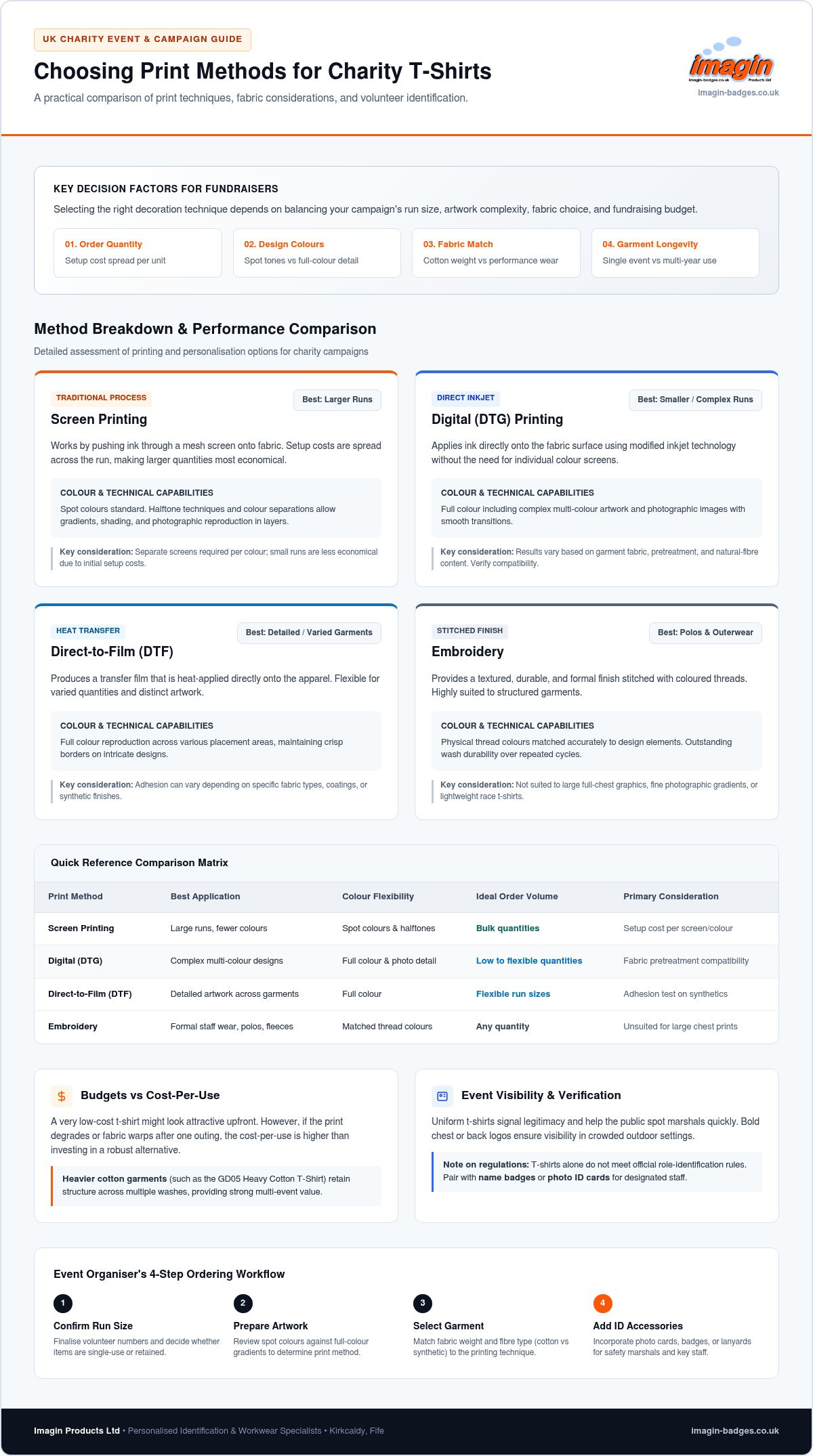
Comparing T-Shirt Printing Methods for Charity Campaigns
Selecting the right print method depends on your order quantity, design complexity, number of colours, and budget. There's no single method that suits every campaign, so understanding the trade-offs helps you make an informed decision.
| Print Method | Best For | Colour Flexibility | Typical Run Size | Key Consideration |
|---|---|---|---|---|
| Screen Printing | Larger runs with fewer colours | Spot colours; halftones allow gradients and photographic imagery | Larger quantities benefit most from setup cost spread | Setup costs per colour make small runs less economical |
| Digital (DTG) Printing | Smaller runs, complex multi-colour artwork | Full colour including photographs | Flexible; suits low quantities | Results can vary by garment fabric and pretreatment |
| Direct-to-Film (DTF) | Detailed designs on varied garment types | Full colour | Flexible | Adhesion may vary by fabric type; verify suitability |
| Embroidery | Formal staff polos, structured garments | Thread colours matched to design | Any quantity | Not suited to large chest graphics or very fine detail |
Screen Printing vs Digital Printing for Charity Wear
Screen printing works by pushing ink through a mesh screen onto the garment, with a separate screen required for each colour in the design. Because setup costs are spread across the print run, it can be a cost-effective option for larger orders with a limited number of spot colours.
It's a common misconception that screen printing is limited to simple, flat graphics. Through halftone techniques, where designs are converted into patterns of varying-sized dots, screen printing can reproduce gradients, shading, and photographic imagery. Colour separations allow full-colour images to be broken into component channels and printed in layers. The results depend on the skill of the printer and the quality of the artwork supplied, so discuss your design requirements with your supplier before committing.
Digital direct-to-garment (DTG) printing applies ink directly to the fabric surface using modified inkjet technology. It handles complex, multi-colour artwork and photographic images without the need for screens or setup costs per colour, making it more flexible for smaller or highly detailed runs. Results can vary depending on the specific equipment used, the inks, and the pretreatment applied to the garment, particularly on fabrics with lower natural-fibre content. If you're ordering DTG printing, it's worth discussing your garment choice with your supplier to confirm compatibility.
Direct-to-Film (DTF) printing produces a transfer that is heat-applied to the garment. It offers good colour reproduction and works across a range of fabric types, though adhesion quality can vary depending on the specific fabric, its coating, and finish. If you're ordering DTF onto performance or synthetic fabrics, ask your supplier to confirm suitability for your chosen garment.
When to Choose Printing Over Embroidery for Charity Wear
Embroidery gives a textured, durable finish that works well on structured garments such as polos, fleeces, and outerwear. It suits smaller logos and formal applications, and it's a popular choice for charity staff who need a professional, long-lasting look on formal representative wear.
For event t-shirts, printing is generally more practical. Large chest or back graphics are lighter when printed, they flex naturally with the fabric, and they allow for the kind of bold, colourful artwork that stands out in a crowd. Printing also handles multi-colour sponsor logos and campaign graphics more readily than embroidery, which is better suited to simpler designs at smaller sizes.
You can explore both options across our t-shirts and polos range, and our team is happy to advise on which approach suits your specific design and garment combination.
Selecting the Right Fabrics and Garment Styles for Volunteers
Fabric choice affects how comfortable your volunteers feel, how well the print performs, and how the garment holds up over time. The right choice depends on what your event involves and who'll be wearing the shirts.
Heavyweight Cotton vs Technical Performance Fabrics
100% cotton and cotton-rich blends are a popular choice for community events, volunteer stewards, and general charity campaigns. They're comfortable for most wearers, accept print well, and tend to be straightforward to care for. Heavier cotton garments generally hold their shape across multiple washes, though this depends on the specific garment construction and how they're laundered.
One thing to bear in mind: large, solid print areas can reduce airflow through the fabric, which may be noticeable for volunteers working physically active roles on warm days. This is worth considering when planning your print design, particularly for fun runs, cycling events, or outdoor challenge days.
For active fundraising events where participants are running, cycling, or taking part in physical challenges, performance fabrics with moisture-management properties can help keep wearers more comfortable. Garments like the JC015 AWDis Ladies Cool Vest are designed with breathability in mind and suit athletic fundraising contexts. Performance fabrics assist with moisture management, though the level of comfort will still vary depending on conditions and individual wearers.
Inclusive Sizing and Tailored Fits for Volunteer Teams
Offering a range of fits helps ensure every volunteer feels comfortable representing your cause. Unisex cuts work well for many teams, but dedicated ladies-fit options, such as the Classic Poloshirt Ladies Fit, are worth including where your volunteer group includes a significant proportion of women who prefer a tailored cut.
Not all styles are available in every size or fit across every garment in a range, so it's worth confirming availability with your supplier before finalising your order. When ordering for an unknown or variable volunteer group, the most reliable approach is to collect individual size preferences directly from participants ahead of the event. This reduces waste and avoids the guesswork involved in estimating distributions. Where direct collection isn't possible, ordering a small buffer of the most common sizes based on your event context gives you some flexibility for last-minute additions.
When measuring for fit, note that garment size charts typically show body chest measurements rather than flat garment measurements, and these can differ. Check the size guide for each specific garment rather than assuming consistency across styles.
How to Plan, Size, and Order Charity T-Shirts Step by Step
A clear ordering process helps avoid last-minute pressure and gives your supplier enough time to produce and deliver garments before your event date. Here's a practical sequence to follow.
- Set your event date and work backwards. Clothing orders are generally dispatched within 10 working days, so build in enough lead time for production and delivery, plus time for any artwork revisions. For events with firm deadlines, discuss your timeline with your supplier at the outset.
- Confirm your garment choices. Decide on style, fabric, and colour options before requesting quotes. Having this information ready speeds up the process and avoids delays caused by changing specifications mid-order.
- Collect size preferences from participants. Where possible, ask volunteers and participants to confirm their preferred size directly. This is the most accurate approach and reduces the risk of over-ordering in sizes that aren't needed.
- Gather and prepare your artwork. Collect logo files from your charity and any corporate sponsors early. Allow time for artwork review and any necessary adjustments before production begins.
- Confirm your order details and approve a proof. Review a digital proof before production starts. Check logo placement, colour accuracy, and spelling carefully. This is the point at which errors are easiest and cheapest to correct.
- Place your order with sufficient lead time. Confirm dispatch and delivery timescales with your supplier, and ensure someone is available to receive the delivery at your chosen address.
- Check garments on arrival. Inspect the order promptly and flag any issues with your supplier as soon as possible.
Artwork Preparation and Sponsor Logo Positioning
Supplying well-prepared artwork is one of the most important things you can do to ensure a good print result. Vector files (such as PDF, EPS, or AI formats) are generally preferred for logos and text-based designs because they scale without loss of quality. Outlining fonts within a vector file is a standard prepress step that prevents font-substitution issues, though it's the scalability of vector artwork that makes it suitable for print rather than font outlining alone.
For raster artwork (such as photographs or complex illustrations), a common benchmark is 300 ppi at the intended final print size. Whether this is sufficient depends on the pixel dimensions of the image relative to how large it will be printed: an image that looks sharp at small sizes may not hold up when scaled to a full back print. If you're unsure whether your files are suitable, share them with your supplier early so they can advise before production begins.
For sponsor logos, request approved single-colour or full-colour assets directly from each sponsor's marketing or brand team, and follow their brand guidelines for minimum sizes, clear space, and colour usage. Avoid manually converting multi-colour sponsor logos yourself, as this can result in inaccurate colour reproduction or brand guideline violations. Managing sponsor artwork early in the process prevents delays and protects the relationships you've built with your supporters.
Common logo positions for charity t-shirts include the left chest, full front, and full back. If you're incorporating multiple sponsor logos, discuss layout options with your supplier to find an arrangement that gives appropriate prominence to your charity's own branding without cluttering the design.
Managing Event Timelines, Sizing, and Accessories
For most charity events, placing your order six to eight weeks in advance gives comfortable lead time for artwork approval, production, and delivery. If your event date is closer than this, discuss the situation with your supplier directly: rush or rapid turnaround options may be available, and it's better to have that conversation early than to discover limitations when time is short.
Printed t-shirts work well alongside other branded items to create a cohesive campaign identity. Button badges are a popular, low-cost addition that can serve as donor rewards, participant mementos, or simple identification for specific roles. Name badges and ID accessories are worth considering for event staff and volunteers in positions of responsibility.
For garment care, follow the decoration-specific care instructions provided by your supplier alongside the standard garment care label. Instructions can vary depending on the print method and inks used, and following supplier guidance helps preserve print quality across repeated washes.
A Note on Fundraising Regulations and Public Collections
Printed charity t-shirts can make your team more visible and identifiable during public fundraising activities, but it's important to understand that branded clothing alone does not ensure legal compliance for your event or collection.
The Code of Fundraising Practice sets the standards that apply to all charitable fundraising across the UK, including Scotland. In Scotland, fundraising is subject to enhanced self-regulation in line with the Code, with the Scottish Fundraising Adjudication Panel overseeing complaints relating to Scottish charities. Whether your activity requires a permit, licence, or notification to a local authority depends on the specific activity, its location, and any applicable exemptions. Requirements vary, so check the guidance relevant to your activity type and location before your event.
For authoritative guidance on public collections and fundraising compliance, refer to the Fundraising Regulator's Code of Fundraising Practice and, for Scottish charities, the Office of the Scottish Charity Regulator (OSCR).
Partnering with Imagin Products for Your Charity Apparel
At Imagin Products, we work with charities, community groups, and volunteer organisations across the UK to produce printed and embroidered apparel that's ready for event day. Printed and embroidered on site in Kirkcaldy, orders are generally dispatched within 10 working days for clothing, with tracked UK delivery and free standard delivery on orders over £150.
We know that event deadlines don't move. That's why we offer a real, human point of contact throughout the process: you can talk to us rather than machines, whether you have a question about artwork formats, need advice on garment options, or want to discuss your timeline before placing an order.
On-Site Production and Dedicated Human Support
All printing and embroidery takes place on site in Kirkcaldy, Fife, which means we have direct oversight of production quality at every stage. Before your order goes to print, our team reviews your artwork to identify any issues that could affect the finished result. Catching problems at this stage is far better than discovering them after production, and it's part of the service we offer as standard.
Bulk pricing discounts apply as quantities increase, making larger volunteer orders more cost-effective. Our team can advise on the most suitable garments and print methods for your specific event, so don't hesitate to get in touch if you're working through the options.
Quality Assurance and Transparent UK Fulfilment
We have over 400 reviews on Trustpilot reflecting consistent feedback from customers across a wide range of sectors and order types. We stand behind the quality of our work, and we're a straightforward team to deal with if anything isn't right.
You can browse our full printed workwear range to explore garment options, or get in touch with our team to discuss your charity event requirements directly.
Frequently Asked Questions
How far in advance should our charity order printed t-shirts for an event?
For most events, placing your order six to eight weeks in advance gives comfortable time for artwork approval, production, and delivery. Clothing orders are generally dispatched within 10 working days, but building in extra time accounts for any artwork revisions or queries. If your deadline is tighter, contact us to discuss what's possible: rapid turnaround options may be available for urgent requirements.
Can we print multiple corporate sponsor logos on volunteer t-shirts?
Yes. Multi-sponsor layouts are common on charity event apparel. Request approved logo assets from each sponsor's brand or marketing team and follow their brand guidelines for colour usage and minimum sizes. Share all artwork with us early in the process so we can advise on layout options and flag any file quality issues before production begins.
What is a practical fabric choice for large charity fun runs?
Cotton and cotton-rich blends are a popular, practical choice for most charity events. They're comfortable, accept print well, and are straightforward to care for. For active participants, performance fabrics with moisture-management properties are worth considering. The most suitable option depends on your event type, your budget, and how the garments will be used, so it's worth discussing your requirements with us before deciding.
Do bulk pricing discounts apply to charity t-shirt orders?
Yes, bulk pricing discounts apply as quantities increase. The final price is shown when you add items to your basket. If you're planning a large order and want to understand the pricing structure before committing, get in touch with our team and we'll talk you through the options.
What file format do you need for our charity crest and artwork?
Vector files (PDF, EPS, or AI) are generally preferred for logos and text-based designs, as they scale cleanly to any print size. For photographic or raster artwork, a common benchmark is 300 ppi at the intended final output size, though suitability depends on the pixel dimensions relative to how large the image will be printed. If you're unsure whether your files are suitable, send them to us before placing your order and we'll advise.
Can we order a mix of sizes and colours within one order?
In most cases, yes. Contact us with your requirements and we'll confirm what's possible for your chosen garment and print combination. Collecting individual size preferences from your volunteers directly is the most reliable way to build your order quantities.
What delivery options are available for urgent charity event deadlines?
All orders are sent with tracked UK delivery. Free standard delivery applies to orders over £150. If your event deadline is pressing, speak to our team about rapid turnaround options. The earlier you contact us about a tight deadline, the more options we're likely to have available.
Article by
Team Imagin :)
Team Imagin helps businesses look their best with quality name badges, photo ID cards, lanyards and branded workwear. Based in Kirkcaldy, Scotland, we combine friendly, personal service with professional printing and embroidery to bring your branding to life. From small teams to large organisations across Scotland, the UK, Europe and America, we help you boost your brand and build connections.
Disclaimer
This article provides general guidance only. Information was correct to the best of our knowledge when published, but product details, prices and regulations may change. Check current specifications and official guidance before making decisions.