
Legal Requirements for Staff Uniforms: 2026 UK Guide

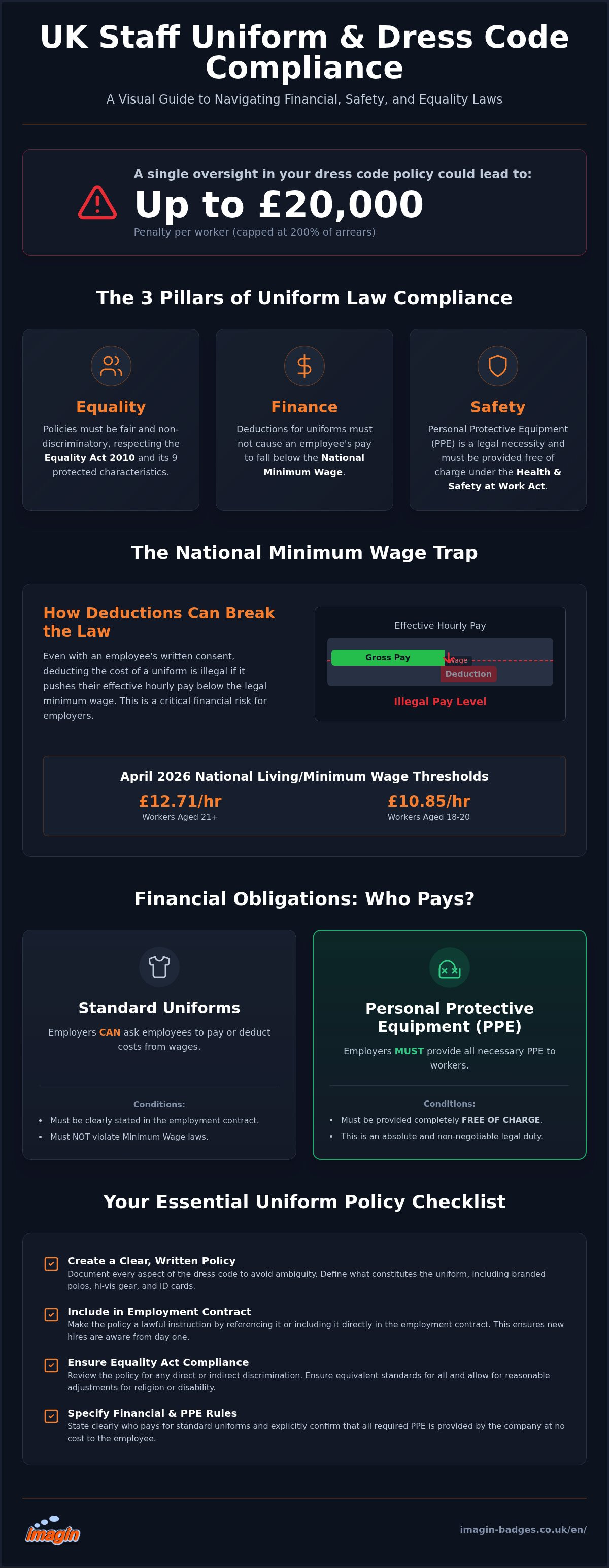
A single oversight in your dress code policy could result in a penalty of up to 200% of arrears, which is capped at £20,000 per worker. It's a sobering thought for any business owner trying to maintain a professional image whilst keeping the books balanced. You likely want your team to look cohesive and represent your brand's unique craftsmanship, but the legal requirements for staff uniforms UK often feel like a complex puzzle of financial and equality regulations.
We know you're looking for a way to provide high-quality branded gear without accidentally falling foul of National Minimum Wage rules or discrimination claims. This guide clears the confusion by explaining exactly what the law requires for workplace attire, from financial responsibilities to essential safety standards. You'll learn how to manage costs, handle tax implications, and ensure your policy fully respects the Equality Act 2010. We'll walk you through everything from PPE obligations to the 2026 wage thresholds, giving you the confidence to build a legally robust and professional uniform policy that supports your team's daily work.
Key Takeaways
- Understand the legal framework that gives you the right to set a dress code whilst ensuring your policy remains reasonable and fair for every team member.
- Avoid the "National Minimum Wage Trap" by learning how garment deductions can impact your legal pay obligations and lead to significant financial penalties.
- Identify the specific legal requirements for staff uniforms UK concerning health and safety, including your absolute duty to provide PPE at no cost to the worker.
- Protect your business from discrimination claims by implementing inclusive, gender-neutral dress codes that align with the latest 2026 standards of the Equality Act 2010.
- Use our professional checklist to create a clear, written policy that covers everything from branded polo shirts and hi-vis gear to photo ID cards.
Understanding the UK Legal Framework for Workplace Dress Codes
Many business owners look for a single "Staff Uniform Act" to guide their decisions, but no such law exists in the UK. Instead, the legal requirements for staff uniforms UK are found within a collection of broader legislations. These include the Equality Act 2010, the Health and Safety at Work etc. Act 1974, and various tax and minimum wage regulations. Together, these form three pillars of compliance: equality, finance, and safety.
For a garment to be considered a uniform by HMRC and employment law, it generally needs to be distinctive. This often means it's clearly branded with a company logo or designed in a way that it isn't suitable for everyday wear. Choosing items like embroidered polo shirts or branded hi-vis safety gear helps clarify this distinction. This makes it easier to manage tax relief and business expenses whilst ensuring your team represents your brand's pride in craftsmanship.
The Legal Right to Implement a Dress Code
Employers have a clear legal right to set workplace dress codes to maintain a professional brand image or ensure security. You might require staff to wear specific colours or items that align with your corporate identity. However, these rules must be reasonable and clearly communicated. It's best practice to include these requirements in your contract of employment. This ensures that every team member understands what's expected from their first day. When a policy is written into the contract, it becomes a lawful instruction that staff are expected to follow.
The Equality Act 2010: The Core Compliance Requirement
The Equality Act 2010 is the primary legislation to consider when drafting your policy. Staying on top of the legal requirements for staff uniforms UK means ensuring your policy doesn't infringe on individual rights. It protects staff from being treated less favourably based on nine protected characteristics, including religion, sex, disability, and age. Whilst you can set different requirements for different roles, the standards must be equivalent. For example, if you require men to wear a specific shirt, you should provide an equivalent option for women.
You must also be careful to avoid indirect discrimination. This happens when a rule applies to everyone but puts people with a specific protected characteristic at a disadvantage without a good reason. A policy that bans all headwear might indirectly discriminate against employees who wear religious coverings. Ensuring your dress code allows for reasonable adjustments helps you stay compliant whilst building an inclusive, professional team.
Financial Obligations: Who Pays for Staff Uniforms and ID?
Deciding who picks up the tab for branded clothing is a common point of confusion for many UK businesses. Under the current legal requirements for staff uniforms UK, employers are generally not required to pay for their employees' uniforms. You have the right to ask staff to buy their own gear or deduct the cost from their wages, provided this is clearly stated in the contract of employment. However, this general rule has a major exception: Personal Protective Equipment (PPE) must always be provided free of charge, as we'll explore in the safety section.
To keep costs manageable for both the business and the team, many organisations choose to supply a core set of garments. Ordering in bulk from a reliable UK workwear supplier allows you to access professional customisation at a lower unit price. This approach ensures a consistent, high-quality appearance across your team whilst reducing the financial burden on individual workers. It's an investment in your brand's pride in craftsmanship that pays off through a more professional team presence.
National Minimum Wage and Uniform Deductions
The most significant risk when charging for workwear is the "National Minimum Wage Trap". Even if an employee agrees to a deduction in writing, that deduction cannot take their hourly pay below the legal minimum. As of April 2026, the National Living Wage for workers aged 21 and over is £12.71 per hour. For those aged 18 to 20, the rate is £10.85 per hour. These rates represent a significant increase from previous years, making compliance more critical than ever.
Consider a worker aged 22 who is paid exactly £12.71 per hour. If you deduct £15 from their weekly pay to cover the cost of an embroidered hoodie, their effective hourly rate drops below the legal threshold. This constitutes a breach of minimum wage law, potentially leading to a penalty of up to 200% of the arrears. This rule also applies if you require staff to buy specific items from elsewhere, such as a particular style of black trousers. These expenses are treated as deductions from their pay in the eyes of the law, regardless of where the money is spent.
Tax Relief and VAT on Branded Workwear
Helpful tax benefits are available for both the business and the employee. Branded workwear that is clearly identifiable as a uniform is generally a tax-deductible business expense for the company. Additionally, employees can often claim tax relief from HMRC for the cost of cleaning or repairing their own uniforms. This relief is typically available if the clothing is specialised and features a permanent company logo that makes it unsuitable for everyday wear.
VAT rules for adult clothing usually require the standard rate, but certain types of protective gear may be zero-rated. You should also consult the government guidance on dress codes to ensure your financial policies remain fair. Providing high-quality photo ID badges alongside branded clothing further reinforces your professional standards whilst staying within the lines of financial compliance. Clear invoicing from a professional manufacturer ensures your records are ready for any HMRC inspection.
Health, Safety, and Security: When Uniforms are a Legal Necessity
Whilst choosing a specific colour for your team’s sweatshirts is a creative branding decision, some garments are non-negotiable under health and safety law. The legal requirements for staff uniforms UK shift from "optional branding" to "mandatory protection" the moment a risk assessment identifies a workplace hazard. In these scenarios, clothing isn't just about a professional appearance; it’s a vital piece of safety equipment designed to prevent injury or illness.
Distinguishing between a standard uniform and safety gear is essential for your compliance strategy. If a garment is required to protect a worker’s health, it’s classified as Personal Protective Equipment (PPE). This distinction changes your financial and maintenance responsibilities overnight, moving the cost entirely onto the business.
PPE and the Personal Protective Equipment at Work Regulations
Personal Protective Equipment is governed by the Personal Protective Equipment at Work Regulations 1992. These rules were updated in 2022 to extend protections to "limb (b)" workers, which includes casual contractors and gig economy workers. If your risk assessment shows that PPE is necessary, you have an absolute duty to provide it free of charge. You cannot ask staff to provide their own or deduct the cost from their wages.
Common items that fall under this legal umbrella include:
- Hi-vis safety gear for those working in low-light environments or near moving vehicles.
- Steel-toe boots or specialised slip-resistant footwear for warehouse and construction roles.
- Protective gloves and aprons for staff handling chemicals, heat, or food preparation.
Your duty doesn't end at the point of purchase. You're also responsible for the assessment, maintenance, and timely replacement of this gear. If a hi-vis vest becomes too dirty to reflect light properly, it’s your responsibility to provide a clean, compliant replacement to ensure the worker stays safe.
The Role of Identification and Security Badges
Security is the third pillar of a robust uniform policy, especially in public-facing roles. In sensitive sectors like healthcare, social care, and education, staff identification is often a legal or regulatory requirement for safeguarding. Providing clear photo ID cards helps your organisation meet these obligations whilst ensuring that only authorised personnel can access restricted areas.
Visible ID builds immediate trust with the public and customers. When a worker enters a private home or a secure facility, a professional badge confirms their identity and authority. For a deeper look at balancing visibility with safety, our Professional Staff ID & Security Guide offers practical insights into implementing secure identification systems. By combining branded clothing with secure ID, you create a team that is safe, compliant, and easy to recognise.
Navigating Discrimination Risks and the Equality Act 2010
Building a team that feels valued means looking beyond simple aesthetics. The Equality Act 2010 serves as the backbone of inclusive dress codes. In 2026, the legal requirements for staff uniforms UK focus heavily on preventing unfair treatment. You must ensure your policy doesn't discriminate against any of the nine protected characteristics. These include religion, sex, disability, and gender reassignment. Direct discrimination is often easy to spot. For example, banning a specific religious item without a valid reason is a clear breach. Indirect discrimination is subtler. It occurs when a rule applies to everyone but puts a specific group at a disadvantage.
To stay compliant, your policy should be flexible enough to accommodate individual needs whilst maintaining your professional standards. This proactive attitude builds immediate trust with your team and protects your business from costly legal claims. If you're ready to update your policy with garments that respect every team member, you can browse our inclusive workwear range to find the perfect fit.
Religious and Cultural Beliefs
Respecting faith in the workplace is a legal duty. You can maintain a cohesive corporate look whilst allowing for religious requirements like head coverings, turbans, or specific jewellery. The only time you can legally restrict these items is if they pose a genuine health and safety risk that cannot be managed otherwise. In such cases, you must be able to provide a documented risk assessment to justify the restriction. Practical tips for inclusive design include offering various sleeve lengths or choosing loose-fitting garments that provide modest coverage whilst displaying your company logo clearly.
Gender Identity and Modern Dress Codes
By 2026, the shift towards gender-neutral dress codes has become a standard practice for forward-thinking UK businesses. The law does not require identical clothing for all genders, but it does demand equivalent standards. Forcing women to wear high heels or makeup whilst men have no such requirements is now a significant legal risk. Modern policies focus on comfort and functionality for everyone. Many organisations now provide a versatile range of branded polo shirts that suit all body types and preferences. This approach ensures a professional, compliant team appearance without imposing outdated gendered expectations.
You also have a legal duty to make reasonable adjustments for employees with disabilities. This might involve allowing a different type of footwear for someone with a musculoskeletal condition. This is a technical term for problems affecting the muscles, bones, or joints, which might make wearing standard work boots painful. Other adjustments could include providing garments with velcro fastenings instead of buttons for someone with limited dexterity. These small, thoughtful changes ensure your uniform policy is a tool for inclusion rather than a barrier to work. By treating every project as a distinct creative endeavour, you can design a dress code that is both legally robust and genuinely welcoming.
Drafting Your Staff Uniform Policy: A Practical Checklist
A written policy is more than just a list of rules; it’s a roadmap that protects your business from the financial and legal risks we’ve discussed. Whilst the UK doesn't have a single "Uniform Act", having a formal document ensures you meet the legal requirements for staff uniforms UK by providing clear evidence of your reasonable and non-discriminatory approach. This document serves as a contract between you and your team, clarifying expectations from the very first day.
To outfit your team efficiently, we recommend following the "Rule of Three". This means providing each staff member with at least three sets of their core uniform: one to wear, one in the wash, and one ready in the drawer. This simple standard reduces daily stress for your workers and ensures they always appear professional and well-presented. It also extends the life of the garments, making your investment more cost-effective over time.
Essential Policy Components
Your policy document should be easy to navigate and leave no room for guesswork. A robust policy typically includes the following sections:
- Garment Definitions: List every required item, from professional name badges to specific trousers or branded outerwear.
- Maintenance and Care: Specify who is responsible for laundering the items. If staff are responsible, provide clear washing instructions to maintain the garment's quality.
- Appearance Standards: Define how the uniform should be worn, such as whether shirts must be tucked in or if specific jewellery is restricted for safety reasons.
- Non-Compliance Procedures: Outline the steps the business will take if the policy isn't followed. This ensures fairness and consistency across the whole organisation.
Implementing the Rollout
Introducing a new dress code to existing staff requires a supportive and proactive attitude. Friction often arises from a lack of communication, so involve your team early in the process. Ask for feedback on fabric choices or fit to build immediate trust. When staff feel that their comfort has been considered, they’re far more likely to embrace the change with enthusiasm. Choosing high-quality, comfortable items like embroidered hoodies or soft sweatshirts can significantly improve adoption rates compared to rigid, uncomfortable alternatives.
Running a pilot phase with a small group of employees allows you to identify any practical issues with the garments or the policy wording before a full company rollout. This trial period shows your team that you value their daily experience and are committed to getting the details right. By moving steadily from inspiration to technical specification, you can create a policy that feels like a collaborative success rather than a top-down mandate.
Building a Compliant and Professional Team Image
Staying on top of the legal requirements for staff uniforms UK doesn't have to be a source of stress. By balancing your brand's creative vision with the 2026 minimum wage thresholds and equality standards, you protect your business whilst supporting your team. Whether you're providing mandatory PPE or designing an inclusive dress code, the key is clear communication and a well-documented policy. A thoughtful approach ensures your staff look cohesive and feel respected in their daily roles.
As a trusted UK manufacturer since 1990, we're here to help you translate your digital concepts into high-quality physical objects. We offer complimentary creative assistance on all designs and have no minimum order on many items, making it easy to outfit your team with pride. Explore our range of professional branded workwear and name badges to see how our pride in craftsmanship can enhance your brand. Your team's professional appearance starts with a compliant, thoughtful policy that's built to last.
Frequently Asked Questions
Is a dress code at work a legal requirement in the UK?
No, a dress code isn't a mandatory legal requirement, but employers have a clear right to implement one for branding or safety reasons. You can require staff to wear specific colours or items like embroidered polo shirts to maintain a cohesive image. Whilst the choice to have a policy is yours, once implemented, the legal requirements for staff uniforms UK dictate that the rules must be reasonable and non-discriminatory to protect both the business and your team.
Does an employer have to provide a uniform for free?
Employers aren't usually required to pay for standard uniforms, though they must provide Personal Protective Equipment (PPE) entirely free of charge. If you choose to charge for non-safety items like sweatshirts or aprons, you must ensure any deductions don't take a worker's pay below the National Minimum Wage. As of April 2026, the National Living Wage is £12.71 per hour, and any deduction that drops pay below this rate is a breach of law.
Can an employee refuse to wear a work uniform for religious reasons?
Employees can request adjustments to a uniform policy if it conflicts with their religious or cultural beliefs. Under the Equality Act 2010, you should accommodate these requests unless there's a significant health and safety reason to refuse. For example, allowing religious head coverings or longer sleeve lengths is usually a reasonable adjustment. Being flexible and creative with your design choices helps build an inclusive workplace whilst keeping your team's appearance professional and compliant.
How many sets of uniform should an employer provide to each staff member?
There's no specific law stating how many garments you must provide, but the "Rule of Three" is a reliable industry standard. Providing three sets ensures a staff member has one to wear, one to wash, and one ready for their next shift. This practical approach reduces wear and tear on individual items and ensures your team always looks their best. It also prevents staff from having to wash their workwear every single evening to stay clean.
Can an employer deduct uniform costs from a final paycheck?
You can deduct the cost of unreturned or damaged uniforms from a final paycheck, but only if this is clearly stated in the signed employment contract. Even in these cases, the deduction must not drop the employee's final hourly pay below the National Minimum Wage for that period. It's best to have a clear process for returning items like hi-vis safety gear or fleece jackets to avoid financial disputes during the offboarding process when a staff member leaves.
Are name badges a legal requirement for UK staff?
Name badges aren't a general legal requirement for all businesses, but they're often mandatory in specific sectors like healthcare, education, or security for safeguarding and identification. Even where not legally required, providing professional name badges or photo ID cards is a smart security measure. It builds immediate trust with customers and ensures that authorised personnel are easily recognisable in public-facing environments, helping your organisation meet its broader duty of care and security obligations.
What happens if a uniform policy is discriminatory?
If a policy is found to be discriminatory under the Equality Act 2010, your business could face an employment tribunal claim. This can lead to significant financial penalties and damage to your brand's reputation. Discrimination occurs if your dress code treats one group less favourably based on protected characteristics like sex or religion. Regularly reviewing your policy to ensure it remains gender-neutral and inclusive is the best way to stay safe and protect your professional standing.
Can I require staff to cover tattoos or remove piercings?
Yes, you can ask staff to cover tattoos or remove piercings if you have a legitimate business reason, such as maintaining a specific brand image or ensuring health and safety. However, you must apply these rules consistently and fairly across your entire team. For instance, if a piercing is removed for safety in a kitchen, the rule should apply to everyone. Always consider if the requirement might indirectly discriminate against certain religious or cultural beliefs before finalising your policy.