
In-house ID printing vs outsourcing: which suits your organisation?

Owning an ID card printer doesn’t automatically make issuing cards quicker or simpler. The real choice in in-house ID printing vs outsourcing is whether your organisation wants to manage the full printing workflow, or have cards produced externally when they’re needed.
Printing cards on site gives you direct control over when they’re produced, which can help when staff details change or replacements are needed. It also means assigning responsibility for artwork, personal information, equipment and supplies. Outsourcing keeps the production workflow outside your organisation, but you’ll need to plan for the steps involved in preparing, approving and receiving cards.
To compare the options fairly, look at how often you issue or update cards, who will manage each task and how quickly changes need to be made. This guide sets out the practical trade-offs, a way to compare the workload and costs, and what to prepare if you outsource production.
Key Takeaways
- Neither in-house ID printing nor outsourcing is right for every organisation. Compare the whole issuing workflow, not just whether you own a printer.
- In-house ID printing vs outsourcing comes down to how often you issue or update cards, who can manage the work and how much control you need over timing.
- Map responsibilities for card details, artwork, equipment and supplies before deciding. This makes the ongoing workload easier to judge.
- Separate regular staff-card needs from event and visitor requirements, then compare how each workflow handles changes and production coordination.
- For outsourced cards, prepare approved details and artwork, then check spelling, photographs and card information before production. We offer real customer service, so you can talk to us rather than machines.
In-house ID printing vs outsourcing: what decision are you really making?
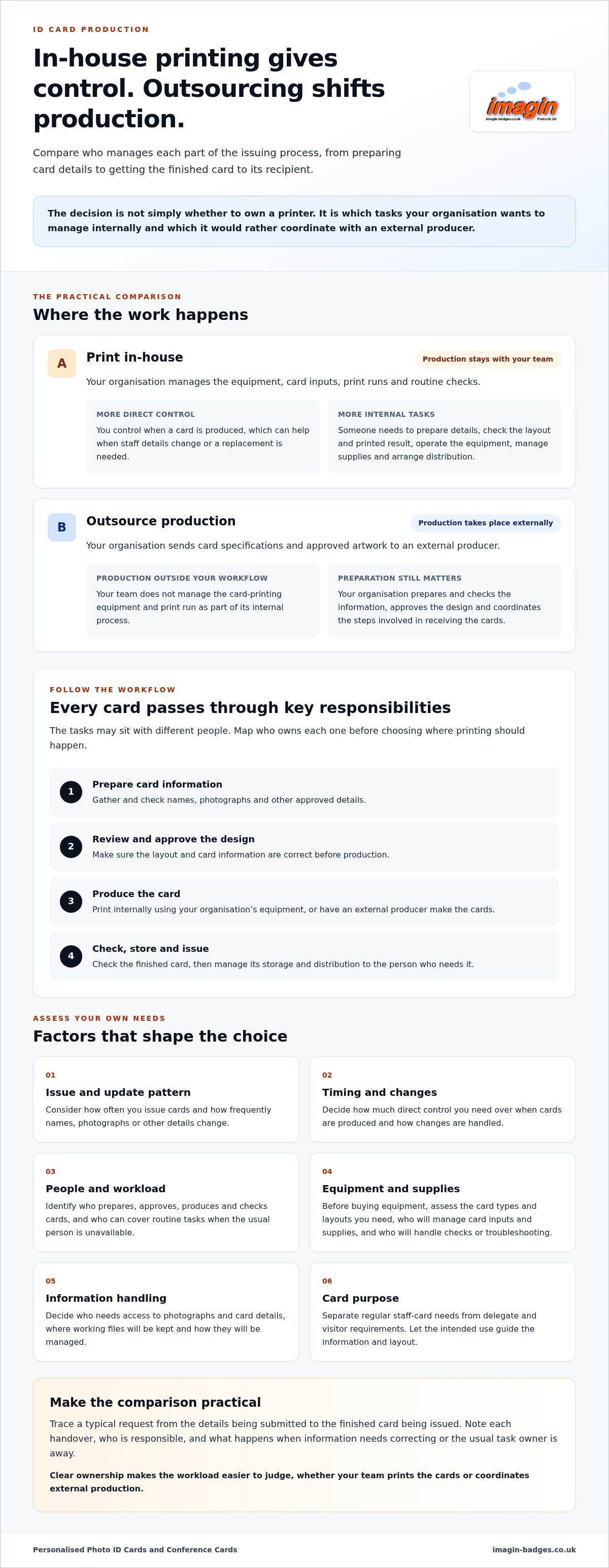
Neither in-house printing nor outsourcing is automatically the better choice. The right fit depends on the full issuing workflow: who prepares card information, approves the design, produces each card, stores it and gets it to the person who needs it. A printer is only one part of that process.
In-house ID printing means your organisation manages card production internally using equipment it owns or operates. Outsourcing means sending card specifications and approved artwork to an external producer to make the cards. This distinction matters because owning a printer doesn’t, by itself, mean your organisation has a complete or well-managed issuing process.
Start by separating the tasks. Design sets the layout and appearance. Data preparation gathers names, photographs and other approved details. Printing produces the physical cards, while storage and distribution cover what happens afterwards. These tasks may sit with different people, even when printing happens in-house. With an external producer, your organisation still prepares and checks the information, but production takes place outside its own workflow.
Cards can serve different purposes, from identifying staff to distinguishing delegates or visitors. A general overview of the role and types of an identity document may help clarify what information a card needs to show. Let the intended use guide the design and details rather than simply copying an existing layout.
What does in-house ID card printing involve?
With in-house production, your organisation manages the equipment, card inputs, print runs and routine checks. Staff still need to prepare names, photographs and approved card details, then make sure the printed result matches the information supplied. Who does each task matters: equipment may be available, but a card can still wait if the person responsible for preparing or checking it is unavailable. The exact setup varies, so assess the equipment, software, features and running costs relevant to your needs rather than assuming a particular arrangement.
What does outsourcing ID card printing involve?
For outsourced production, you provide the card specifications and approved information to an external producer. Your organisation remains responsible for the accuracy of the details and for approving the design before production. Imagin Products supplies personalised Photo ID Cards and Conference Cards in a range of formats, including single-sided and double-sided options. We offer real customer service, so you can talk to us rather than machines while working through your requirements.
The practical question isn’t simply “Should we buy a printer?” It’s which parts of issuing cards your organisation wants to manage itself, and which it would rather coordinate with an external producer. Map those responsibilities before comparing the two approaches. This gives you a clearer basis for weighing control, staff workload and how each route fits your issuing needs.
What changes when you manage ID printing in-house?
Printing cards internally gives your organisation more direct control over when a card is produced, but it also brings production tasks into your team’s day-to-day workload. Consider who prepares each card, checks it, prints it, manages supplies and responds when the usual process can’t run. Being able to operate equipment is only one part of the job.
To estimate the effort, trace a typical request from the moment someone submits staff details to the point the finished card is issued. Note who handles each handover, how the work fits alongside their other duties and what happens when that person is away. This can reveal gaps that a printer quote alone won’t show.
How much staff time does an in-house process need?
Map each task, including receiving and checking names and photographs, preparing card details, reviewing the layout, operating the equipment, checking the result and arranging collection or distribution. Include reprints and corrections: a changed name or an error spotted before issue still needs someone to update the information and produce another card. The time required depends on your organisation’s process and issuing pattern, so assess your own steps rather than relying on a general estimate.
Give the process a named owner, even if several people contribute. That person can coordinate handovers, make sure an approval hasn’t been missed and identify who can cover routine tasks. Without clear ownership, requests can stall between the person supplying details, the person approving artwork and the person operating the equipment.
What should an organisation assess before buying equipment?
Set out what you need the cards to do before assessing equipment. Consider the card types and layouts required, how often you expect to issue them, and how frequently names, photographs or other approved details change. Then identify who will learn the process, manage card inputs and supplies, and handle routine checks or troubleshooting. Treat these as areas to investigate, not costs or capabilities to assume.
Include information handling in the assessment. Decide which staff need access to photographs and card details, where working files will be kept, and how your organisation will manage them through preparation, printing and storage. Owning a printer doesn’t automatically determine who can access information or how it’s stored. Make those responsibilities clear before issuing begins.
For a fair comparison of in-house ID printing vs outsourcing, account for people and procedures as well as equipment. Internal control may make it easier to act on a change, provided a trained member of staff and the necessary supplies are available. If you’re considering externally produced cards, our ID products provide a starting point for reviewing available options.
In-house ID printing vs outsourcing: compare the practical trade-offs
The best comparison looks at who does each task, how often cards are needed and where changes are handled. Neither approach removes the work entirely. It changes which parts your organisation manages directly and which it coordinates with an external producer.
Workload
In-house: Staff prepare card details, check artwork, operate equipment and manage the print process. Outsourced: Your team prepares and approves the information, then coordinates production with an external provider.
Changing details
In-house: Internal control may help your team respond to a revised name or photograph, depending on staff and equipment availability. Outsourced: Changes need to be shared with the producer and incorporated into the production process.
Equipment responsibility
In-house: Your organisation is responsible for its equipment and for investigating supplies, training and troubleshooting needs. Outsourced: Your organisation doesn’t operate the production equipment, but still needs to provide clear requirements and manage the order.
Coordination
In-house: Work may pass between the people supplying details, approving layouts and printing cards. Outsourced: Coordination includes preparing the order, approving information and communicating with the producer.
Data handling
In-house: Your organisation decides how staff access and store card information through its internal process. Outsourced: Your organisation still needs to prepare accurate, approved information and account for how it is shared for production.
Control and convenience depend on the full process, including who prepares, checks, produces and issues each card. Use the same period and expected card requirements when comparing costs. For in-house printing, identify equipment purchases and any relevant setup, consumables, training, staff time and troubleshooting. For outsourcing, include production costs and the staff time needed to prepare, check and coordinate orders. Use actual quotes and your own workload figures rather than assuming one route will save money.
When might in-house printing be a better operational fit?
In-house printing may suit an organisation that issues cards frequently, particularly when trained staff can take clear responsibility for the process. Internal control may be useful if staff details change regularly, as your team can manage updates within its own workflow. That doesn’t guarantee immediate output: availability still depends on staff, equipment and supplies. Judge suitability against your organisation’s actual arrangements.
When might outsourced production be a better operational fit?
Outsourcing may suit organisations that print occasionally or prefer not to take on equipment ownership and operation. Production is handled externally, while your team focuses on providing accurate details and approving the card design. There’s still coordination to plan, and production and delivery timing depend on the order. Imagin’s Photo ID & Conference Cards are an option for staff, delegate or visitor identification.
Once you’ve identified the tasks your organisation wants to manage, compare the workload against your actual issuing pattern. If you’re also reviewing personalised identification products, you can explore Imagin Products.
How to choose an ID printing approach for your organisation
A useful decision starts with the cards people need and the work required to issue them. Follow these five steps, then compare the same requirements and period for each approach. This gives you a practical basis for choosing without relying on a universal card-volume threshold or a supposed break-even point.
- Define the card’s purpose. Separate regular staff identification from visitor passes and event or delegate cards. Decide what each card needs to communicate and whether different groups need different layouts.
- Estimate your issuing pattern. Note how often you expect to issue new cards, replace them or update details. Include planned recruitment or events where relevant, but distinguish known requirements from estimates.
- Map responsibilities. Identify who prepares details, checks photographs and artwork, approves the card, manages production and distributes finished cards. Include who covers these tasks when the usual person is unavailable.
- Compare the workflows. Record staff time, approval steps, equipment responsibilities and ordering tasks for both routes. Check how each handles corrected information, artwork changes and reprints.
- Choose against your actual needs. Consider the workload alongside your preference for internal control or external production. If staff cards and event cards follow different patterns, assess those requirements separately rather than forcing them into one assumption.
What card and information requirements should you define?
List the intended cardholders, such as staff, visitors or delegates, and the information each group needs. Specify names, photographs and any other approved details, plus the preferred orientation and whether the design should be single-sided or double-sided. If you have a confirmed need for RFID/NFC printing, include it as a requirement; don’t assume every organisation needs that option. For events, compare your needs with the available Conference Cards range.
How can you compare the total effort fairly?
Use one worksheet for each route and the same review period. Record the staff hours involved in preparation, checking, approvals and issue, along with equipment tasks or external ordering steps. Add documented internal costs and actual supplier quotations, noting what each figure includes and the assumptions behind it. Compare how changes, artwork approval and reprints are handled, not only the initial production step.
- In-house: Record staff time, equipment responsibilities, supplies, training and troubleshooting areas to investigate.
- Outsourced: Record the quotation, time spent preparing and approving the order, and coordination needed for updates or reprints.
Review the worksheet with the people who’ll manage the process. If the issuing pattern or responsibilities are still unclear, resolve those gaps before committing to equipment or a recurring order. A sound choice is one your organisation can support consistently, with clear ownership of card details and approvals.
To explore the cards we produce, see our ID products.
Outsource ID card production with a clear, manageable process
Outsourcing moves card production outside your organisation, but a well-prepared order still depends on clear information and careful approval. Before submitting requirements, decide what each card needs to do, gather the final details and artwork, and assign someone to check the order before production. This keeps the process organised without taking on an internal printing workflow.
What should you prepare before placing an outsourced card order?
Bring the card requirements together in one place. This gives the person placing the order and the person approving it the same reference, and avoids relying on scattered emails or out-of-date artwork.
- Purpose and cardholders: State whether the cards are for staff, visitors, delegates or another group, and what information each card needs to show.
- Approved details: Gather the final names, photographs and other card information. Have the responsible person check spelling, photo selection and details before approving production.
- Artwork: Provide the intended design and branding, including relevant colour or layout guidance. Make sure the version supplied is the one approved for use.
- Format: Choose portrait or landscape, and whether you need single-sided or double-sided cards. Consider what information needs to fit on each side.
- Additional options: Specify a signature strip on a double-sided card or RFID/NFC printing only if it serves a defined requirement. Don’t add options simply because they’re available.
Keep a copy of the final approved details and artwork with the order record. If information changes before approval, make sure the revised version clearly replaces earlier files, so there’s no ambiguity about which version should be used. If you’re ordering different card types, label each set of details by its intended use to keep the specifications easy to follow.
How does Imagin fit an outsourced ID card workflow?
Imagin Products supplies personalised Photo ID and Conference Cards, giving organisations an external production option when they don’t want to operate their own printing workflow. Available formats include single-sided and double-sided cards in portrait or landscape orientation. Double-sided cards with a signature strip and RFID/NFC printing are also options. Choose according to the information and purpose of your cards, rather than assuming every format or feature is needed.
Before approving production, make sure the card details and selected format match the intended use. A clear specification gives the order a consistent reference from artwork review through to issue, particularly when different groups need different card layouts.
If outsourcing suits your issuing needs, explore our Photo ID Cards and consider which options fit your requirements.
Build an ID issuing process that works for your team
Your choice can evolve as your organisation’s needs change. A process that suits a particular team or event today might need a fresh look if responsibilities or card requirements shift. Treat your decision as a working arrangement, not a permanent commitment, and note what would prompt you to review it.
For the in-house ID printing vs outsourcing decision, record the reasons behind your choice. Note what your organisation values most, such as having production handled internally or keeping it outside the team’s routine tasks. This gives colleagues a clear basis for maintaining the approach and reconsidering it if circumstances change.
When you’re ready to explore personalised card options, Imagin Products offers Photo ID and Conference Cards in a range of formats, including portrait and landscape, single-sided and double-sided designs. You can choose options such as a signature strip or RFID/NFC printing where they suit your requirements.
Choose the route that fits your issuing pattern and the time your team can commit. To discuss outsourced cards, explore our Photo ID and Conference Card options.
Frequently Asked Questions
Can an organisation use both in-house and outsourced ID card printing?
Yes. You could manage one card type internally and outsource another, provided each has a clear process and owner. For example, an organisation might handle routine staff cards in-house while arranging Conference Cards externally. Keep the approved visual identity consistent, and document which route applies to each card type so requests aren’t passed between teams without a clear next step.
Should staff and visitor ID cards look different?
They can, if a visible distinction helps people recognise each card’s purpose. You might use different headings or layouts for staff and visitors while keeping the organisation’s core branding consistent. Decide what distinction is useful for the people issuing and checking cards, then make sure the wording and design are clear at the size the card will be viewed.
What should we do if card details change after production has been approved?
Contact the production provider promptly with the correction and identify which card or details are affected. Don’t assume an approved order can be amended without affecting production. Internally, make sure the person requesting the change has authority to do so, and record the corrected information so the revised version is clear to everyone handling the order.
How should we organise the distribution of finished ID cards?
Decide who will receive the cards and how they’ll be handed out before production is complete. For staff cards, you might arrange collection through a named department or manager. If cards are being prepared for an event, plan how they’ll reach the registration point. A clear handover reduces the chance of cards being left unclaimed or issued to the wrong person.
What should happen to an ID card when someone no longer needs it?
Set a straightforward process for collecting or disposing of physical cards that are no longer required. Assign responsibility for recording that the card has been returned or removed from circulation, where that record is part of your organisation’s procedure. If a card is connected to a separate access system, handle that system through its own process rather than assuming the printed card controls access by itself.
Can we use the same card design across different sites or departments?
A shared design can help maintain a consistent appearance, but different teams may need distinct labels or information. Start with a common approved layout, then identify any variations that serve a clear purpose. Keep track of which version applies to each group, so staff don’t select an outdated or unsuitable design when preparing a future order.

Article by
Team Imagin :)
Team Imagin helps businesses look their best with quality name badges, photo ID cards, lanyards and branded workwear. Based in Kirkcaldy, Scotland, we combine friendly, personal service with professional printing and embroidery to bring your branding to life. From small teams to large organisations across Scotland, the UK, Europe and America, we help you boost your brand and build connections.
Disclaimer
This article provides general guidance only. Information was correct to the best of our knowledge when published, but product details, prices and regulations may change. Check current specifications and official guidance before making decisions.