
Hi-Vis Safety Gear: The 2026 Guide to UK Standards and Custom Branding

What if the hi-vis safety gear your team is wearing right now is actually making your business uninsurable under the updated 2026 HSE guidelines? We know that deciphering EN ISO 20471 standards is the most frustrating part of a site manager's week; a 2025 industry report found that 34% of UK firms still struggle to correctly identify the required protection levels for their specific site risks. It's a heavy burden when you're trying to protect your staff while also maintaining a professional brand image that clients can trust.
This guide will help you master the complexities of UK safety compliance while showing you how to apply vibrant, durable branding that won't peel or crack. We'll help you understand the precise technical differences between Class 1, 2, and 3 garments so you can make informed decisions for your fleet. From explaining the precision of our branding techniques to ensuring your logo meets visibility requirements, we'll provide the clear roadmap you need to bring your branded workwear ideas to life with total confidence.
Key Takeaways
-
Navigate the latest HSE regulations to accurately identify which class of hi-vis safety gear is required for your specific workplace environment.
-
Master the "Gap Rule" of branding to ensure your company logo remains compliant without obscuring essential fluorescent and retroreflective areas.
-
Compare the durability of bespoke embroidery against the precision of heat transfers to choose the most professional finish for your team’s workwear.
-
Understand sector-specific requirements, including the strict RIS-3279-TOM standards that mandate orange-only visibility for the UK rail industry.
-
Learn how our Fife-based specialists use a free design service to bring your branding ideas to life while meeting all UK safety specifications.
Table of Contents
Understanding Hi-Vis Safety Gear Standards in the UK
High-visibility clothing serves as the first line of physical defence for workers in high-risk environments across Scotland. This specialised equipment combines vibrant fluorescent fabrics with precision-engineered retroreflective strips to ensure staff remain visible in 100% of lighting conditions. Whether it's a roadside recovery on the A9 or a construction site in Glasgow, the primary goal is to provide a visual contrast between the wearer and their background. This contrast is vital for preventing accidents involving moving vehicles or heavy machinery.
The Health and Safety Executive (HSE) enforces strict regulations under the Personal Protective Equipment at Work Regulations 1992. A significant update on 6 April 2022 expanded these duties, requiring employers to provide compliant gear to "limb (b) workers" as well as standard employees. This legal framework ensures that safety is never optional. The HSE mandates that every piece of hi-vis safety gear must be fit for purpose, clean, and maintained to a standard that ensures the wearer is visible from all angles. Providing high-quality High-visibility clothing isn't just a box-ticking exercise; it directly influences how a team functions on the ground.
There's a deep psychological benefit to investing in premium equipment. A 2023 industry survey revealed that 64% of workers felt more valued and performed more consistently when provided with durable, bespoke gear rather than generic, ill-fitting alternatives. High-quality garments project an image of a seasoned professional who cares about detail. It transforms a workforce from a group of individuals into a unified team. At Imagin Products Ltd, we believe in bringing your ideas to life by combining these rigorous safety requirements with a professional aesthetic that builds immediate trust with the public.
-
Fluorescence: Essential for daytime visibility, converting UV light into a brighter visible glow.
-
Retroreflection: Critical for night-time safety, bouncing light back to sources like headlights.
-
Durability: Ensuring the gear survives the harsh Scottish weather without losing its protective properties.
What is EN ISO 20471?
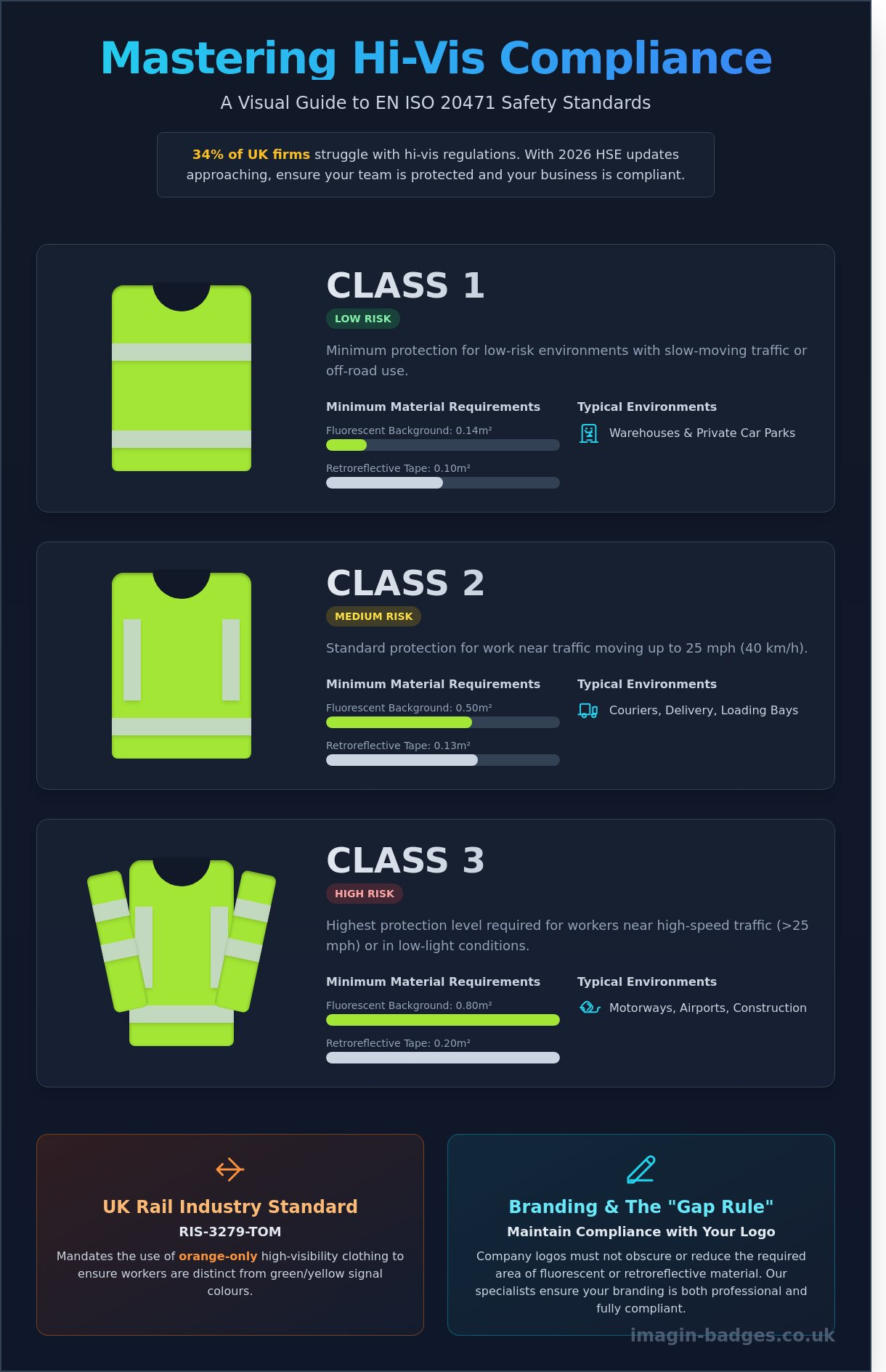
This international standard replaced the older EN471 in 2013 and remains the benchmark for hi-vis safety gear in the UK. It categorises clothing into three tiers based on the surface area of reflective material. Class 3 provides the highest level of protection, requiring 0.80m² of background material and 0.20m² of reflective tape. By 2026, all procurement managers must ensure their stock strictly adheres to ISO 20471 to remain legally compliant and ensure maximum worker protection.
Retroreflective vs. Fluorescent Materials
Fluorescent colours use special pigments to absorb invisible ultraviolet light and re-emit it as visible light, making the wearer appear vibrant during the day. However, these colours don't work in the dark. That's where retroreflective tape comes in. It uses thousands of tiny glass beads to return light directly to the source, such as a driver's eyes. A compliant garment must use a precise balance of both materials to be considered legal PPE under UK law.
Selecting the Correct Hi-Vis Class for Your Workplace
Choosing the right level of protection isn't just about ticking a box; it's about ensuring every member of your team returns home safely at the end of their shift. The EN ISO 20471:2013 standard categorises garments into three distinct classes based on the surface area of fluorescent material and reflective tape. Selecting the wrong class can lead to serious safety lapses or unnecessary expenditure. Employers must follow the HSE guidelines on high-visibility clothing to ensure they meet their legal obligations under the Personal Protective Equipment at Work Regulations 1992.
Class 1 hi-vis safety gear provides the minimum level of protection. You'll typically see these garments used in environments where the risk of collision is low, such as private car parks or indoor warehouses where vehicles move slowly. The background material must cover at least 0.14m², with 0.10m² of reflective tape. These are perfect for "warehouse walkers" or staff in low-traffic zones.
Class 2 is the standard for most UK work sites. It's suitable for couriers or workers in loading bays where traffic speeds don't exceed 25mph. You'll find that a standard waist-length vest usually meets this requirement, providing 0.50m² of background material and 0.13m² of reflective tape. This class offers intermediate visibility, making it the go-to choice for general construction and delivery roles.
The 'Rule of Coverage' becomes vital when you move to Class 3. This class represents the highest level of safety, requiring 0.80m² of fluorescent background material and 0.20m² of reflective tape. To achieve this surface area, garments must often include long sleeves and full-length trousers. The goal is to define the human shape clearly against complex backgrounds like motorways or airports. Our experts can help you select the right garments and apply your branding with precision through our bespoke design service.
Class 1 vs. Class 2: Making the Choice
Identifying the difference between 'off-road' and 'near-road' risks is the first step for your team. Class 1 trousers are often sufficient for indoor staff, but as soon as a worker steps into a loading bay or near a public road, Class 2 vests become essential. While Class 2 gear costs slightly more, many businesses find that over-speccing safety equipment leads to a 5% to 10% reduction in insurance premiums. It also demonstrates a proactive safety culture that builds immediate trust with your employees.
When is Class 3 Mandatory?
Class 3 is a legal requirement for anyone working on UK motorways or dual carriageways, as specified in Chapter 8 of the Traffic Signs Manual. These high-speed environments require maximum visibility from a distance. A single jacket might not always meet Class 3 standards on its own. Many site managers choose to combine Class 2 tops with Class 2 bottoms to achieve an overall Class 3 rating for the ensemble. This flexibility allows workers to stay comfortable while remaining fully compliant with the most stringent UK safety laws.
-
Class 1: 0.14m² background / 0.10m² tape (Low risk).
-
Class 2: 0.50m² background / 0.13m² tape (Intermediate risk).
-
Class 3: 0.80m² background / 0.20m² tape (High risk/High speed).
Branding Hi-Vis Gear: Embroidery vs. Heat Transfer
Personalising your hi-vis safety gear involves a careful balance between corporate identity and strict legal compliance. Your brand needs to be visible, but it cannot come at the expense of worker safety. The most critical factor we consider during the design phase is the Gap Rule. Under EN ISO 20471 standards, every garment must maintain a minimum area of fluorescent background material to remain certified. If a logo is too large, it reduces the visible surface area, potentially demoting a Class 3 jacket to a Class 2 garment. Generally, we recommend keeping chest logos within a 100mm by 100mm area to ensure you don't breach these safety thresholds.
Large back-prints require even more precision. While a massive logo across the shoulders offers great exposure, it must never overlap the retro-reflective strips. These silver bands are engineered to return light to its source; covering even 10% of a strip significantly reduces a worker's visibility in low-light conditions. Understanding the hi-vis requirements for construction sites is essential when deciding on logo placement, as different environments demand different levels of unobstructed fluorescent fabric.
Is Embroidery Safe for Hi-Vis?
A common myth suggests that embroidery needles ruin the waterproof integrity of safety jackets. While it's true that needles create tiny holes, we use specific techniques to maintain the garment's performance. For heavy-duty 300gsm parkas and thick fleeces, embroidery is the superior choice because it handles the weight of the fabric without puckering. We often apply a waterproof backing or "seal" over the reverse of the stitching to prevent moisture ingress. When choosing thread colours, we recommend high-contrast tones like navy blue or black for fluorescent yellow vests. This ensures your branding remains legible even from a distance of 20 metres.
Digital Printing for Complex Logos
For lightweight 120gsm waistcoats and breathable wicking t-shirts, digital heat transfers are the ideal solution. Embroidery can be too heavy for these thin fabrics, causing the garment to sag or chafe the wearer. Digital transfers allow for vibrant, multi-coloured gradients that embroidery simply cannot replicate. Our transfers undergo rigorous durability testing to ensure they should last around 1 year** without peeling or cracking. This is vital for hi-vis safety gear used in UK rail or road works, where grime and oil require frequent, heavy-duty cleaning.
We use ultra-thin transfer films that avoid blocking the breathability of high-performance fabrics. If your company logo features complex shadows or more than four distinct colours, digital printing provides a crisp, professional finish. It's a reliable way to bring your creative vision to life without compromising the garment's flexibility. By choosing the right application method for the specific fabric weight, you ensure your team stays comfortable, visible, and professional on every job site.
** based on 1 wash per week at 40 degrees
Sector-Specific Gear: From Construction to Rail
Safety requirements aren't a blanket rule across every Scottish industry. A bespoke approach is necessary because the hazards on a Glasgow construction site differ vastly from those in a Fife distribution centre. Choosing the right hi-vis safety gear involves matching technical fabric properties to the specific risks of your environment.
Construction and trade professionals require garments built for longevity. We recommend trousers and jackets featuring dark, dirt-resistant panels on the cuffs and hems. These contrast areas hide the inevitable grease and mud of a site, ensuring the fluorescent sections remain effective for longer. Durability is a priority; look for triple-stitched seams and Cordura-reinforced pockets that won't rip when carrying heavy tools. For workers on roads with speed limits exceeding 50mph, EN ISO 20471 Class 3 garments are a legal necessity to provide maximum visibility from all angles.
-
Events & Security: While yellow and orange are standard, many event firms use vibrant pink, green, or blue vests. These non-standard colours help staff stand out from the public for identification purposes rather than strictly meeting roadside safety laws.
-
Warehousing: Statistics show that roughly 15% of warehouse injuries involve moving vehicles or conveyors. We provide "tear-away" vests with five-point Velcro closures. These are designed to pull apart instantly if the fabric gets caught in machinery, protecting the wearer from being pulled into a hazard.
-
Lightweight Options: High-activity roles benefit from 100% polyester mesh fabrics that offer maximum breathability during physically demanding shifts.
The GO/RT 3279 (RIS-3279-TOM) Standard
The UK rail industry operates under the RIS-3279-TOM standard, which replaced the old GO/RT 3279 rules in 2016. On the trackside, yellow hi-vis safety gear is strictly prohibited. This is because yellow can be easily confused with green signal lights or blend into autumnal foliage during low-light conditions. Only high-visibility orange is permitted. For contractors working with Network Rail Scotland, garments must provide a minimum of 0.5m² of fluorescent material and 0.13m² of reflective tape to meet these rigorous safety benchmarks.
Multi-Norm Safety Gear
Utility workers often face complex risks that require multi-norm protection. This gear combines high visibility with flame-retardant (EN ISO 11612) and anti-static (EN 1149) properties. As we approach 2026, the industry is shifting toward sustainability; we're seeing a 25% increase in requests for gear made from recycled polyester (rPET) that doesn't compromise on luminosity. For the unpredictable Scottish climate, we suggest gear rated EN 343 Class 4:4, which offers the highest level of waterproofing and breathability, keeping teams dry during heavy rain without causing overheating.
Whether you need trackside-approved orange or bespoke branded vests for a local event, our team provides a free design service to help you get the details right. We take your project from concept to completion with precision and care.
Explore our range of customisable safety gear at Imagin Badges and if you can't find what you want on the website just contact us on 01592 653 865 or email us at sales@imagin-badges.co.uk to discuss your requirements
Why Imagin Products is Your Trusted UK Hi-Vis Partner
Selecting the right hi-vis safety gear involves more than just picking a bright colour. It requires a partner who understands the technical demands of UK safety legislation and the nuances of high-quality branding. At Imagin Products, we operate from our dedicated facility in Fife, where we've spent over 12 years perfecting the art of garment customisation. We don't outsource our branding to third-party providers. By keeping every heat-press and embroidery machine under our own roof in Kirkcaldy, we maintain total control over the finished product. This setup allows us to offer a 5-day standard turnaround, which is significantly faster than the 14-day industry average for imported bespoke goods.
Our free design service is a cornerstone of our commitment to your safety. When we apply your logo, we don't just aim for aesthetic appeal; we ensure legal compliance. Under BS EN ISO 20471 standards, the area of reflective tape and background fluorescent material must meet specific square-metre requirements. If a logo is too large or poorly placed, it can technically de-classify the garment. Our design team reviews every layout to ensure your branding is impactful without compromising the protective rating of your hi-vis safety gear. You'll receive a digital proof to approve, so there are no surprises when the box arrives.
Accessibility is vital for the Scottish workforce. We've eliminated minimum order quantities to ensure that a sole trader in Fife and the UK receives the same premium service as a multinational corporation with 500 staff. Every single garment undergoes a rigorous quality check. We inspect the retro-reflective strips for cracks and test the branding adhesion to ensure it won't peel after the first few heavy-duty washes. Our goal is to provide workwear that lasts the entire season, reducing your replacement costs by an estimated 15% annually.
The Benefit of Local Manufacturing
Sourcing your workwear from our Fife facility reduces your carbon footprint by approximately 22% compared to ordering from suppliers who ship from overseas hubs. You gain a personalised experience by speaking directly to the experts in Kirkcaldy who handle your gear. If you have an urgent contract starting on a Monday, our fast-track production options can often bypass standard queues to get your team kitted out in 48 hours. This local agility is something distant online retailers simply can't match.
Ordering Your Branded Gear
Getting started is straightforward. Upload your logo through our website to receive a free design proof within 24 hours. For managers planning their 2026 safety requirements, we provide bespoke quotes that include tiered bulk discounts. For example, orders exceeding 50 units typically benefit from a 12% price reduction. Contact our team today for a comprehensive quote that ensures your team stays visible, compliant, and professional throughout the year. We're ready to bring your vision to life with precision and care.
Future-Proof Your Team’s Safety and Branding
Ensuring your team stays safe and visible requires more than just a standard vest. By 2026, strict adherence to EN ISO 20471 standards is essential to maintain workplace compliance across the UK. Whether you’re operating in the rail sector or managing a busy construction site, selecting the correct class of hi-vis safety gear ensures your staff remain protected in every lighting condition. Your choice of branding, from durable embroidery to vibrant heat transfers, transforms essential PPE into a professional extension of your company’s identity.
At Imagin Badges, we act as your creative collaborator. Our team in Fife, Scotland, handles every detail of the manufacturing process to ensure your garments meet rigorous quality benchmarks. We provide a ** professional design service** to help you visualize the final result before production begins. From concept to completion, we’re a safe pair of hands for your project. We’ll help you navigate technical specifications so you can focus on your business goals.
Ready to see your logo on premium, compliant apparel? Request a Design Proof for Your Branded Hi-Vis Gear today. Let’s bring your ideas to life together.
Frequently Asked Questions
Can I put a large logo on the back of a hi-vis vest?
You can add a logo to the back, but it mustn't exceed 0.01 square metres for Class 1 garments or 0.05 square metres for Class 3 items. Covering too much of the fluorescent material with branding can void the safety certification of your clothing. Our free design service helps you bring your ideas to life by calculating the exact dimensions needed to keep your bespoke branding both vibrant and legal.
What is the difference between yellow and orange hi-vis safety gear?
Orange hi-vis safety gear is the mandatory requirement for UK rail workers under the RIS-3279-TOM standard because it provides superior contrast against green rural landscapes. Yellow remains the most common choice for general construction and industrial work throughout Scotland. Both colours meet the EN ISO 20471 standard for high visibility, but your choice often depends on the specific safety regulations of your site or industry.
Do I need Class 2 or Class 3 hi-vis for my construction site?
You need Class 3 garments for any work near traffic moving at speeds over 60km/h, while Class 2 is typically sufficient for standard construction sites with slower vehicle movements. A Class 3 jacket requires at least 0.80 square metres of fluorescent background material and 0.20 square metres of reflective tape. We provide precision advice during the ordering process to ensure your team has the durable protection required for their specific environment.
Can you embroider hi-vis waterproof jackets without them leaking?
We don't recommend traditional embroidery for waterproofs because the needles create thousands of tiny holes that allow water to seep through. To keep your team dry, we use high-quality heat-seal transfers or apply a specialist waterproof backing to any embroidered areas. This approach ensures your logo looks professional and stays durable without compromising the jacket's ability to withstand a Scottish downpour.
What does the 'Gap Rule' mean for custom branded workwear?
The 'Gap Rule' states that any break in the reflective tape, whether for a zip or a side seam, cannot exceed 50mm in width. If you're planning bespoke branding that sits near or over the reflective strips, the total gap must stay within this 50mm limit to maintain certification. Our experts manage these technical details from concept to completion, ensuring your custom design doesn't interfere with safety requirements.
Is there a difference between hi-vis for cyclists and hi-vis for work?
Professional hi-vis safety gear must meet the EN ISO 20471 standard, while cycling gear often only meets EN 17353 for non-professional use. Work-grade garments are designed with specific amounts of reflective tape and fluorescent fabric to ensure visibility in dangerous industrial settings. While cycling jackets are bright, they don't usually offer the same certified surface area or durability required for a UK construction site or roadside workspace.