
Guide to Custom Hi-Vis Jackets for UK Businesses 2026

Your company’s logo shouldn't be the reason your safety gear fails a site inspection. Many UK business owners worry that adding branding to custom hi-vis jackets might compromise EN ISO 20471 compliance or that a professional logo will simply peel away after a few weeks on a rainy construction site. It's frustrating to balance the need for a polished team appearance with the strict legal requirements of workplace safety. You want gear that protects your staff and represents your craftsmanship without the stress of a complex ordering process.
We've designed this guide to help you master that balance. You'll learn how to select the right safety classes for your specific industry, choose customisation methods that survive industrial washing, and maintain your garments for long-term use. From understanding the latest 2026 regulations to utilizing our complimentary creative assistance, we'll show you how to transform essential PPE into a durable branding asset. We'll walk through everything from technical specifications to final delivery, ensuring your team stays visible, compliant, and professional.
Key Takeaways
- Learn how to navigate EN ISO 20471 safety classes to ensure your branding remains compliant without obscuring essential reflective materials.
- Discover why embroidery offers a premium, tactile finish for long-term wear while heat transfer printing provides flexibility for intricate, multi-coloured designs.
- Identify the right custom hi-vis jackets for your specific environment, from breathable summer vests to heavy-duty parkas and specialised rail-approved gear.
- Understand the digitisation process and how complimentary creative assistance helps translate your digital logo into a high-quality physical product.
- Explore how to maintain your branded safety gear to ensure your company logo survives industrial washing and harsh outdoor conditions.
What are Custom Hi-Vis Jackets and Why Does Your Business Need Them?
High-visibility clothing is a specialised form of personal protective equipment (PPE) designed to make the wearer stand out against any background. In low-light or hazardous environments, these garments are essential for preventing accidents and ensuring worker safety. Custom hi-vis jackets take this functionality a step further. They combine vital safety features with your company’s unique branding, effectively turning every member of your team into a mobile billboard. This dual-purpose approach ensures you meet legal health and safety obligations while simultaneously building brand awareness in the field.
While construction is the most obvious user, other sectors like transport, logistics, and event management are quickly adopting branded safety gear. In a busy warehouse or a crowded festival site, visibility isn't just about avoiding vehicles; it's about being identifiable. When your staff wears unified, branded jackets, it instils a sense of public trust and authority. It also has a significant psychological impact on your workforce. Wearing a professional, high-quality uniform builds team cohesion and pride. It signals that you value your employees' safety and their role within the company.
The Anatomy of a Professional Safety Jacket
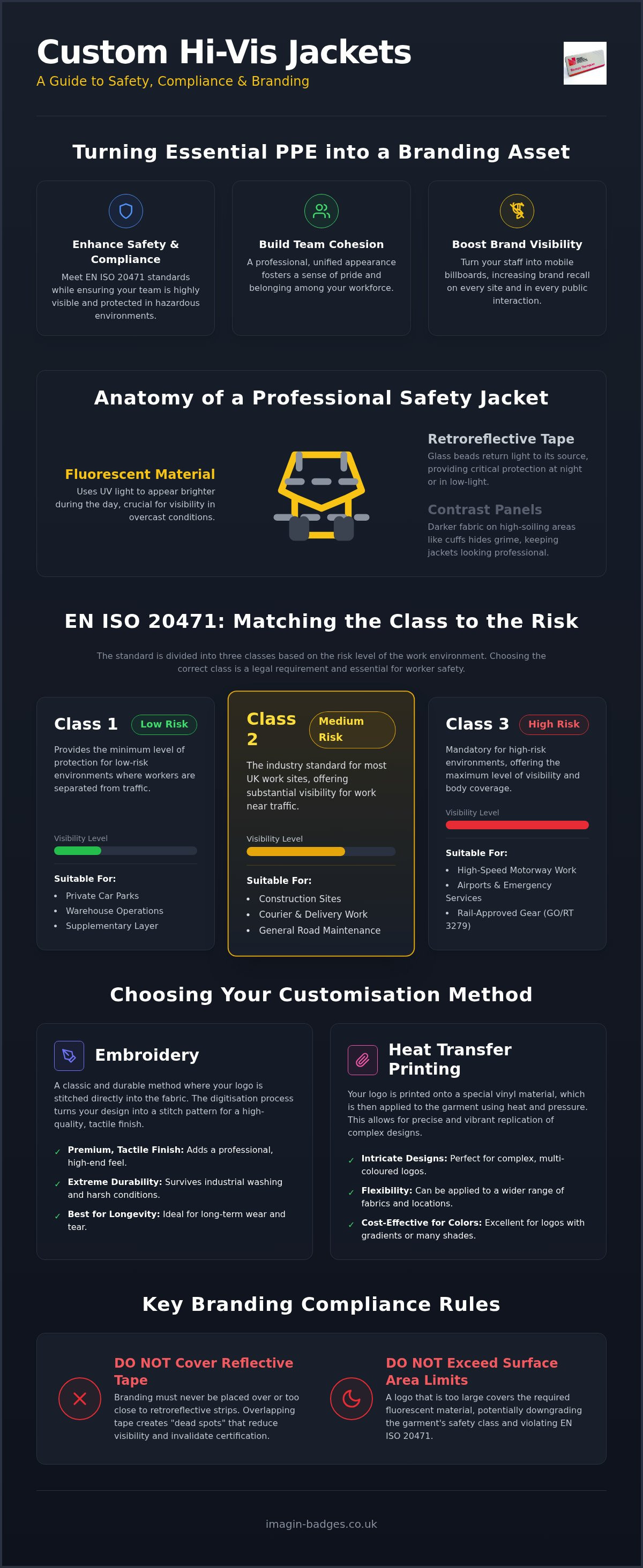
A professional jacket relies on three technical components to keep your team safe and your brand sharp. Fluorescent base materials use UV light to appear brighter during the day, which is essential for overcast conditions. Retroreflective tape uses glass beads to return light to its source, providing night-time protection. We also use contrast panels in high-soiling areas like cuffs. These darker sections hide grime, ensuring your custom hi-vis jackets look clean and professional all day long.
Benefits of Customisation for Modern Organisations
Branding offers practical advantages beyond aesthetics. On busy multi-contractor sites, it simplifies security and identification, helping you distinguish authorised staff instantly. It also boosts brand recall; your logo is visible in every site photo and public interaction. Swapping generic vests for tailored safety jackets demonstrates a commitment to quality. It positions your business as a dependable expert, showing clients and the public that you value both safety and professional standards.
Understanding Safety Standards: EN ISO 20471 and Custom Branding
EN ISO 20471 is the international standard for high-visibility clothing. It establishes the technical requirements for the amount of fluorescent material and retroreflective tape required to keep workers safe in hazardous conditions. Under the Personal Protective Equipment at Work Regulations 1992, UK employers are legally obligated to provide suitable safety gear where risks are identified. When you invest in custom hi-vis jackets, the branding process must respect these technical boundaries. A logo that is too large or poorly placed can actually invalidate the garment's certification, leaving your business vulnerable during a safety audit.
The core of this standard is the "logo surface area" rule. Every certified jacket has a minimum required amount of fluorescent background material. If a custom print covers too much of this fabric, the garment may no longer meet its original safety class. Similarly, branding must never be placed over or too close to retroreflective strips. These bands are designed to return light directly to its source; even a small amount of embroidery or ink overlapping the tape can create "dead spots" that reduce visibility at night. We carefully calculate logo dimensions to ensure your branding stays within legal tolerances.
Which Class Does Your Team Need?
Visibility requirements are divided into three distinct classes based on the level of risk in the environment. It's essential to match your gear to the specific hazards your team faces:
- Class 1: This is the lowest level of protection. It's suitable for low-risk environments, such as private car parks or as a supplementary layer for staff who are already wearing higher-class gear.
- Class 2: Considered the industry standard for most UK construction sites. It provides sufficient visibility for courier work and general maintenance on public roads.
- Class 3: This offers maximum protection. It is mandatory for high-speed motorway work and environments with extreme low-visibility, such as heavy fog or night-time utility repairs.
Legal Compliance vs. Branding Freedom
Your customisation journey should always begin with a thorough workplace risk assessment. This audit determines the class of gear required, which then dictates how much space is available for your logo. Maintaining certification is a collaborative effort between the business and the manufacturer. We ensure that every garment retains its CE or UKCA marking after customisation, proving it has been tested and remains fit for purpose. If you're concerned about how your logo might affect compliance, our team provides complimentary creative assistance to find the perfect, safe placement for your brand assets.
Embroidery vs. Printing: Choosing the Best Customisation Method
Selecting the right application method for your custom hi-vis jackets is just as important as the garment itself. The choice between stitching and ink isn't just about aesthetics; it affects the jacket's technical performance, its lifespan, and how your brand is perceived on-site. Embroidery uses approximately 5,000 to 10,000 stitches for a standard chest logo, creating a dense, tactile finish that remains sharp even after years of use. While this method offers a premium feel, certain environments and garment types require the specific benefits of modern printing techniques. According to UK Health and Safety Executive (HSE) guidelines, employers must ensure PPE is maintained in an efficient state; choosing a branding method that peels or fades prematurely can undermine your compliance efforts.
For large-scale orders with straightforward, single-colour designs, screen printing remains a highly cost-effective solution. It allows for rapid production without sacrificing clarity. However, for modern logos with complex gradients or fine details, heat transfer printing is often the superior choice. This method maintains the flexibility of the fabric and is particularly effective for the lightweight materials found in summer safety gear. We help you navigate these options through our complimentary creative assistance, ensuring the method we choose matches the specific demands of your industry.
When to Choose Embroidery
Embroidery is the gold standard for durability. It is the best choice for heavy-duty bomber jackets and parkas that face constant abrasion or frequent industrial washing. The thread is dyed to resist fading, ensuring your brand remains vibrant in harsh outdoor conditions. Beyond toughness, embroidery provides a sophisticated, professional look that is ideal for management, site visitors, or client-facing roles. It signals a level of permanent craftsmanship that printed alternatives can't quite replicate.
When Printing is the Smarter Option
Printing is often the technically superior choice for specialised weather-proof gear. Unlike embroidery needles, which must puncture the fabric thousands of times, heat transfer printing bonds to the surface without damaging waterproof membranes. This preserves the garment's integrity in heavy rain. Printing is also the only way to capture intricate logo details and photographic gradients. Because it adds almost no weight to the fabric, it keeps breathable mesh vests and lightweight custom hi-vis jackets comfortable and airy during the summer months.
Selecting the Right Jacket for Your Industry and Environment
Choosing the correct garment for your team requires a careful look at both the weather and your specific operational needs. In the peak of summer, breathable mesh vests keep workers cool while maintaining visibility. As the temperature drops, your team will need a transition to insulated winter parkas that provide thermal protection alongside safety certification. If you operate within the UK rail industry, you must adhere to the RIS-3279-TOM standard. This mandates specific shades of orange hi-vis gear to ensure drivers can distinguish workers from green foliage. Selecting the wrong colour or material for these custom hi-vis jackets isn't just a branding error; it's a safety violation.
Beyond the fabric, you should evaluate the practical features that help your staff perform their daily tasks. Security teams often require radio loops and pen pockets, while site supervisors benefit from clear ID badge holders for quick identification. For teams requiring a complete identification solution, you can pair your jackets with our integrated options discussed in The Ultimate Guide to Custom Name Badges. Our goal is to provide a "safe pair of hands" for your procurement process, ensuring every feature serves a functional purpose.
The Versatile Hi-Vis Bomber Jacket
The bomber jacket remains a staple for general construction and yard work across the UK. Its popularity stems from a classic design that balances warmth with ease of movement. Elasticated waistbands and cuffs serve a dual purpose: they keep out the cold wind and prevent the fabric from snagging on equipment or scaffolding. These jackets also offer a generous back-print area. This makes them perfect for large-scale branding, ensuring your company logo is visible from a significant distance on a busy site.
Softshell and Fleece: The Modern Alternative
For more active roles, such as delivery drivers or warehouse technicians, softshell jackets offer superior comfort and mobility. The stretchable fabric allows for a full range of motion, while the breathable membrane manages moisture during physical labour. If your team works in extreme cold, hi-vis fleeces act as an excellent mid-layer. They provide an extra thermal barrier without the bulk of a heavy coat. Whatever your environment requires, you can browse our full range of hi-vis safety gear to find the perfect fit for your team.
Ordering Your Branded Hi-Vis: The Imagin Products Approach
Ordering custom hi-vis jackets shouldn't be a stressful administrative task. While many suppliers offer a purely automated experience, we believe complex safety gear requires a human touch. We act as a dependable expert, guiding you through the technical requirements of logo placement and fabric selection. This end-to-end involvement ensures that your finished item doesn't just look professional but remains fully compliant with UK safety standards. Our UK-based manufacturing facility handles every stage of the process, providing a "safe pair of hands" for even the most complex institutional orders.
Our complimentary creative assistance is a cornerstone of our service. We don't just reproduce a logo; we help translate your digital brand assets into high-quality physical workwear. This involves a precise digitisation process. We convert your artwork into a format compatible with high-precision embroidery machines, ensuring every stitch aligns with your visual identity. Once production is complete, every jacket undergoes quality assurance. We inspect each garment to confirm that safety markings and retroreflective strips remain intact. To support growing teams, we provide tiered pricing. This ensures that bulk orders benefit from significant volume discounts, making premium safety gear accessible for any organisation.
From Concept to Finished Garment
The journey begins with an initial consultation to discuss your safety needs and branding goals. We help you choose the right visibility class and customisation method for your specific environment. Next, you'll receive a digital proof. This mock-up allows you to review the logo placement and scale before any needles or ink touch the fabric. Finally, our manufacturing team takes over. We leverage decades of experience in Kirkcaldy-based production standards to deliver a product that reflects our genuine pride in craftsmanship.
Next Steps for Your Team
Ready to start the process? Begin by gathering accurate sizes and quantities for your staff. We recommend measuring over the clothing your team usually wears to ensure a comfortable fit. When preparing your artwork, vector files like AI, EPS, or high-resolution PDFs provide the best results. If you only have a low-resolution file, our creative team can often help refine it for production. Once you have these details ready, we're here to help you move from initial thought to a finished, professional item. Contact Imagin Products for a personalised hi-vis quote and let us handle the technical details for you.
Elevate Your Team’s Safety and Professionalism
Investing in high-quality workwear is about more than ticking a compliance box. It's an opportunity to showcase your brand's commitment to excellence and safety simultaneously. By understanding the nuances of EN ISO 20471 classes and selecting the right customisation method, you ensure your team stays protected while looking their best. Whether you need the rugged durability of embroidery for heavy-duty parkas or the precision of heat transfer printing for lightweight vests, the right choice makes all the difference in garment longevity.
We take pride in our UK-based manufacturing expertise and offer complimentary creative design assistance to ensure your custom hi-vis jackets meet every technical standard without sacrificing aesthetic appeal. From the initial digitisation of your logo to the final inspection in our workshop, we're here to act as your safe pair of hands throughout the entire process. Let's work together to create safety gear that your team is proud to wear. Explore our range of custom hi-vis safety gear and request a quote today.
Frequently Asked Questions
Can I put a logo on any part of a hi-vis jacket?
No, logo placement is restricted to ensure compliance with EN ISO 20471 safety standards. Branding must not cover too much of the fluorescent material or overlap any retroreflective tape. We provide complimentary creative assistance to identify safe zones, typically on the chest or the large back panel. This ensures the garment remains certified for site use while prominently displaying your company brand.
Will embroidery ruin the waterproofing of my hi-vis jacket?
Standard embroidery can compromise a jacket's waterproof membrane because the needles create thousands of tiny punctures in the fabric. For heavy-duty waterproof parkas, we often recommend heat transfer printing as a safer alternative. This method bonds the logo to the surface without piercing the material. It keeps your team dry in harsh weather while maintaining a sharp and professional brand appearance on every garment.
How many times can a custom hi-vis jacket be washed?
Most hi-vis garments are certified for 25 to 50 wash cycles, depending on the specific manufacturer’s guidelines. You should always check the internal care label for the exact limit before cleaning. To protect your custom hi-vis jackets, wash them inside out at low temperatures. Avoid using biological detergents or bleach, as these chemicals can dull the fluorescent pigments and degrade the reflective tape over time.
What is the difference between Class 2 and Class 3 hi-vis?
The primary difference lies in the minimum area of visible fluorescent material and reflective tape required for certification. Class 2 gear is suitable for work on public roads and construction sites where traffic speeds are moderate. Class 3 provides the highest level of visibility, requiring more surface area of safety materials. This makes it mandatory for high-speed motorway environments and extreme low-light conditions where maximum protection is essential.
Is there a minimum order quantity for custom hi-vis jackets?
We cater to organisations of all sizes, though ordering in larger volumes allows you to access our tiered discount structure. Whether you need a small batch for a niche team or a bulk order for an entire workforce, we treat every project with the same level of craftsmanship. For small runs, we suggest specific customisation methods that keep setup costs efficient for your business without sacrificing quality.
Can I have my logo in full colour on a yellow or orange background?
Yes, modern printing and embroidery techniques allow for vibrant, full-colour logos on any hi-vis background. Heat transfer printing is particularly effective for capturing complex gradients and fine details on fluorescent fabrics. Our creative team ensures that your brand colours remain accurate and stand out clearly against the high-visibility yellow or orange base material, ensuring your logo remains a prominent and professional feature.
How do I know if my branded jacket still meets UK safety standards?
A branded jacket remains compliant if the customisation doesn't reduce the fluorescent or reflective area below the thresholds set by EN ISO 20471. Every garment we supply is inspected at our UK facility to ensure the CE or UKCA marking is still valid. We proactively guide you on logo sizing and placement to ensure your safety gear stays within legal requirements, giving you peace of mind during inspections.
What happens if the reflective tape on my jacket starts to peel?
If the retroreflective tape begins to peel or crack, the jacket no longer meets safety standards and must be replaced immediately. This degradation usually happens due to excessive heat during washing or simple wear and tear over time. Regularly inspecting your custom hi-vis jackets for damage is a vital part of your workplace safety audit to ensure your staff always remain visible and protected in hazardous environments.