
Fleece vs Softshell Jackets: Which Outerwear Suits Your UK Team?

Fleece vs Softshell: Core Fabric Differences Explained
- A direct comparison of synthetic polyester fleece fibres against tightly woven polyester-elastane softshell weaves.
- How fleece traps dead air to generate thermal insulation without excessive garment weight.
- How bonded softshell membranes deflect wind chill whilst repelling light precipitation and surface grime.
- Key trade-offs between open breathability in fleece versus exterior barrier protection in softshell.
Understanding Fleece Construction and Thermal Insulation
- Examine microfleece, midweight, and heavyweight fleece structures and their respective warmth levels.
- Discuss the hydrophobic properties of polyester, which allow perspiration vapour to vent rapidly during physical work.
- Highlight the soft, tactile comfort that makes fleece an enduring favourite for indoor staff.
Understanding Softshell Engineering and Weather Resistance
- Explain the diversity in softshell construction, including two-layer and three-layer options featuring a water-repellent outer face.
- Detail how dense outer weaves create an effective barrier against biting UK winds.
- Evaluate the elastane content that grants softshell garments flexible four-way stretch.
Performance Comparison: Warmth, Weather, and Breathability
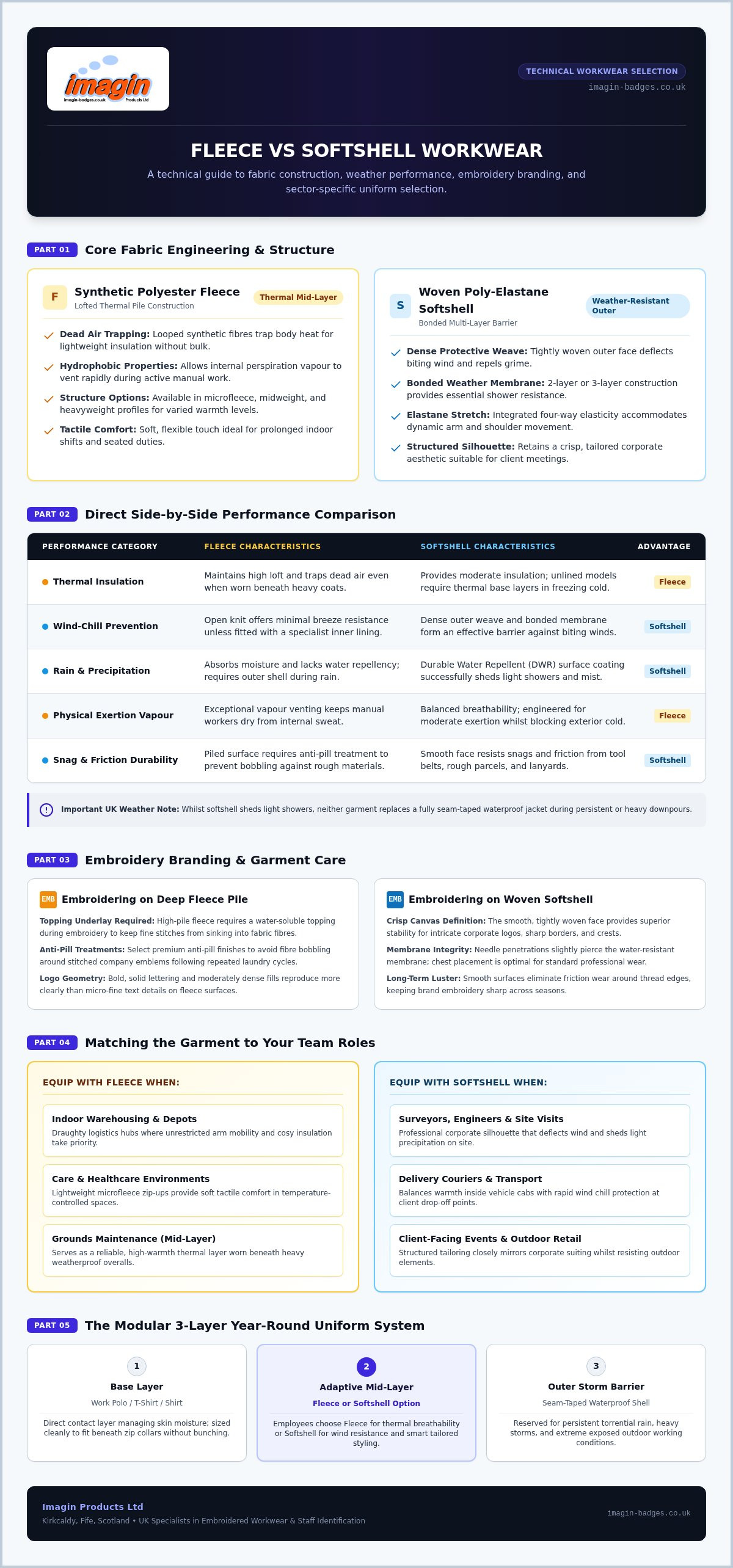
- A detailed side-by-side performance matrix comparing thermal retention, wind-chill prevention, and water resistance.
- Why fleece excels under an external shell but struggles as a standalone layer in brisk winds.
- How softshell functions as an accomplished standalone outer garment throughout changeable spring and autumn conditions.
- Breathability dynamics during high-exertion manual tasks versus stationary outdoor supervision.
Insulation and Temperature Regulation Across Both Styles
- Assess how fleece maintains loft and warmth even when worn under heavy overalls or coats.
- Explain why unlined softshell requires thermal base layers during freezing winter spells.
- Compare dry-time performance when garments become damp from internal perspiration or external mist.
Windproofing and Rain Resistance in Changing UK Climates
- Clarify that standard fleece offers minimal resistance to cold breezes unless lined with windproof material.
- Explain that durable water repellent (DWR) coatings are used on softshell to shed light showers.
- Remind readers that neither garment replaces a fully seam-taped waterproof jacket during persistent downpours.
Workplace Durability, Care, and Embroidery Branding
- Comparing abrasion resistance between smooth softshell surfaces and high-friction fleece piles.
- How fabric density affects logo embroidery precision, thread tension, and visual clarity.
- Washing routines and anti-pilling considerations to keep staff uniforms looking smart over time.
- Explore our dedicated custom branded workwear options designed for long-term team wear.
Custom Embroidery on Fleece vs Softshell Fabrics
- Why dense, stable softshell weaves provide a flat canvas for intricate corporate logos.
- Using topping underlay techniques when embroidering deep fleece piles to prevent stitches from sinking.
- Assessing whether embroidery needle penetrations affect the water resistance of softshell chest panels.
Long-Term Wear, Pilling, and Maintenance Routines
- Explain why premium anti-pill fleece treatments are essential to avoid bobbling after multiple washes.
- Review how snag-resistant softshell faces resist friction damage from rough tools, lanyards, or parcels.
- Provide straightforward wash care recommendations to preserve softshell water repellency and embroidery lustre.
Matching the Garment to Your Team: Practical Work Scenarios
- Indoor warehousing, assembly, and drafty depot environments: why fleece remains the top comfort choice.
- Client-facing trades, surveying, and mobile sales: how tailored softshell delivers a sharper corporate silhouette.
- Delivery couriers and transport workers: balancing cab warmth with wind protection at drop-off points.
- Check our collection of protective outerwear to equip various departmental roles seamlessly.
When to Equip Your Staff with Branded Fleece Jackets
- Select fleece for indoor distribution centres where unrestricted arm flexibility and cosy insulation matter most.
- Use fleece as an adaptable mid-layer beneath waterproof coats for outdoor grounds maintenance teams.
- Recommend lightweight microfleece zip-ups for healthcare staff and care workers in temperature-controlled environments.
When Softshell Jackets Represent the Smarter Investment
- Choose softshell for estimators, project managers, and engineers visiting active commercial construction sites.
- Equip outdoor retail or event personnel who require rain protection whilst maintaining a polished company image.
- Benefit from the clean, structured tailoring of softshell that closely mirrors formal corporate suiting.
How to Build a Cohesive Year-Round Uniform Strategy
- Establishing a modular three-layer uniform system combining base shirts, mid-layers, and outer weather barriers.
- Allowing hybrid choices where employees select either fleece or softshell depending on their daily workplace duties.
- Pairing outerwear with waterproof jackets for severe storms, alongside smart underlayers.
- Streamlining corporate apparel procurement with dependable nationwide UK production and consistent brand digitisation.
Layering Outerwear with Polos, Sweatshirts, and Shells
- Ensure comfortable collar clearance when layering zip jackets over embroidered work polos or shirts.
- Calculate sizing allowances so team members can comfortably wear fleeces over branded hoodies in winter.
- Incorporate high-visibility accessories or dedicated waterproof outer shells when site regulations require them.
Ordering Your Embroidered Team Jackets with Imagin Products
- Prepare your vector artwork or company logo files for our expert embroidery digitisation process.
- Evaluate fabric swatches and garment samples to finalise colour matching and sizing profiles.
- Place your order with confidence, supported by helpful guidance from our experienced UK production team.
FAQs
Is softshell warmer than fleece for everyday workwear?
Generally, fleece provides superior thermal insulation due to its loft, which traps air. Softshell, however, can be warmer in windy conditions as it offers some wind resistance.
Can you embroider company logos on both fleece and softshell jackets?
Yes, both fabrics can be embroidered. Softshell offers a smoother surface for intricate designs, while fleece may require specific techniques to ensure the logo stands out.
Is a softshell jacket completely waterproof in heavy rain?
A standard softshell jacket is typically shower-resistant but not fully waterproof. For heavy rain, a jacket with taped seams is recommended.
Will fleece jackets stop cold winds when working outdoors?
Standard fleece jackets offer minimal wind resistance unless they are lined with a windproof layer. They are best used as mid-layers under an outer shell in windy conditions.
How should we wash embroidered softshell and fleece uniforms to ensure longevity?
Always follow individual garment care labels. Generally, avoid fabric softeners and wash at lower temperatures to maintain the integrity of the fabric and embroidery.
Conclusion
In the debate of fleece vs softshell jackets, the right choice ultimately depends on your team's specific needs and working environment. Fleece excels in warmth and comfort, making it ideal for indoor use, whereas softshell offers versatile weather resistance and a polished appearance for client-facing roles. By understanding the distinct qualities of each fabric, you can make informed decisions that enhance your team's performance and presentation.