
Extending the Life of Embroidered Clothing: A Practical Guide

Could your washing routine affect an embroidered garment as much as the work you wear it for? If you’re unsure whether embroidery needs special treatment, or worry that washing, drying or ironing could disturb the stitching, start with the garment’s own care instructions. There isn’t one care routine that suits every fabric and use.
Extending the life of embroidered clothing means caring for the whole garment, not just its logo. The care label, how often you wear it and the conditions it faces all help shape a practical routine. This matters especially for workwear, which may need regular laundering while still looking presentable.
This guide explains what to review when washing, drying, ironing, wearing and storing embroidered clothes. You’ll learn how to follow the garment’s instructions, spot habits that may cause unnecessary wear and choose workwear suited to its intended use. With a few considered choices, it’s easier to care for the fabric and embroidery without making everyday workwear harder to manage.
Key Takeaways
- For extending the life of embroidered clothing, follow the care label rather than assuming every garment needs the same washing routine.
- Review how garments are handled, stored and rotated to help keep workwear presentable during regular use.
- Before replacing a garment, check its fabric, seams, fastenings, fit and care instructions against the demands of the job.
- Choose embroidered workwear to suit the tasks, wearing conditions and practical needs of the people who’ll wear it.
- Care can support continued wear, but neither a routine nor a garment choice guarantees a fixed lifespan.
What affects the life of embroidered clothing?
Garment longevity is how long clothing remains suitable and comfortable to wear, while embroidery appearance describes the condition of the stitched design. They’re related, but they’re not the same. A logo might still look neat when the fabric has thinned or a seam has started to open. Equally, the garment may remain wearable even if the embroidery has become loose or distorted.
Condition depends on what the garment is made for and how it’s used. A polo worn for light indoor duties faces different demands from a jacket worn outdoors or an apron used around spills. Repeated movement, contact with equipment, frequent handling and laundering all contribute to wear. Care instructions matter because suitable washing and drying methods depend on the garment and its embroidery. To interpret your labels, see GINETEX’s care-symbol guide. A numbered wash symbol shows the maximum temperature, not a temperature that must always be used.
Does embroidery change how you should care for clothing?
Embroidery can affect a garment’s care requirements. Follow the garment label alongside any additional instructions supplied by the embroiderer. Use a method suitable for both the garment and its decoration, and ask your supplier if the instructions conflict.
Which signs of wear should you look for?
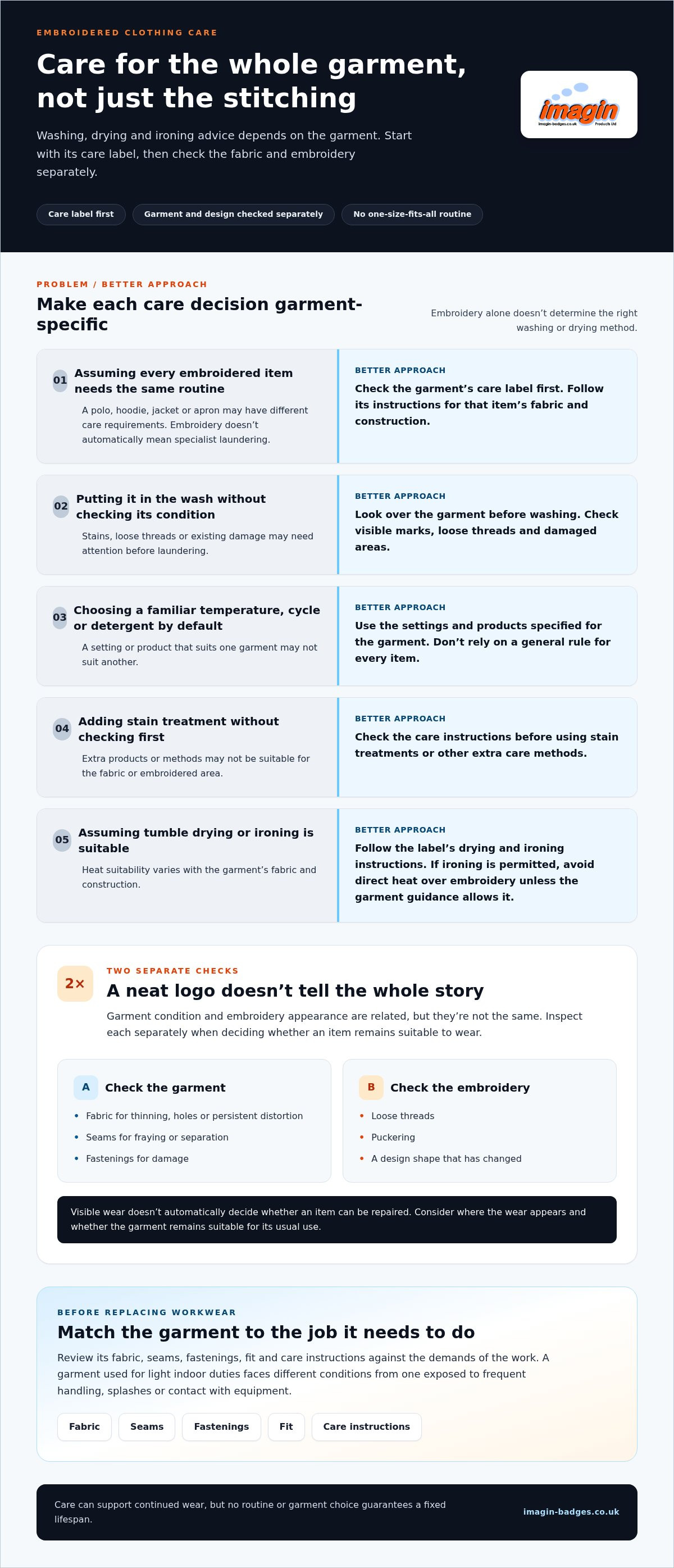
Inspect the garment and design separately. Check fabric for thinning, holes or persistent distortion, and look along seams for fraying or separation. Test fastenings for damage, then view the embroidery for loose threads, puckering or a shape that has changed. These signs don’t all mean the item can be repaired, but spotting them early helps you judge whether it’s still suitable for regular use.
For workwear, consider where wear appears and what the garment does during a typical shift. A damaged fastening may matter more on clothing that needs to stay closed, while weakened fabric at a high-contact area may affect comfort or suitability. Review visible changes as part of routine garment checks, especially when items are worn frequently. That gives you a clearer basis for deciding whether to keep using, set aside or replace a garment.
How should you wash and dry embroidered clothing?
Start with the garment’s care label, then check any care instructions for the finished embroidered garment, as a label may predate customisation. There isn’t one washing routine for every embroidered polo, hoodie, jacket or apron, because suitable settings and products depend on the garment and its decoration.
What should you check before washing embroidered clothing?
Before laundering, use this simple sequence:
- Read the care label. Check the stated washing instructions, including any limits or restrictions, and any instructions for the finished embroidered garment.
- Look over the garment. Check for stains, loose threads or damage that might need attention before washing.
- Choose suitable settings and products. A numbered wash symbol indicates the maximum temperature, not a temperature that must always be used. Don’t assume one detergent or cycle suits all embroidered clothing.
- Check before adding extra treatment. Check the garment and embroidery care guidance, then follow the cleaning product’s instructions and compatibility advice. Ask the supplier if you’re unsure.
This keeps the routine specific to the item. A recommendation that suits one fabric or construction might not suit another, so don’t rely on a general rule for every garment. If the label is unclear or missing, avoid guessing at a temperature or product; check the garment manufacturer’s care guidance where available.
How can drying and ironing affect a garment?
Heat suitability varies with fabric, embroidery and garment construction. Don’t assume that tumble drying is suitable, or that every item can be ironed. Check the care instructions for the finished embroidered garment, as the original label may predate customisation. Where ironing is permitted for both fabric and embroidery, iron on the reverse side or use a protective pressing cloth at an appropriate temperature, so direct heat doesn’t touch the embroidery.
Careful handling matters during these steps too. Avoid pulling at loose threads or forcing a garment into a drying method the label rules out. If a mark or damaged area remains after washing, review the instructions before repeating treatment or applying more heat. A cautious, label-led approach helps you avoid turning a small concern into additional wear.
For extending the life of embroidered clothing, consistency is more useful than a one-size-fits-all rule: read the label each time you’re unsure, and adapt the routine to the garment. If you’re selecting garments for regular team use, explore Imagin Products Ltd embroidered workwear and choose pieces to suit their intended tasks.
Which everyday habits help embroidered workwear stay presentable?
Workwear takes different kinds of wear depending on how often it’s worn and what the job involves. A garment used for desk-based duties may need a different day-to-day routine from one exposed to frequent handling, splashes or contact with equipment. Simple habits help you notice marks and wear early, keep clothing ready for use and make care more consistent across a team. They don’t guarantee a longer lifespan.
How should you handle stains and day-to-day wear?
Check the garment and embroidery care guidance, then follow the cleaning product’s instructions and compatibility advice. Ask the supplier if you’re unsure. Care labels generally cover washing, bleaching, drying, ironing and professional cleaning, not specific stain removers. Avoid experimenting with products or vigorous rubbing that could affect the fabric or stitching.
After a shift, check for marks, loose threads or damage before putting the garment away. That quick look helps you decide whether it needs cleaning or attention before it’s worn again. For the washing and drying steps, follow the care guidance in the previous section and the garment’s own label.
Does rotating and storing workwear make a difference?
Where a team has more than one suitable garment per wearer, rotation can spread use across those items rather than relying on the same piece each day. It doesn’t guarantee a particular result, but it can make it easier to keep a clean, ready-to-wear option available. Store garments clean and dry, in a way that suits their shape and construction, and avoid leaving damp clothing folded away.
Use this quick comparison to build a routine around the job and the garment’s instructions:
| Routine | Practical habit | Keep in mind |
|---|---|---|
| Handling | Check for marks or damage after use and handle the embroidered area without pulling loose threads. | Follow garment-specific guidance if cleaning or treatment is needed. |
| Stain response | Check the garment and embroidery care guidance, then follow the cleaning product’s instructions. | Don’t assume a stain remover or technique is suitable for every fabric or design; ask the supplier if unsure. |
| Storage and rotation | Put clean, dry garments away appropriately and rotate available workwear to suit wear frequency. | Storage and rotation support an organised routine, not a guaranteed lifespan. |
For more guidance, use the washing and drying advice above alongside each garment’s care label. If you’re selecting garments for your team’s day-to-day tasks, explore our embroidered workwear range.
How can you assess embroidered clothing before replacing it?
Look at the whole garment, not just the logo. A stitched design may need closer inspection even when the clothing is still wearable, while fabric or seam damage can make an item unsuitable for its task despite embroidery that looks tidy. Use the garment’s intended use and actual condition to decide whether to keep it in rotation, repair it or replace it.
What should a workwear durability checklist include?
Assess the garment against the work it needs to do. No single feature, including fabric weight, determines how long it will remain suitable. Consider:
- Fabric composition and weight: Compare these with the task and wearing conditions. A heavier fabric isn’t automatically the better choice if it doesn’t suit the work or wearer.
- Seams: Check for fraying, opening or strain, especially where the garment moves with the wearer.
- Reinforced areas: Look at reinforced sections, if present, and whether they remain in good condition where the garment experiences contact or pressure.
- Fastenings: Check that zips, buttons or other fastenings work as intended for the garment’s use.
- Fit: Consider whether the garment still allows the wearer to move comfortably and carry out their tasks.
- Care instructions: Check that the labelled washing and drying directions are practical for the team to follow consistently.
This checklist helps connect garment condition to real working demands rather than judging by appearance alone. A jacket used outdoors, for example, may need its fastenings and fit assessed in light of how it’s worn, while a frequently laundered top calls for particular attention to its fabric, seams and care guidance.
When might repair or replacement be the more practical choice?
Consider whether the issue affects fit, function or the standard of appearance needed for the role. A loose embroidery thread doesn’t necessarily mean the garment itself is worn out, just as smart-looking stitching doesn’t make damaged clothing suitable to wear. Inspect the fabric, seams, fastenings and embroidered area separately, then weigh their condition against the garment’s everyday purpose.
There’s no universal repair threshold. A minor fault might matter little for one use but affect the comfort or function required for another. If damage compromises how the garment fits or works, replacement may be more practical. If the garment remains fit for its task and the concern is limited to the design, assess that separately before deciding. This whole-garment approach supports extending the life of embroidered clothing without assuming that every item can or should be kept in use.
How can you choose embroidered workwear that suits its use?
Start with the work, then choose the garment. Consider the tasks people do, how often they’ll wear each item, the conditions they’ll work in and what feels practical for the wearer. A suitable choice makes it easier to follow care instructions and keep the team comfortably dressed, though neither garment choice nor careful maintenance guarantees a fixed lifespan.
Which garment type suits your team’s day-to-day work?
Think about function rather than assuming one style is more durable than another. T-shirts and polos may suit lighter everyday workwear, while hoodies can be useful where an extra layer is practical. Jackets may fit outdoor duties or changing conditions. Aprons suit tasks where an outer layer is useful, but should be chosen for the work they’ll be used for. Fit, ease of movement and care instructions all matter alongside appearance.
Before deciding, consider what the garment needs to do through a typical working day. Will staff be moving frequently, working indoors or outdoors, or changing layers as conditions shift? Does the item need to fit comfortably over other clothing? These details help narrow the choice without relying on fabric weight alone as a measure of suitability.
What should you consider before ordering embroidered workwear?
Settle the practical details before placing an order: garment type, intended use, wearer sizes and logo placement. Think about how the placement will look during normal wear and whether it suits the garment’s shape. For clothing used as protective equipment, follow the manufacturer’s branding instructions and make sure the embroidery doesn’t interfere with its protective performance.
Care requirements deserve attention at the selection stage too. Check that the garment’s washing instructions fit the routine your team can follow. This supports extending the life of embroidered clothing by making care manageable, but doesn’t promise a particular number of wears or years.
At Imagin Products, our embroidered workwear range includes T-shirts, polos, hoodies, sweatshirts, jackets and aprons. Clothing orders are generally dispatched within 10 working days. Timing depends on stock availability, artwork approval and production schedules, and delivery time is additional. If you have a deadline, contact us before ordering. Our team can help you talk through garment choices and logo placement, with real people rather than machines.
Explore our embroidered workwear range to find garments suited to your team’s day-to-day work.
Choose workwear with care and confidence
Extending the life of embroidered clothing starts with a practical routine: follow each garment’s care label, notice signs of wear early and assess the fabric and stitching separately. When choosing workwear, match the garment to its tasks, wearing conditions and the needs of the people who’ll wear it. Good care and a suitable choice support continued use, but neither guarantees a fixed lifespan.
Imagin’s embroidered workwear range includes T-shirts, polos, hoodies, jackets and aprons. Our team offers real customer service, so you can speak to staff rather than machines when shaping your workwear choices. With the right garment and a care routine that suits it, you can make considered decisions for your team’s day-to-day wear.
Frequently Asked Questions
Can embroidered clothing go in a washing machine?
Yes, if the care instructions for the finished embroidered garment permit machine washing. Check the garment label and any embroiderer instructions, as the label may predate customisation. A numbered wash symbol shows the maximum temperature, not a mandatory one. If the instructions specify hand washing or other restrictions, follow them rather than treating the embroidery as permission to use a particular cycle.
How do you wash embroidered clothing without damaging the stitching?
Begin by reading the care label and any instructions for the finished embroidered garment. Check for marks, loose threads or damage before laundering. For stains, check the garment and embroidery care guidance, then follow the cleaning product’s instructions and compatibility advice. Ask the supplier if you’re unsure. Avoid pulling at the embroidery, and don’t assume that one detergent or setting suits every garment.
Can you tumble dry embroidered workwear?
Only if the care instructions for the finished embroidered garment permit tumble drying. The original label may predate customisation, so check it alongside any embroiderer instructions. Suitability depends on the fabric, construction and embroidery. If the instructions rule out tumble drying or give a different method, follow that guidance.
Should you iron directly over embroidered clothing?
Follow the care instructions for the finished embroidered garment. Where ironing is permitted for both fabric and embroidery, iron on the reverse side or use a protective pressing cloth at an appropriate temperature, so direct heat doesn’t touch the embroidery. If the instructions don’t clearly explain how to treat the embroidered area, ask your supplier before applying heat.
Does embroidery make clothing last longer?
No. Embroidery doesn’t guarantee that a garment will last longer. Clothing condition depends on factors such as its fabric, seams, fastenings, how it’s worn and how it’s cared for. Assess the garment and its stitched design separately: embroidery might remain presentable when the fabric is worn, or the garment may still be wearable when the stitching needs attention. Neither appearance alone determines the item’s overall suitability.
When should embroidered workwear be replaced?
Consider replacement when damage affects the garment’s fit, function or suitability for its everyday task. Inspect the fabric, seams and fastenings as well as the embroidery, since a tidy logo doesn’t mean worn clothing remains practical. A loose thread doesn’t automatically mean the whole garment needs replacing, either. The decision depends on the type and extent of wear, the garment’s use and whether it remains fit for that purpose.

Article by
Team Imagin :)
Team Imagin helps businesses look their best with quality name badges, photo ID cards, lanyards and branded workwear. Based in Kirkcaldy, Scotland, we combine friendly, personal service with professional printing and embroidery to bring your branding to life. From small teams to large organisations across Scotland, the UK, Europe and America, we help you boost your brand and build connections.
Disclaimer
This article provides general guidance only. Information was correct to the best of our knowledge when published, but product details, prices and regulations may change. Check current specifications and official guidance before making decisions.