
Durable Workwear for Manual Labour: How to Choose the Right Kit

The toughest-looking garment isn’t automatically the right choice. Durable workwear for manual labour needs to suit the task, the working conditions and the care instructions, while remaining comfortable enough to wear for a full shift. A hard-wearing fabric won’t make a garment suitable if it restricts movement or lacks protection the job requires.
Comparing garments can be difficult when product details are incomplete. Before ordering, check the manufacturer’s information on fit, construction, intended use and care. If you’re adding a logo, confirm that the branding method, size and placement follow the garment manufacturer’s instructions and preserve any required protective performance.
This guide explains how to compare workwear for different tasks and what to consider when hi-vis or other protective clothing guidance applies. If an employer’s risk assessment identifies PPE as necessary, it must be provided free of charge and doesn’t replace other necessary risk controls. These checks can help you choose practical workwear and make informed personalisation decisions.
Key Takeaways
- Choose durable workwear for manual labour by matching each garment to the tasks, conditions and care routine, rather than relying on its category name.
- Compare garment-specific information about construction, intended use, fit and care before deciding what to order.
- Use the job to narrow down options such as trousers, coveralls, tops and outerwear, then check the details for each garment.
- Before adding a logo, confirm that the artwork, branding method, size and placement suit the garment and preserve any required protective performance.
- Check sizes, garment details, artwork and deadlines before ordering. Our team offers real customer service, so you can talk to us rather than machines.
What makes workwear durable for manual labour?
Durable workwear for manual labour is clothing suited to the wearer’s tasks, working conditions and care routine, not a garment with a guaranteed lifespan. How long it remains useful depends on how it’s worn, the conditions it faces and how it’s cared for. Without product evidence and knowledge of the job, a claim that a garment will last for a particular length of time is only a promise.
There isn’t one garment that suits every manual job. Someone who spends much of the day kneeling has different requirements from someone who regularly reaches overhead or works outdoors. Treat “workwear” as a broad category, not proof that a garment has a particular strength, weather resistance or protective function. Imagin’s workwear collection includes different garment types. Check the specific item’s details against the work it needs to support.
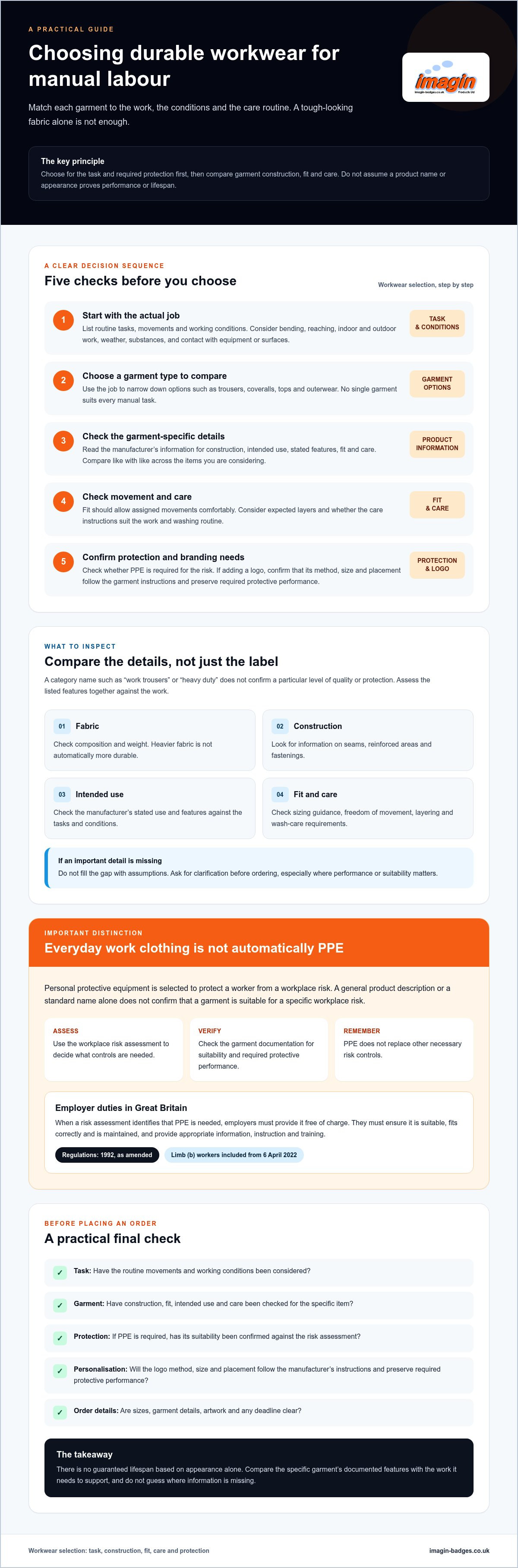
Everyday work clothing and personal protective equipment (PPE) aren’t interchangeable terms. PPE is selected to protect a worker from a workplace risk. HSE guidance on PPE covers employers’ responsibilities for selecting and using protective equipment, but a general description doesn’t establish whether a particular item is suitable for your workplace.
Which working conditions should shape your choice?
Start with the job, not a general impression that a garment looks hard-wearing. List the routine tasks and movements, exposure to weather or substances, and likely contact with equipment or surfaces. Note practical requirements such as bending, reaching or moving between indoor and outdoor work. This gives you a clearer basis for comparing garments than a broad label such as “heavy duty”.
Separate confirmed requirements from assumptions. Don’t infer abrasion resistance, weather protection or other performance from a product name or appearance. Check the garment’s product information for its intended use and stated features, then decide whether those details match the tasks. If the information doesn’t answer an important question, ask for clarification before ordering.
When is workwear also personal protective equipment?
Legal duty in Great Britain: under the Personal Protective Equipment at Work Regulations 1992, as amended, employers must provide required PPE free of charge when a risk assessment identifies that it’s needed. The duties were extended on 6 April 2022 to include limb (b) workers. Employers must ensure PPE is suitable, fits correctly, is maintained, and that workers receive appropriate information, instruction and training.
Official guidance and standards: HSE guidance for employers on PPE helps explain these duties, while a relevant standard may describe requirements for a type of protective garment. Neither a general product description nor a standard name alone confirms that an item suits a specific risk. Check the garment’s documentation.
Applying the duty: use the workplace risk assessment to decide what controls are needed. PPE isn’t a substitute for other necessary risk controls. Where clothing is protective, verify its suitability before treating it as PPE or workwear for the task.
How to assess workwear construction, fit and care
Compare details for each garment rather than treating a label such as “work trousers” or “jacket” as evidence of quality. For durable workwear for manual labour, check the manufacturer’s information against this objective checklist:
- Fabric weight and composition: heavier fabrics can suit abrasive tasks, but check the stated weight and fibre content against the job rather than assuming it indicates overall quality.
- Seam construction: reinforced or double-stitched seams are relevant where a garment is regularly stretched, knelt on or subject to friction.
- Reinforced areas: check for reinforcement at knees, elbows or other points that meet the demands of the specific task, such as kneeling or crawling.
- Fastenings: confirm the fastening type (zips, poppers, hook-and-loop) suits the task, including use with gloves or in wet conditions.
- Care instructions: check wash and drying requirements against how often the garment will need cleaning in your working environment.
A heavier fabric isn’t automatically more durable: assess how these features work together for the tasks and washing routine. If the product description doesn’t provide those details, don’t fill the gaps with assumptions about performance or how long the item will last.
What garment details are worth checking before ordering?
Read the manufacturer’s description for stated materials, construction features and intended use. Check the care instructions and consider whether they fit your work routine. If the garment will need frequent washing, understand its care requirements before choosing it. Missing information isn’t proof of any particular performance. Ask the supplier to clarify details that matter to the job, and compare like with like across the specific garments you’re considering.
How should fit and layering affect your choice?
Choose a fit that lets the wearer carry out assigned movements comfortably, without clothing getting in the way. Consider bending, reaching and any layers the worker is expected to wear. Check the sizing guidance for each garment rather than assuming the same size will fit consistently across styles or wearers. For protective clothing, confirm that the fit, including any layers worn beneath it, doesn’t undermine its intended protective function.
Construction details are useful for comparing garments only when they’re documented for the item. Look for specific stated features, then consider whether the care guidance is realistic for day-to-day use. If the details are unclear, ask before ordering instead of relying on an assumption about performance.
For protective garments, check the manufacturer’s instructions and relevant Great Britain workplace guidance before making decisions about fit or use. The HSE guidance for employers on PPE explains employer responsibilities for selecting suitable PPE, maintaining it and providing workers with appropriate information, instruction and training.
Imagin Products offers workwear with embroidery or full-colour printing. Explore our workwear collection and check the details of each item before deciding whether it suits your team’s tasks and care routine.
Which workwear type suits different manual jobs?
Choose a garment category by considering the tasks, movement and coverage the wearer needs. Trousers, coveralls, tops and outerwear are categories to compare, but their names alone don’t establish suitability or protective properties. Imagin’s workwear offering includes T-shirts, polo shirts, hoodies, sweatshirts, jackets, aprons, trousers, coveralls and hi-vis safety wear. Check the product information for the specific item rather than assuming every garment is suitable for every job.
| Garment category | Questions to investigate |
|---|---|
| Trousers | Does the selected item’s product information describe a fit and design suited to the tasks and movements? |
| Coveralls | Does the specific item provide the coverage required? Check intended use, sizing information and care details. |
| Tops | Will the selected top allow the wearer to move comfortably? Check the item’s fit guidance and stated use. |
| Outerwear | What use does the manufacturer state? Check how the garment is intended to fit over any layers worn for the job. |
Use these questions as comparison prompts, not performance rankings. Don’t assume a garment protects against a hazard because it covers part of the body or looks substantial. Match documented features to the employer’s requirements, and ask the supplier to clarify important information that isn’t published. The Health and Safety Executive’s Good handling technique guidance is a useful reference when considering whether clothing allows the wearer to move as the work requires.
When might trousers, coveralls or tops be relevant?
These categories offer different approaches to coverage, but the task and wearer’s needs should guide the choice. A category isn’t evidence that a garment is suitable for a particular hazard. For each item, check its product description for design, fit and care information. Imagin’s branded workwear options include garments such as polo shirts, T-shirts, hoodies, sweatshirts, jackets, aprons, trousers and coveralls.
Consider the wearer’s routine as well as the garment category. Think about the movements involved, the coverage needed and how the garment will be cared for. Then compare the published details for the specific items that meet those requirements. If a key feature isn’t described, seek clarification instead of treating the category name as a guarantee.
What should you verify when choosing hi-vis workwear?
First establish whether high-visibility clothing is required for the job, then check the documentation for the specific garment. Where the product documentation states certification to EN ISO 20471, check the certified class and any conditions attached to it; certification classes may vary by garment size and colour, so verify this against the manufacturer's documentation rather than a general product listing. Don’t infer certification, class or suitability from a general category description. Check the specific product information before relying on an item for a protective purpose.
How branding and PPE requirements affect workwear choices
Adding a logo is part of choosing workwear, but it shouldn’t be considered separately from the garment’s purpose. For everyday clothing, weigh the garment type, artwork, design size, colour detail, placement and intended use. For protective clothing, first check whether the proposed branding is permitted and whether it preserves the garment’s protective performance. This makes sure branding complements the workwear rather than compromising its purpose.
How do you choose between embroidery and full-colour printing?
Imagin Products offers embroidery and full-colour printing for workwear. Neither method is automatically right for every garment or design. Consider whether your artwork has fine detail or several colours, how large it needs to appear, where it will sit and how the garment will be used. Then confirm that the selected method, design size and position are available for the specific garment. Don’t assume a method is suitable for protective clothing until it’s been checked.
What should employers check before modifying protective clothing?
Before approving branding on protective workwear, branding must follow the garment manufacturer’s instructions, confirming the proposed method, size and position are allowed. Reflective tape must not be obscured, and visible fluorescent material must remain compliant with the garment’s certified class. A logo placement that looks clear isn’t evidence that the garment remains suitable for its protective purpose.
Legal duty: under the Personal Protective Equipment at Work Regulations 1992, as amended (including the 6 April 2022 extension to limb (b) workers), where a risk assessment identifies PPE as necessary, employers must provide it free of charge, ensure it's maintained appropriately, and ensure workers receive suitable information, instruction and training. PPE is not a substitute for other necessary risk controls. Read the HSE guidance for employers on PPE, and check the documentation for the individual garment rather than relying on general claims about a product category.
Before placing a branded workwear order, confirm the garment, artwork, personalisation method, design size and position. If it’s protective clothing, get confirmation that the proposed branding follows the manufacturer’s instructions and preserves its required performance.
A practical checklist for ordering durable branded workwear
A clear brief makes it easier to compare suitable garments and confirm branding details before you order. For durable workwear for manual labour, work through the job requirements first, then check each garment, its personalisation options and the order details. This also helps you spot questions that need answering before you approve the order.
What should you prepare before requesting branded workwear?
Bring together information that will help a supplier understand your request. Include the intended tasks, wearer requirements, garment categories and any protective clothing requirements identified by your workplace risk assessment. Have your logo artwork ready, and note your preferred branding method and placement.
- List the tasks and movements the clothing needs to accommodate.
- Note the garment types and quantities you want to enquire about.
- Identify any product specifications or care details that need clarification.
- Share your artwork and preferred branding method, size and position.
- Flag whether protective performance needs to be preserved.
What should you confirm with your workwear supplier?
Before placing an order, check that the selected garments and personalisation options meet your brief. Confirm sizes, garment-specific details, artwork requirements and any deadline. If protective clothing is involved, make sure the proposed branding follows the manufacturer’s instructions and doesn’t compromise the garment’s protective performance.
- Confirm garment availability and the details of each item in your order.
- Check the available branding method, artwork size and placement for each garment.
- Review quantities, sizes and other order details before approving them.
- Ask about quantity pricing for your chosen garments.
- Confirm the current dispatch estimate for your branded workwear order, particularly if you have a deadline, and note that delivery time is additional to dispatch.
Dispatch and delivery are separate stages. The 2–4 day window refers to order dispatch, not final delivery; delivery times are additional and should be confirmed separately for your individual order, particularly if you have a deadline.
Choose workwear with confidence
Choosing durable workwear for manual labour starts with the job, not a promise about how long a garment will last. Match the garment’s stated construction, fit and care instructions to the tasks and working conditions. If product details are missing, ask for clarification before ordering rather than assuming the garment has a particular feature.
For protective clothing, follow workplace requirements and check the individual garment’s documentation. Before adding a logo, confirm that the branding method, size and placement are permitted and won’t affect protective performance. These checks help you make a considered choice for both the wearer and the work.
Imagin Products offers workwear with embroidery or full-colour printing. The right option depends on your garment and design.
With your requirements clear, you’re ready to choose workwear that fits the task and bring your team’s branding together with confidence.
Frequently Asked Questions
How do I choose workwear for different manual tasks?
Start by identifying the tasks, movements and working conditions. Establish whether the risk assessment requires PPE, then compare relevant garment categories and check fit and product information. Trousers, coveralls, tops and outerwear offer different coverage options, but their category alone doesn’t confirm suitability for a task or hazard. Review the manufacturer’s details for each item, including intended use, sizing guidance and care instructions, before deciding what to order.
Is hi-vis workwear suitable for every manual job?
No. Whether high-visibility clothing is required depends on the workplace risk assessment and applicable requirements. Check the documentation for the specific garment, including its intended use and any certification details relevant to the task. Don’t assume every hi-vis garment, colour, size or class has the same certification or provides the same level of visibility. If the information is unclear, seek clarification before relying on the garment for a safety purpose.
Can you embroider logos onto protective workwear?
It depends on the specific garment and its manufacturer’s instructions. Branding must follow the manufacturer's instructions, confirming the approved logo size and placement. Reflective tape must not be obscured, and visible fluorescent material must remain compliant with the garment's certified class. Don’t assume embroidery is suitable for every protective garment. If the instructions don’t answer your questions, ask the supplier or manufacturer before proceeding with the branding.
What should I check before ordering branded workwear?
Confirm the tasks, garment type, wearer sizes and product details, then agree the artwork, branding method and placement. For protective clothing, check the manufacturer’s instructions and garment documentation before approving branding. Confirm order details with your supplier, including availability and any deadline. The 2–4 day estimate refers to dispatch, not delivery; delivery times are additional, so confirm the current dispatch estimate for your branded workwear order if you have a deadline.
Does branded workwear count as PPE?
Not automatically. Adding a logo to standard clothing does not turn it into PPE. PPE status depends on the garment being selected and documented as suitable for controlling the relevant workplace risk. Existing PPE can retain its compliance when customised in accordance with the manufacturer's specifications, without compromising its protective performance. Where a risk assessment identifies PPE as necessary, employers must provide it free of charge and ensure appropriate maintenance and training; this duty extends to limb (b) workers following the 2022 amendment. PPE is not a substitute for other necessary risk controls. See the HSE guidance for employers on PPE for further information. To discuss garment and branding options, explore our workwear collection.

Article by
Team Imagin :)
Team Imagin helps businesses look their best with quality name badges, photo ID cards, lanyards and branded workwear. Based in Kirkcaldy, Scotland, we combine friendly, personal service with professional printing and embroidery to bring your branding to life. From small teams to large organisations across Scotland, the UK, Europe and America, we help you boost your brand and build connections.
Disclaimer
This article provides general guidance only. Information was correct to the best of our knowledge when published, but product details, prices and regulations may change. Check current specifications and official guidance before making decisions.