
Choosing Workwear Fabrics: A Practical Guide for Your Team

The fabric with the most appealing name isn’t necessarily the right one for your team. Choosing workwear fabrics means looking beyond material labels to how a garment needs to perform during the working day.
Terms such as fabric weight, stretch and care instructions don’t always make it clear how a garment will feel or suit daily tasks. The best choice depends on the work, the environment, comfort needs and garment type, as well as how you plan to add your logo.
This guide helps you compare those factors and narrow down suitable options. You’ll find practical checks for different garments, working conditions and branding methods, plus a checklist to use before ordering.
Key Takeaways
- Start with your team’s tasks, working environment and wear patterns before comparing fabric options.
- Compare the product information for cotton, polyester and blended fabrics. Fibre names alone don’t tell you how a garment will feel or perform.
- Assess comfort, movement, layering and care separately for each role.
- Check garment information and branding requirements before deciding between embroidery and full-colour printing.
- Record your team’s needs in a simple checklist, then compare garments against those criteria.
Choosing workwear fabrics starts with the job your team does
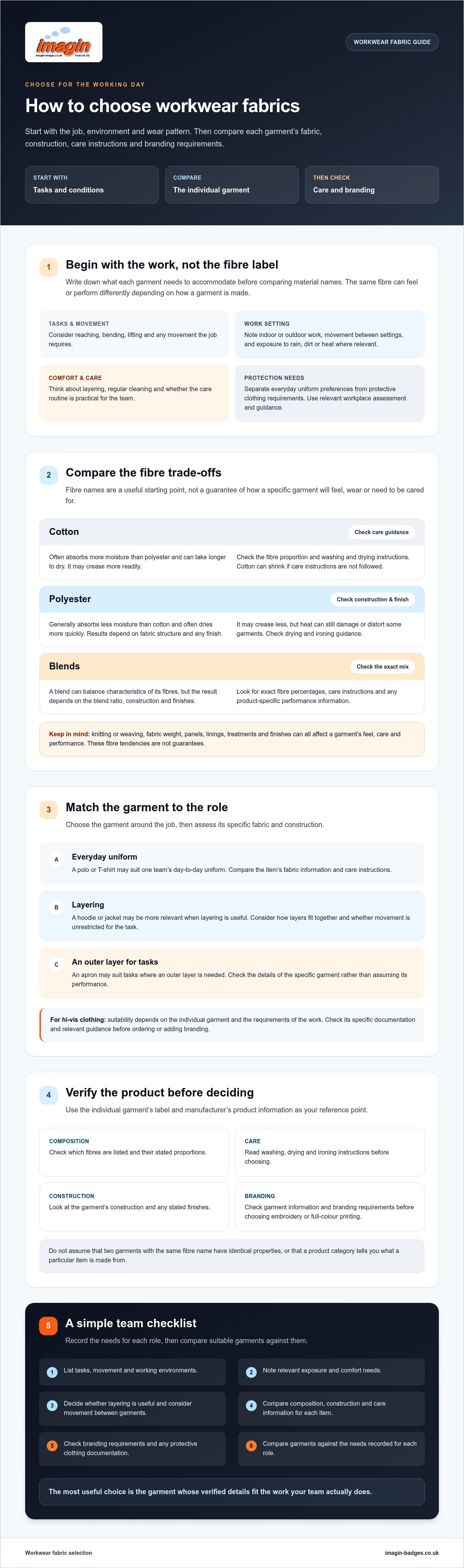
Start with the tasks, working environment and wear patterns your team faces. Then compare the fabric information for garments that suit those needs. Choosing workwear fabrics is only part of the decision: garment construction and intended use matter too. The same fibre can feel or perform differently depending on how a garment is made.
Workwear has long been shaped by the needs of particular jobs. For a practical choice today, focus on what your team needs its uniform to do, then use the workwear checklist to compare suitable garments.
What should you assess before choosing a workwear fabric?
Write down the conditions each garment needs to accommodate before comparing material names. Consider whether staff work indoors, outdoors or in both settings. Note whether their tasks involve frequent reaching, bending or lifting, or contact with equipment and surfaces. Record exposure to rain, dirt, heat or other workplace conditions where relevant, along with comfort needs during a typical shift.
- Tasks and movement: Identify the actions the garment must allow without getting in the way.
- Exposure: Record the conditions staff encounter and whether they move between different environments.
- Comfort and care: Consider layering, how often garments need cleaning and whether your team can follow the care instructions.
- Protection: Separate everyday uniform preferences from protective clothing requirements. If protection is needed, use the relevant workplace assessment and guidance rather than choosing by fabric description alone.
How should you verify garment information?
Check the individual garment’s label and manufacturer’s product information for its composition, care instructions, construction and any stated performance. Use this information as the reference point for choosing and caring for the item. Don’t assume that two garments with the same fibre name have identical properties, or that a product category tells you what a particular item is made from.
How do garment type and workplace affect fabric choice?
Choose the garment around the job, then assess its specific fabric and construction. A polo or T-shirt may suit one team’s day-to-day uniform, while a hoodie or jacket may be more relevant when layering is useful. An apron may suit tasks where an outer layer is needed. These examples don’t guarantee a particular comfort level or performance, so check the information for each garment.
Work setting affects what to prioritise. Staff moving between indoor and outdoor spaces may need a different combination of garments from a team working in one setting. Consider how layers will fit together, whether the garment allows the movement needed for the job and whether its care routine is practical for regular use.
For hi-vis clothing, suitability depends on the individual garment and the requirements of the work. Check its specific documentation and relevant guidance before ordering or adding branding. Our branded workwear range includes options for different team needs, but product details should guide your choice.
Cotton, polyester and blended fabrics: compare the trade-offs
Cotton, polyester and blends tell you which fibres are present, but the names alone don’t establish how a particular garment will feel, wear or need to be cared for. Compare the information provided for each item rather than assuming one fibre has a universal advantage.
| Fibre description | Practical characteristics to compare | What to check |
|---|---|---|
| Cotton | Often absorbs more moisture than polyester and can therefore take longer to dry. It may crease more readily and can shrink if the care instructions are not followed. | Whether it is the only listed fibre or part of a blend, its stated proportion, the washing and drying instructions, and whether the construction or finish changes its expected feel or performance. |
| Polyester | Generally absorbs less moisture than cotton and often dries more quickly, but the result depends on the fabric structure and any wicking, brushed or other finish. It may crease less, although heat can still damage or distort some garments. | Its stated proportion, the garment’s construction, drying and ironing guidance, and any manufacturer-provided information relevant to your team’s use. |
| Blends | Can balance characteristics of the listed fibres, but the moisture response, drying time, creasing and shrinkage depend on the blend ratio, construction and finishes rather than the word “blend” alone. | The exact fibre percentages, care instructions and product-specific information, including any stated finish or performance claim. |
These are practical tendencies, not guarantees. Knitting or weaving, fabric weight, garment panels, linings, treatments and finishes can all affect moisture management, drying, creasing, shrinkage, durability and care. Follow the instructions for the specific finished garment.
Fibre composition identifies the fibres and proportions present. Fabric construction describes how fibres or yarns are formed into a textile, for example through knitting or weaving. Both are different from the finished garment’s design and construction. Check the product information for each, along with intended use and care guidance, before comparing options.
What can cotton offer in workwear?
The word “cotton” tells you about fibre content, not the full character of a garment. Product information may show whether cotton is the sole listed fibre or part of a blend, but it doesn’t establish comfort, durability or care requirements by itself. Check the stated composition and washing instructions for the specific item, then consider its construction and intended use before deciding if it suits your team.
When might polyester or a fabric blend be worth comparing?
Compare polyester and blended options by checking their exact fibre proportions and the manufacturer’s information for each garment. A fibre name or blend ratio alone doesn’t confirm how the finished item will suit a particular task. If clothing is needed for protection against a workplace hazard, use the relevant product documentation and official HSE guidance for employers on PPE.
For branded garments, review the available product details before choosing. You can explore Imagin Products’ workwear collection and check the information provided for each item.
Match workwear fabric to comfort, care and branding needs
There isn’t one fabric that suits every team. Compare comfort, movement, layering and care as separate requirements, then check how the chosen garment can be personalised. The fabric name alone won’t tell you whether the garment is comfortable for a particular task or whether its decoration and care instructions fit your routine.
How should comfort and garment care affect the choice?
Think about how staff move throughout a shift, what they wear underneath or over the garment, and how its fit works for their tasks. A uniform worn on its own may need different qualities from a layer used with a jacket. Check the specific item’s care instructions before ordering, especially if several people will be responsible for washing it. Don’t assume garments made from similar fibres have the same care requirements.
For everyday uniform options, compare the actual product details for T-shirts and polos. The right choice depends on your team’s work and preferences, not a universal ranking of fabric types.
What should you check before adding a logo?
Confirm which branding method is available for the selected garment, and consider the artwork’s size, detail and position. A large design or fine detail may call for a different approach from a small, simple logo. Imagin Products offers embroidery and full-colour printing, but suitability depends on the garment and design. Check the product information and agree the placement and method before placing an order.
Follow the garment’s care instructions after personalisation and confirm the manufacturer’s decoration guidelines for the chosen item. For hi-vis or other protective clothing, use only a method, size and position that preserve the required fluorescent areas and the documented certification class, where applicable. Keep reflective tape unobstructed and do not add branding in a way that compromises the garment’s required protective performance.
If you’re weighing up garment and branding options, you can explore Imagin Products. Our team offers real customer service, so you can talk to us rather than machines if you need help confirming product details.
Use a simple checklist to choose fabric for each team
A short written brief makes choosing workwear fabrics easier across different roles. Record what each garment needs to do before comparing products. This keeps the decision focused on the job rather than a guess based on material names.
- Task: Note the wearer’s main duties and the movements the garment must allow.
- Environment: Record whether the work is indoors, outdoors or across both, and note relevant exposure or workplace conditions.
- Garment: Decide what type of clothing is needed, such as a polo, T-shirt, jacket or apron, and whether it’ll be worn alone or in layers.
- Fabric evidence: Check the exact product’s composition and any manufacturer-stated properties. Don’t infer these from the garment type or a general fibre description.
- Branding: Confirm which decoration methods suit that garment, and agree the logo’s size and position.
- Care: Review the garment’s care instructions and consider whether they fit your team’s routine.
Which questions should a workwear buyer ask?
For each role, ask what work the garment will be used for and what conditions the wearer faces. Then check the exact product’s composition, care information and branding options. If the garment is intended to protect against a hazard, confirm its suitability using the relevant manufacturer documentation and HSE guidance, or seek advice from a competent source. Keep separate requirements for different roles rather than assuming one garment will suit everyone.
What extra checks apply to hi-vis or other protective clothing?
Hi-vis suitability depends on the specific garment and the work it’s needed for. Where the product documentation confirms it, check for the relevant standard, such as EN ISO 20471, and the stated garment class. Do not assume that every garment, colour, size or class has the same certification. You can browse the hi-vis workwear category as a starting point, but verify the individual product documentation before ordering or adding branding.
Choose branded workwear with clear garment information
Once you’ve identified what each role needs, compare the garments and personalisation options. Imagin Products supplies workwear with embroidery or full-colour printing, giving you different ways to add your organisation’s logo. The right option depends on the garment, artwork and intended use, so confirm the details for the specific item rather than assuming one method suits every fabric.
Our branded workwear collection includes garments for different team requirements. Use the product information to check whether an option fits your brief, then confirm any details you need before ordering.
What product details should you confirm before ordering?
Check the individual garment’s composition, available sizes and care information. Confirm which personalisation options are available for that item, and agree the logo artwork, size and placement. If you’re comparing garments for several roles, keep these details alongside each role’s requirements so you can see which product meets which need.
- Garment: Confirm the product and sizes you need for your team.
- Fabric and care: Check the stated composition and the manufacturer’s care instructions for that exact garment.
- Branding: Confirm the available method, artwork requirements and logo position before production.
- Quantity and timing: Ask us about your order quantity, as quantity discounts vary depending on the garments chosen and do not apply uniformly across all workwear. Branded workwear is generally dispatched within 10 working days. Dispatch is when the order leaves us; delivery is separate and depends on the delivery service and destination, so contact us to confirm the current estimate if you have a deadline.
How can Imagin Products help with your workwear choice?
Share the garment you’re considering, your logo artwork and any requirements for sizes, care or timing. Our team provides real customer service, so you can talk to us rather than machines while confirming product and personalisation details. We can help you work through the available options, but technical or PPE decisions should be based on the manufacturer’s documentation and relevant professional guidance.
Choosing workwear fabrics with confidence means checking the specific garment, not relying on a fibre label alone. If you have a deadline, allow for branded workwear to be generally dispatched within 10 working days and remember that delivery takes place after dispatch; contact us to confirm the current estimate before placing your order.
Choose workwear that fits the way your team works
Choosing workwear fabrics is easier when you start with the job, working conditions and how each garment will be worn and cared for. Compare the product’s stated composition and instructions rather than relying on fibre names alone. The right choice also depends on garment type, comfort and the branding you want.
Before ordering, confirm the exact garment, its available sizes, care information and personalisation options. Imagin Products offers workwear with embroidery or full-colour printing. The suitable method depends on the garment and artwork, so check what’s available for your chosen item. If you’re considering protective clothing, confirm its suitability and any branding requirements against the manufacturer’s guidance.
Our team provides real customer service, so you can talk to us rather than machines while checking garment and branding details. Bring your requirements and artwork together to help choose workwear that’s practical for your team and consistent with your organisation’s identity.
With clear information and a considered brief, you can choose a uniform that fits your team’s work and branding needs.
Frequently Asked Questions
How do I choose the right fabric for workwear?
Start with the tasks, working environment and movement the garment needs to accommodate. Then choose a suitable garment type and compare its stated composition, construction, care instructions and branding options. Choosing workwear fabrics is a product-by-product decision, so don’t assume a fibre name guarantees particular comfort or performance. If clothing needs to protect against a workplace hazard, confirm the requirements using relevant guidance and the manufacturer’s information.
Is cotton or polyester better for workwear?
Neither is automatically better for every team or task. Compare the composition and manufacturer’s information for the exact garments you’re considering, then check how their construction, fit and care instructions suit your requirements. Fibre names alone don’t establish comfort, durability or maintenance needs. If a product’s information doesn’t answer an important question, ask the supplier or manufacturer for clarification before choosing.
Are blended fabrics suitable for branded workwear?
They may be suitable, but check the specific garment and its available decoration options before ordering. Review the blend’s stated fibre proportions and product information rather than relying on the word “blend”. Confirm that the proposed branding method and logo placement are appropriate for the item. For protective clothing, also follow the manufacturer’s instructions and make sure personalisation won’t compromise the garment’s required protective performance.
Can workwear fabric affect embroidery or printing?
The garment and its construction are among the factors to consider when confirming a branding method, alongside the artwork’s size, detail and position. Imagin Products offers embroidery and full-colour printing, but don’t assume either method is available or suitable for every item. Confirm the options for your chosen garment, agree the logo placement and check any care guidance after personalisation. Protective garments need additional checks to preserve their required performance.
What should I check when choosing hi-vis workwear?
Check the individual garment’s documentation and confirm it suits the work and relevant requirements. Where the documentation confirms it, verify the applicable standard, such as EN ISO 20471, and the stated garment class for that specific item. Don’t assume every garment, colour, size or class shares the same certification. For branding, follow the manufacturer’s decoration guidance and keep required fluorescent areas and reflective tape unobstructed.
How do I check the fabric composition of a workwear garment?
Use the exact garment’s product information and, where available, its label. Check the named fibres and their proportions rather than inferring composition from the garment type, product image or a similar item. The verification guidance above explains how to use this information alongside the manufacturer’s care instructions and stated properties.
Can I choose workwear fabric based on washing requirements?
Yes. Use your team’s care routine as one decision factor, then compare it with the care instructions for each specific garment. Check the stated washing and drying guidance before ordering, and consider whether it’s practical for the people responsible for looking after the workwear. Don’t assume similar fibre content means identical care requirements. For branded clothing, also confirm any relevant care guidance for the personalisation method used on that garment.

Article by
Team Imagin :)
Team Imagin helps businesses look their best with quality name badges, photo ID cards, lanyards and branded workwear. Based in Kirkcaldy, Scotland, we combine friendly, personal service with professional printing and embroidery to bring your branding to life. From small teams to large organisations across Scotland, the UK, Europe and America, we help you boost your brand and build connections.
Disclaimer
This article provides general guidance only. Information was correct to the best of our knowledge when published, but product details, prices and regulations may change. Check current specifications and official guidance before making decisions.