
Choosing the Right Lanyard: A UK Buying Guide

Choosing the correct lanyard for your Business and Industry. Your Complete Autumn 2026 Guide.
By Imagin Products Ltd
A lanyard might be a small part of your working day, but choosing the right one deserves more thought than simply picking a colour. It needs to hold the right identification, suit the person wearing it and work in the environment where it will be used.
For an office, that might mean a branded lanyard carrying a photo ID card. For a school reception, it could mean clearly distinguishing visitors from staff. For a conference, it might be about helping delegates find the organisers. In some working environments, the right answer may be a different way of displaying identification altogether.
As you review your supplies for autumn 2026, consider new starters, visitor arrangements, upcoming events and the extra clothing people will wear as temperatures fall. A lanyard that works with a summer polo shirt should also be considered alongside a fleece or jacket.
At Imagin Products Ltd, our range includes plain, STAFF, VISITOR and personalised lanyards. This guide explains the differences and helps you choose a practical combination of lanyard, card and holder for your business.
Start with the job your lanyard needs to do
Before choosing a design, ask what the wearer actually needs to carry and how they will use it.
Someone displaying a visitor pass has different requirements from an employee presenting an access card at doors throughout the day. A conference organiser needs to be easy to spot, while someone working near moving machinery may need identification secured close to their clothing.
Start with these questions:
- Who will wear it: employees, visitors, contractors, volunteers or delegates?
- What will it carry: a photo ID card, event pass or access card?
- Where will it be worn, and what tasks will the person perform?
- Does the lanyard need a logo, role wording or a simple colour?
- How will it be issued, cleaned, checked and replaced?
Think about the complete arrangement. A suitable lanyard attached to an incompatible holder is still an awkward purchase. Equally, an attractive design will achieve little if the card repeatedly turns backwards or disappears beneath clothing.
Where possible, try a sample with the actual card, holder and uniform before ordering for everyone.
Plain, STAFF, VISITOR or personalised: which should you choose?
Each option has a useful role. The best choice depends on whether your priority is flexibility, clear role identification or your own branding.
Plain lanyards for a straightforward setup
Plain lanyards make sense when the card provides the main identification and you want a simple strap to support it. They are also useful when you want different colours for different groups without creating separate printed designs.
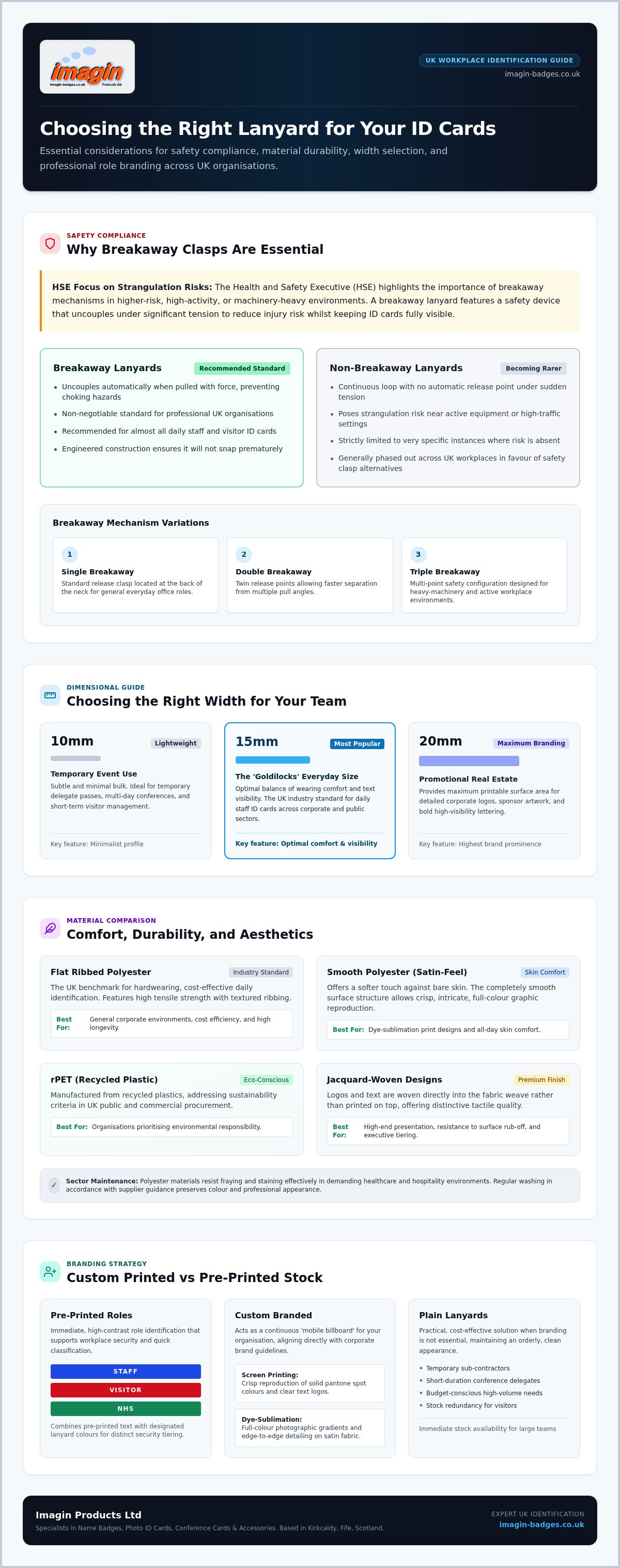
Our plain lanyards are made from 100% polyester and feature a metal lobster clip, a safety breakaway and a 15mm strap width. The listed colours are black, red, green, yellow, sky blue and royal blue. [1]
Consider them for office teams, training days, temporary projects or events where a clear badge already carries the organisation’s branding.
If you use colour to distinguish groups, explain the system and include readable wording on the badge. Someone should not need to distinguish two similar colours to understand whether a person is an employee or a visitor.
STAFF lanyards for visible team identification
A STAFF lanyard gives customers, visitors and colleagues an immediate visual cue about the wearer’s role.
Our STAFF lanyards use 100% polyester, a plastic J-clip, a safety breakaway and a 15mm strap width. They are listed in navy blue, red and black. [2]
They can be useful at reception desks, public events, retail premises and community venues where people need to find assistance quickly. Pair them with an appropriate name badge or photo ID card so that the person, as well as their general role, can be identified.
STAFF wording does not establish someone’s identity or authorisation by itself. It should support your existing identification arrangements.
VISITOR lanyards for reception and guest management
VISITOR lanyards help distinguish guests from the regular team. Our visitor option has a 15mm polyester strap, a plastic J-clip and a safety breakaway. [3]
Use one alongside a visitor pass that carries the information your organisation needs, such as the visitor’s name, host and visit date.
Agree who issues passes, when they expire and where they are returned. A clearly labelled return point can make collection easier at a busy reception.
A visitor lanyard is a visual aid. It does not replace signing in, checking the purpose of a visit or applying escort arrangements where required.
Personalised lanyards for your own branding
Personalised lanyards let you bring your organisation’s name, logo and colours into the design. They suit businesses looking for a consistent appearance across staff identification, exhibitions and events.
Our personalised lanyards are printed on both sides of satin-smooth recycled PET fabric made from recycled plastic bottles. They use dye-sublimation printing for full-colour designs and include a metal trigger clip and a safety breakaway at the back. [4]
Keep the artwork focused. A recognisable logo and clear company name usually deserve more space than a long strapline or a list of services.
If you plan to reuse the lanyards, consider leaving dates and individual event names off the strap. Put changing details on the accompanying card instead.
Understand safety breakaways and their limits
A breakaway is a connector designed to separate under tension. It is different from the clip at the bottom that attaches the badge or holder.
This feature should be considered as part of choosing a neck lanyard, but it is not a guarantee against injury. Release behaviour depends on the product and the circumstances. Do not assume that every breakaway has the same release force or that any particular model is suitable for every task.
Ask for relevant product information if your organisation has a specified safety requirement. Check the lanyard’s condition and follow the supplier’s instructions. Do not glue, tape or otherwise modify a breakaway to prevent it opening.
Most importantly, decide whether a neck lanyard belongs in that working environment at all. HSE machinery guidance warns against dangling items and loose clothing that could be caught in moving parts. Applying that principle, a dangling ID lanyard should not be treated as suitable near machinery simply because it has a breakaway. [5]
Where there is an entanglement, grabbing or other relevant hazard, follow the workplace risk assessment and consider an approved alternative for displaying identification.
Choosing lanyards for your industry
Offices and professional services
For offices, consider how staff move through the building. If employees regularly present access cards, test whether the card can reach the reader comfortably without pulling on the neck strap.
Personalised lanyards can provide a consistent appearance for client-facing teams. Plain versions may be sufficient where the photo ID card already provides strong branding. Distinct VISITOR lanyards can support reception procedures.
A badge reel may be worth considering where repeated card presentation makes a fixed strap awkward. Choose the attachment position carefully and check that the identification remains visible when required.
For hybrid teams, include occasional office users in your issue-and-return arrangements. Keep a clear process for forgotten passes rather than handing out unrecorded spare credentials.
Schools, colleges and universities
Educational settings should begin with their own safeguarding, visitor and site-security procedures.
STAFF and VISITOR wording can help people distinguish roles, while personalised lanyards can carry the institution’s identity. The badge should provide whatever additional information the organisation requires.
Avoid assuming that a particular colour has the same meaning everywhere. Your colour choices need to be explained locally, and any distinction about escorting or access must be backed by the relevant checks and procedures.
A lanyard colour does not prove that someone has undergone a safeguarding check or is authorised to work unsupervised.
Consider suitability separately for different activities and wearers. Identification arrangements for reception staff may differ from those for practical workshops, sports sessions or younger pupils. Make those decisions through the institution’s policies and risk assessment.
Healthcare and care settings
Healthcare requires a particularly careful approach because identification needs sit alongside infection prevention, patient care and local uniform policies.
A lanyard used at an administrative desk may not be appropriate during hands-on care. NHS England’s uniforms and workwear guidance identifies wearing neckties or lanyards during direct patient care as poor practice. [6]
Follow the current policy for your organisation and location, including the relevant arrangements in Scotland, England, Wales or Northern Ireland. Do not assume one national document replaces your employer’s requirements.
Where a lanyard is permitted, confirm the cleaning arrangements and how it will be kept clear of patients and equipment. Where it is unsuitable, use the approved alternative.
An ordinary polyester lanyard should not be described as antimicrobial or infection-proof without specific supporting evidence. Appearance, material and a breakaway feature do not establish clinical suitability.
Retail, hospitality and customer service
In a busy shop, attraction or reception area, clear identification helps customers know whom to approach. STAFF wording can be useful for temporary teams, while personalised lanyards can complement branded workwear.
Choose according to the task rather than the business name alone. A hotel receptionist and someone preparing food in the same building may need different arrangements.
Check whether a hanging card gets in the way when reaching across counters, handling stock or carrying trays. Follow food hygiene and workplace rules in preparation areas, where a secured name badge may be a more appropriate option.
For autumn recruitment and seasonal events, plan enough identification for new starters and supervisors, with a modest reserve for replacements.
Construction, manufacturing and warehousing
Industrial workplaces need decisions based on specific work areas and tasks. A site-office visitor may be allowed a neck lanyard, while someone operating machinery may not.
Consult the site rules before ordering. Where hanging items are unsuitable, consider an approved fixed badge or other identification arrangement that does not create the same hazard.
Trial identification with the clothing and protective equipment people actually wear. Check that it does not obstruct equipment, catch during movement or interfere with required visibility.
An ordinary ID lanyard is not a fall-arrest lanyard, tool tether or substitute for high-visibility clothing. Similar terminology does not mean similar protection.
Do not assume a retractable reel automatically resolves an entanglement problem either. Its cord and mounting position also need consideration.
Conferences, exhibitions and business events
At events, start with the information people need to recognise quickly: attendee name, organisation and role where relevant.
Use the lanyard for branding and the badge for readable identification. Organisers, exhibitors and delegates can be distinguished with clearly labelled badge designs, supported by different strap colours if useful.
Check any access categories with the people controlling entry. A colour scheme only works when the team understands it and checks the accompanying credentials.
Try the finished combination while walking and sitting. A design that looks excellent on a screen may behave differently when the card flips or rests against a jacket.
For recurring events, reusable organisation-branded lanyards and replaceable dated passes can simplify preparation for the next occasion.
Charities, volunteers and community groups
Volunteer identification should be easy to understand and straightforward to issue. Clear role wording can help visitors find an organiser without assuming every volunteer has the same responsibilities.
For groups with changing teams, keep individual names on replaceable cards and use a reusable organisational design on the lanyard.
Build collection into the end of a session or event. Before reissuing items, check their condition and follow your cleaning arrangements. Ask volunteers whether the attachment is comfortable and manageable, including anyone who would benefit from a different fitting.
Choose the clip, holder and card together
The clip is a small detail that can make a noticeable difference in daily use.
A J-clip, lobster clip and trigger clip have different shapes and opening actions. Check that the chosen fitting works with the holder’s attachment slot and is manageable for the wearer. Avoid assuming that one style is easiest for everyone.
Consider dexterity, grip and whether the person needs to remove the card frequently. Where practical, let staff try the options.
Then choose the holder around the actual card dimensions and orientation. A holder’s overall external size is not the same as its usable internal space. Portrait and landscape formats also affect how the card sits and where the attachment point falls.
An enclosed holder may offer more coverage than an open-faced design, but that does not automatically make it waterproof. Confirm any protection you specifically need.
For access cards, test the card and holder with your own reader. Avoid punching holes in electronic cards unless the card supplier confirms that this is safe, because internal components could be damaged.
Get the length, comfort and artwork right
Length descriptions can be confusing. Total strap length, loop length and hanging drop are different measurements. If fit matters, ask exactly how a stated dimension has been measured rather than assuming it describes the distance from the neck to the card.
Try the complete arrangement on different wearers. Include the weight of the holder and card, and avoid loading the strap with unnecessary keys or accessories.
For autumn, check how it sits with fleeces, coats and scarves. Follow workplace rules about whether identification should be visible outside clothing, and make sure the arrangement does not interfere with other equipment.
When designing a personalised lanyard, keep small text to a minimum and choose strong contrast between lettering and background. Check the artwork at actual size, including logo proportions, spelling and print orientation.
Do not assume that colours on a screen will match printed fabric exactly. If colour matching is critical, discuss the available checks before production.
A short wear trial can reveal more than comparing product photographs. Ask people whether the strap rubs, whether the badge stays readable and whether they can use the clip comfortably.
Recycled materials and practical reuse
Recycled PET describes the material used in our personalised lanyard fabric. It does not mean that every component of the finished lanyard is recycled, or that the assembled product belongs in a household recycling bin. [4]
Be specific when explaining purchasing choices. Terms such as “recycled PET fabric” tell people more than broad claims such as “completely green”. The Competition and Markets Authority’s Green Claims Code says environmental claims should be clear, accurate and supported by evidence, with relevant aspects of the product’s life cycle considered. [7]
There are practical purchasing choices to consider alongside material content. Order quantities you can reasonably use, select designs that will remain relevant and collect reusable items where appropriate.
Reuse should depend on condition and your workplace’s hygiene requirements. Inspect fabric, stitching, clips and breakaways before reissue, and replace damaged items. Follow the product’s care instructions rather than assuming it can withstand a particular washing temperature or disinfectant.
If disposal is necessary, check what your waste contractor accepts. Recycled content and recyclability are different questions.
Plan your autumn 2026 order
Count the people who need identification, then consider replacements, visitors and upcoming events separately. This helps avoid ordering every item in the same quantity when your requirements differ.
An office might need personalised staff lanyards, a smaller pool of VISITOR versions and spare holders. An event might need reusable organiser lanyards alongside dated delegate passes.
Compare the complete cost, including cards, holders, printing, delivery and any applicable setup charges. Check current pricing and quantity options rather than relying on a previous order.
For personalised items, allow time to prepare artwork, review the design and resolve any questions before production. Confirm availability and delivery timing for your required date.
Finally, decide who will maintain the supplies. Record issue and return where appropriate, replace worn components and make sure lost electronic access credentials are reported through your organisation’s process. Replacing a lanyard alone does not cancel access permissions.
Frequently asked questions
Which lanyard is best for everyday business use?
Choose around the wearer’s tasks. Plain lanyards suit simple setups, STAFF and VISITOR versions make roles clearer, and personalised options add your branding. Confirm that a neck lanyard is appropriate before choosing the design.
Are breakaway lanyards suitable for every workplace?
No. A breakaway has a useful release function, but it does not make a neck lanyard suitable for every hazard. Follow your workplace assessment and any specific product requirements.
Can one organisation use several types?
Yes. Different roles may need different arrangements. You could use personalised lanyards for employees, VISITOR lanyards at reception and another approved identification method for tasks where neck straps are unsuitable.
Should I choose a lanyard or badge reel?
Consider visibility, comfort and how frequently the card is presented. A reel can provide extra reach, but its attachment and retractable cord still need to suit the work environment.
Can I reuse lanyards after an event?
Potentially, provided they remain suitable, clean and undamaged. A design without a specific date is easier to reuse. Check your organisation’s requirements before collecting and reissuing them.
Find the right lanyard with Imagin Products Ltd
The right lanyard should make identification easier for the people wearing it and the people who need to recognise them. Start with the working environment, choose the appropriate fitting and holder, then bring the design together.
At Imagin Products Ltd in Kirkcaldy, Fife, we offer plain, STAFF, VISITOR and personalised lanyards, alongside photo ID cards and accessories. Whether you are updating your office identification, preparing for an exhibition or organising visitor passes, we can discuss the available options with you.
Explore our lanyard collection and photo ID accessories, or call 01592 653 865 to talk through your requirements.
Boost Your Brand & Build Connections with Imagin Products Ltd.
Sources and further reading
Product information checked for this guide on 21 September 2026. Check individual listings for current options and specifications.
- Imagin Products Ltd: Plain lanyards
- Imagin Products Ltd: STAFF lanyards
- Imagin Products Ltd: VISITOR lanyards
- Imagin Products Ltd: Personalised lanyards
- Health and Safety Executive: Introduction to machinery safety
- NHS England: Uniforms and Workwear, Guidance for NHS Employers
- Competition and Markets Authority: Making environmental claims on goods and services