
Care Home Staff Uniforms: Comprehensive UK Guide 2026

Did you know that 70% of UK care home residents are living with dementia or severe memory problems? For these individuals, a sea of identical clinical scrubs can feel intimidating and confusing, making it difficult to build the vital trust needed for quality care. You likely want your team to look professional, yet you also need care home staff uniforms that feel like home rather than a hospital. It's a common frustration to find clothing that shrinks or loses its colour after the frequent 60°C washes required for essential infection control.
We understand that choosing the right workwear is about more than just fabric; it's about creating a safe, recognisable environment for your residents. This guide explores how to select durable, comfortable garments that balance clinical hygiene with a warm, approachable aesthetic. You'll discover how the right mix of embroidered polo shirts, soft fleeces, and clear name badges can boost staff morale whilst ensuring every resident knows exactly who is there to help. We'll walk you through the technical side of industrial laundering and the creative process of building a professional identity that residents and families can trust.
Key Takeaways
- Learn how to strike the ideal balance between meeting rigorous clinical hygiene standards and creating a warm, domestic atmosphere that puts residents at ease.
- Discover the technical specifications required for garments to withstand frequent 60°C industrial washes without losing their shape or professional finish.
- Understand the vital role that high-contrast, easy-to-read name badges play in supporting residents with dementia and improving overall site safety.
- Find out how to design an effective colour-coding system for care home staff uniforms to help residents and families easily distinguish between different staff roles.
- Explore the advantages of partnering with a UK-based manufacturer, from rapid turnaround times to receiving complimentary creative assistance with your branding.
The Role of Uniforms in Modern UK Care Settings
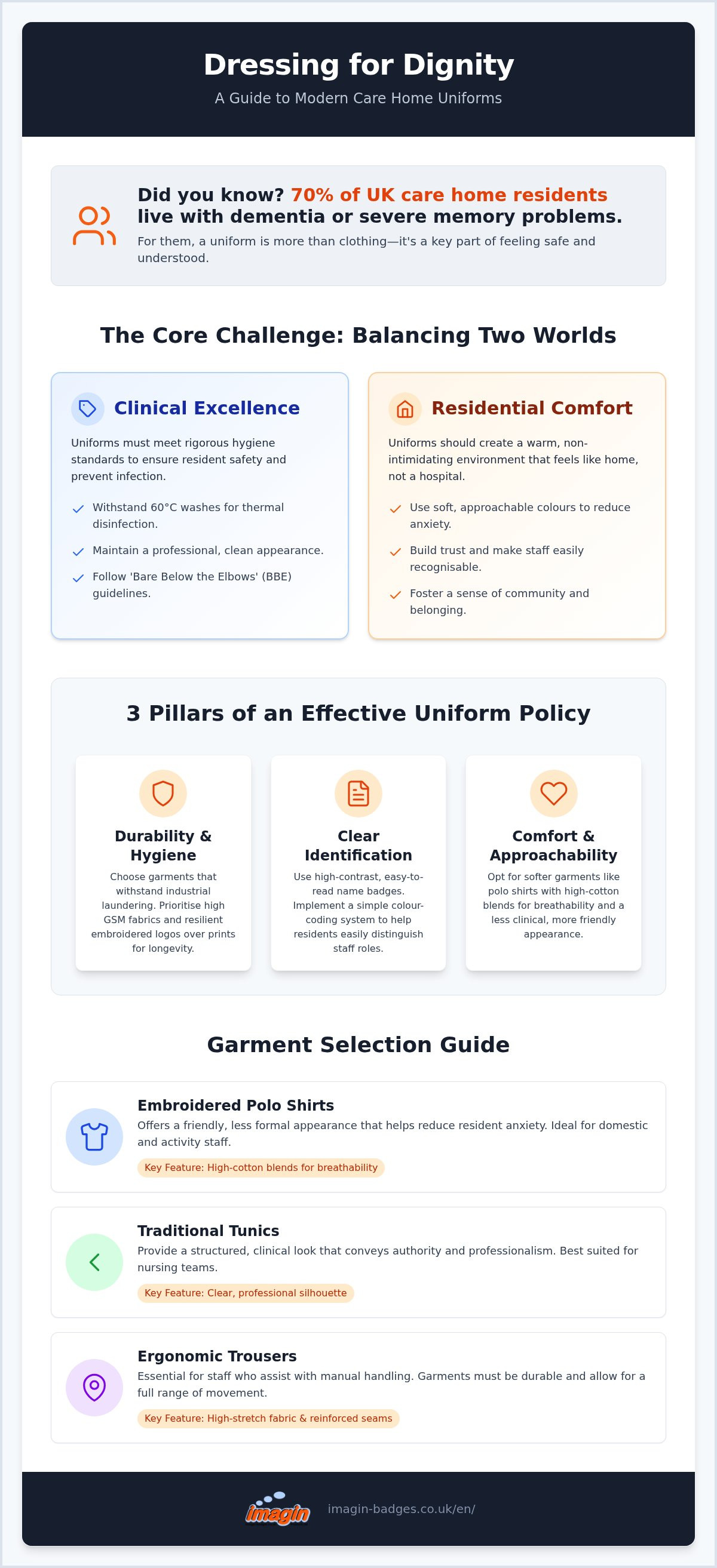
In the modern care sector, the clothing your team wears does far more than just meet a dress code. It serves as a visual bridge between clinical excellence and the warmth of a domestic setting. Selecting the right care home staff uniforms is a strategic decision that affects resident well-being and staff morale. When a team looks cohesive, it fosters a sense of belonging and professional pride. This collective identity is often the first thing a prospective family notices during a tour; it signals that their loved one is in a safe, well-organised environment.
Professional Identity vs. Residential Comfort
Moving away from traditional, sterile clinical whites is a growing trend in UK care. Harsh colours can often feel intimidating, especially for residents living with cognitive impairments like dementia. By opting for softer tones or smart, branded apparel, you create a more relaxed atmosphere. This shift doesn't mean sacrificing authority. A professional appearance is still necessary for medical tasks and emergency situations. Using high-quality embroidered polo shirts provides a comfortable, approachable look that still maintains the clear boundaries of a professional relationship. It helps residents feel they are in a home, not a hospital.
Infection Control and Hygiene Standards
Hygiene is the non-negotiable foundation of any care setting. While policy is often influenced by broader NHS uniform standards, care homes must ensure their specific choices support rigorous infection control. A primary requirement is "thermal disinfection," which involves washing garments at 60°C to kill bacteria. This is where quality matters. Fabrics must be durable enough to withstand these temperatures without shrinking or losing their shape.
As a Kirkcaldy-based manufacturer, we prioritise craftsmanship that lasts. We've found that embroidered logos are significantly more resilient than printed alternatives when subjected to frequent industrial laundering. Additionally, maintaining a "bare below the elbows" (BBE) standard is vital. It's a simple way to facilitate thorough hand hygiene. When combined with clear name badges, these standards help you meet CQC requirements for a "safe" and "well-led" service. Investing in high-quality care home staff uniforms is an investment in your home's reputation and safety. Families feel reassured when they see a team that is both easily identifiable and compliant with modern health standards.
Choosing the Right Garments: Tunics, Polos, and Layers
Selecting the right mix of garments for your team is a practical science. Whilst traditional tunics offer a structured, clinical appearance, many modern providers now prefer the softer look of polo shirts for certain roles. This choice often depends on the specific daily tasks of your staff. For example, nursing teams might retain the authority of a tunic, whereas domestic and activity leads benefit from the flexibility of more casual wear. Every piece of clothing should contribute to a cohesive professional identity that residents recognise and trust.
When you are sourcing care home staff uniforms, pay close attention to the fabric's GSM (grams per square metre). This technical term simply refers to the weight and density of the material. A higher GSM usually indicates a more durable garment that won't thin out or lose its shape after repeated high-temperature cycles. We recommend looking for mid-to-heavyweight fabrics to ensure longevity in industrial laundering. It's also vital to consider the ergonomics of your team's work. Staff spend long hours on their feet and frequently assist with manual handling; therefore, trousers must offer a high degree of stretch and reinforced seams to prevent tearing whilst providing full ease of movement.
All garment selections should align with NHS guidance on uniforms and workwear. This ensures that resident comfort and staff well-being never compromise essential hygiene standards.
Embroidered Polo Shirts and T-Shirts
Domestic and activity staff often find that polo shirts are the most practical choice for their roles. These garments offer a friendly, less formal appearance that can help reduce resident anxiety. We suggest choosing high-cotton blends for maximum breathability during physically demanding shifts. Cotton is naturally moisture-wicking and comfortable against the skin, making it a favourite for long hours. You can browse our range of embroidered t-shirts and polos to find a style that suits your home's specific colour-coding system.
Layering for Comfort: Fleeces and Softshells
Layering is essential for night shifts or when staff accompany residents on community outings and garden walks. A smart fleece provides necessary warmth without restricting the arms, which is crucial for safety during resident transfers. Unlike bulky coats, softshell jackets offer a professional, slim silhouette that keeps staff dry and warm in light rain. If you want to maintain a unified look even in colder weather, you can explore professional outerwear for care staff that balances thermal performance with a polished finish.
If you're unsure which fabric weight is best for your specific laundry setup, our Kirkcaldy team is ready to help you select the most durable workwear for your needs.
Identification Solutions: The Key to Care Home Safety
Safety in a care home depends on clarity. When a resident or family member enters the building, they need to know exactly who is who. A complete identification system is just as important as the fabric of the care home staff uniforms themselves. Without clear badges, even the most professional tunic or polo shirt fails to provide the reassurance that residents deserve. It's about building immediate trust through easy recognition. This principle of reliable identification is universal; for instance, when ensuring the safety of therapy animals or pets at home, Pet ID Tags Australia provides heavy-duty solutions built for clarity and durability.
Choosing the right fastening is a small detail with a big impact. We often recommend magnetic fastenings over traditional pins. Magnets don't pierce or damage the high-quality fabrics we've discussed in previous sections, and they eliminate the risk of sharp points in a clinical setting. From our Kirkcaldy workshop, we see first-hand how these durable solutions stand up to the daily rigours of a busy care environment without losing their grip. It's a simple way to protect both the garment and the wearer.
Legibility is a cornerstone of person-centred care. For residents living with dementia, high-contrast badges are essential. We use large, sans-serif fonts; these are simplified letterforms without the small decorative "feet" at the ends of strokes, which makes them much easier to read for those with declining vision. This approach supports the "Hello my name is..." initiative, ensuring that every interaction starts with a clear, friendly introduction. You can customise your standard name badges for care staff to include specific role titles and names that stand out clearly against the background.
Secure Photo ID and Accessories
Security is a priority, especially when managing agency staff and external contractors who may not be familiar to residents. Photo ID cards provide an immediate layer of verification for family members and auditors alike. However, the accessories used to carry these cards must also be safe. We provide lanyards with "breakaway" safety features. These are specialised clips designed to snap apart if the lanyard is pulled or caught, preventing any risk of injury or accidental choking. It's a proactive safety measure that protects your team during physical tasks. To ensure your facility remains secure, you can find professional photo ID badges for healthcare providers that integrate perfectly with your existing uniform policy.
By combining durable apparel with clear identification, you create a "safe pair of hands" for your residents. Our team offers complimentary creative assistance to help you design a system where badges and workwear work in harmony to support your home's unique needs.
Designing and Implementing a Uniform Policy
A successful uniform policy does more than dictate what staff wear; it creates a framework for consistency, safety, and brand identity. When you introduce care home staff uniforms, you are establishing a visual language that residents and visitors use to navigate the home. A clear policy ensures that every team member understands their responsibility regarding hygiene and professional appearance. This is often formalised through a "Uniform Agreement," a simple document that outlines how garments should be worn and maintained to meet infection control standards. For more context on building these frameworks, you can read The Industry Guide to Staff Uniform Policy.
Inclusivity and comfort must be at the heart of your policy. A diverse workforce requires a wide range of sizes and fits to ensure every individual feels confident and supported. When staff feel uncomfortable in their clothing, it can distract from the high level of care they provide. By prioritising breathable fabrics and ergonomic designs, you demonstrate that you value your team's well-being as much as the residents' comfort. It's a proactive way to boost morale and reduce staff turnover in a demanding sector.
Departmental Colour Coding Strategies
Consistency is key for residents with cognitive impairments. Using a standardised colour-coding system helps everyone identify roles at a glance. In many UK care settings, Navy Blue is often reserved for Senior Nurses, whilst Royal Blue or Sky Blue is used for Care Assistants. Domestic and catering teams might wear distinct shades like Green or Maroon. It's vital that these colours remain consistent across all garment types, whether a staff member is wearing a traditional tunic or one of our embroidered polo shirts. This visual shorthand reduces resident confusion and streamlines communication during busy shifts.
Managing the Rollout and Staff Feedback
The transition to a new uniform should be a collaborative process. We always suggest organising wearer trials before committing to a bulk order. This allows your team to test the sizing, breathability, and ease of movement in real-world conditions. Staff who feel comfortable in their workwear are more likely to take pride in their appearance. Once the rollout is complete, managing new starter kits and replacements must be efficient to avoid gaps in your professional image. We provide clear care instructions with every order to help your team maintain the longevity of their embroidered logos, especially during the 60°C washes required for thermal disinfection.
If you are ready to refresh your team's look with durable, professional apparel, you can browse our full workwear collection and benefit from our Kirkcaldy-based manufacturing expertise.
Sourcing Quality Care Home Uniforms in the UK
Sourcing care home staff uniforms shouldn't be a stressful transaction. Working with a UK-based manufacturer like us in Kirkcaldy offers more than just fast delivery; it provides peace of mind. You aren't just buying clothes; you're building a partnership with experts who understand the unique pressures of the healthcare sector. We pride ourselves on being a "safe pair of hands" for institutional clients who need reliable, high-quality results without the long lead times associated with international shipping. This local presence allows for accessible, human-to-human communication that larger, faceless suppliers simply can't match.
Bulk ordering is often the most cost-effective way to manage your budget. We offer tiered pricing structures that allow you to equip your entire team whilst keeping costs predictable. Because we handle everything under one roof, we can maintain strict quality control from the initial stitch to the final badge attachment. This end-to-end involvement ensures that your vision is never lost in translation. It's a logical, instructional process that moves steadily from your initial inspiration to a technical specification that works for your specific home.
The Imagin Advantage: From Concept to Care Home
Our production facility in Kirkcaldy ensures that every garment meets high ethical standards and local quality benchmarks. We don't just take an order; we offer complimentary creative assistance to help you refine your care home’s logo for the best possible result. This collaborative process makes the brand feel supportive rather than merely transactional. Whether you're a single home or a large group, our team supports you through every step of the journey from initial thought to finished item. You can learn more about our professional workwear collections to see how we translate digital concepts into durable physical objects.
Custom Embroidery for a Lasting Impression
Regarding professional branding, embroidery is the superior choice for healthcare settings. Unlike screen printing, which can crack or peel after repeated exposure to the 60°C thermal disinfection washes required for infection control, our embroidery stays vibrant. We use technical finishing processes and high-quality threads that resist fading. This ensures your team maintains a premium appearance even after months of industrial laundering. It's a hallmark of craftsmanship that reflects the quality of care you provide.
Strategic logo placement is also vital. We ensure your branding is positioned for maximum visibility on both tunics and polo shirts. This isn't just about aesthetics; it's about making sure job titles are clearly visible to residents and families. Clear communication is a cornerstone of quality care. A well-designed uniform facilitates this by removing ambiguity and building immediate trust. By choosing durable, embroidered branding, you're making a long-term investment in your home's professional identity and the well-being of those in your care.
Elevating Your Professional Identity in 2026
Choosing the right care home staff uniforms is a vital step in creating a safe, welcoming environment for your residents. You've seen how the right mix of breathable fabrics and clear identification can reduce anxiety for those with dementia whilst maintaining strict infection control standards. It's about more than just clothing; it's about building a team culture that residents and families can trust every day. A cohesive look doesn't just improve aesthetics; it streamlines communication and reinforces the professional pride of your hard-working staff.
Our Kirkcaldy-based team is here to act as a safe pair of hands for your next project. We specialise in high-durability embroidery that stands up to frequent 60°C washes and provide complimentary creative assistance to help refine your branding from initial concept to finished item. When you're ready to transform your home's professional image with quality UK-manufactured workwear, you can request a bespoke quote for your care home uniforms and badges. We look forward to helping you realise your vision with the care and craftsmanship your team deserves. Your residents deserve the best, and we're here to help you deliver it through every stitch.
Frequently Asked Questions
What is the best fabric for care home staff uniforms?
The most effective fabric for care home staff uniforms is typically a high-quality poly-cotton blend. This combination offers the natural breathability of cotton with the durability and crease-resistance of polyester. It's essential that the fabric weight is sufficient to withstand frequent industrial laundering whilst remaining comfortable for staff during long, physically demanding shifts. We recommend choosing mid-to-heavyweight fabrics to ensure your investment lasts through years of daily wear.
Can care home uniforms be washed at 60 degrees?
Yes, professional uniforms should be washed at 60°C to achieve thermal disinfection. This temperature is the standard for killing bacteria and viruses, which is a critical component of infection control in residential care settings. When sourcing your workwear, always verify that the garments and any embroidered branding are specifically rated for high-temperature cycles. This prevents shrinking or fading, ensuring your team always presents a smart, professional image to residents and families.
Why is colour coding important in care homes?
Colour coding is vital because it provides a visual shorthand for residents, visitors, and fellow professionals. In a busy care environment, being able to distinguish a senior nurse in navy from a carer in royal blue at a glance reduces confusion. This is particularly important for residents with cognitive impairments who may struggle with verbal identification. It creates a structured, organised atmosphere that fosters trust and helps everyone navigate the home more safely.
How do I choose dementia-friendly name badges for my staff?
To choose the best badges, prioritise high-contrast colours and large, clear sans-serif fonts. Avoid busy logos or small text that can be difficult for elderly residents to read. We suggest using a simple layout that features the staff member's first name prominently. Magnetic fastenings are also preferred over pins as they sit flatter against the garment and don't damage the fabric of your care home staff uniforms over time.
What is the difference between embroidery and printing for workwear?
Embroidery is the superior choice for care home environments because of its exceptional durability. While screen printing can crack or peel when exposed to the high temperatures of 60°C industrial washes, embroidered logos are stitched directly into the fabric. This creates a long-lasting, premium finish that maintains its colour and integrity. It projects a sense of quality and craftsmanship that reflects the high standards of care provided within your facility.
Are there specific safety requirements for lanyards in care homes?
Lanyards in care settings must include breakaway safety features. These are specialised plastic clips that snap apart if the lanyard is pulled with force or gets caught on a piece of equipment. This is a non-negotiable requirement to prevent accidental choking or injury during resident transfers and other physical tasks. We always recommend using these safety-first accessories alongside professional photo ID cards to ensure your staff remain secure whilst on duty.
How many sets of uniforms should I provide for each staff member?
We typically recommend providing between three and five sets of uniforms for each full-time staff member. This allows for a "one on, one in the wash, and one ready" rotation, which is essential when garments must be laundered at 60°C after every shift. Providing an adequate number of sets reduces the wear and tear on individual items, extending the overall lifespan of your workwear and ensuring staff always have a fresh, clean set available.
Can I reclaim tax on my care home staff uniform?
Staff may be able to reclaim tax on the cost of cleaning or repairing their workwear if the employer doesn't provide laundry facilities. According to HMRC rules, the clothing must be a recognisable uniform that is only worn for work. Whilst we cannot provide specific financial advice, we recommend that staff check the current flat-rate expenses for healthcare workers on the official government website. This can help offset the personal costs of maintaining a professional appearance.