
Branded Uniforms for Cafés and Restaurants: Buying Guide

A good hospitality uniform starts with the job, not the logo. Choosing branded uniforms for cafes and restaurants means balancing a consistent look with clothing suited to front-of-house service, barista work and food preparation. The right choices depend on what each person does during a shift and how you want your team to represent your venue.
When comparing garments, consider whether embroidery or full-colour printing suits your logo and how the clothing will fit into your cleaning routines. For food-preparation teams, clothing needs to support your hygiene and contamination-control procedures. An apron alone doesn’t establish compliance.
This guide covers planning garments by role, comparing embroidered and printed branding, and organising artwork, sizes and responsibilities before you order.
At Imagin Products, our workwear range includes aprons, T-shirts and polos, as well as other garments. We offer real customer service, so you can talk to us rather than machines if you have a question about artwork or your order.
Key Takeaways
- Plan branded uniforms for cafes and restaurants around staff roles and service routines, then use shared colours or logo placement to create a coordinated look.
- Compare embroidery and full-colour printing by considering the garment, artwork, colours, placement and finish you want.
- For food preparation, include hygiene, cleaning and contamination control in your clothing plan. An apron alone doesn’t establish compliance.
- Gather staff feedback early and agree who will buy, clean and replace ordinary uniforms before ordering.
- Imagin Products offers embroidered and printed aprons, T-shirts, polos and other workwear. Bulk pricing discounts apply.
What makes branded uniforms work for cafes and restaurants?
Choose garments around staff roles, service routines and the look of your venue. A useful uniform should feel consistent with your brand while allowing each person to do their job. That balance makes branded uniforms practical as well as recognisable.
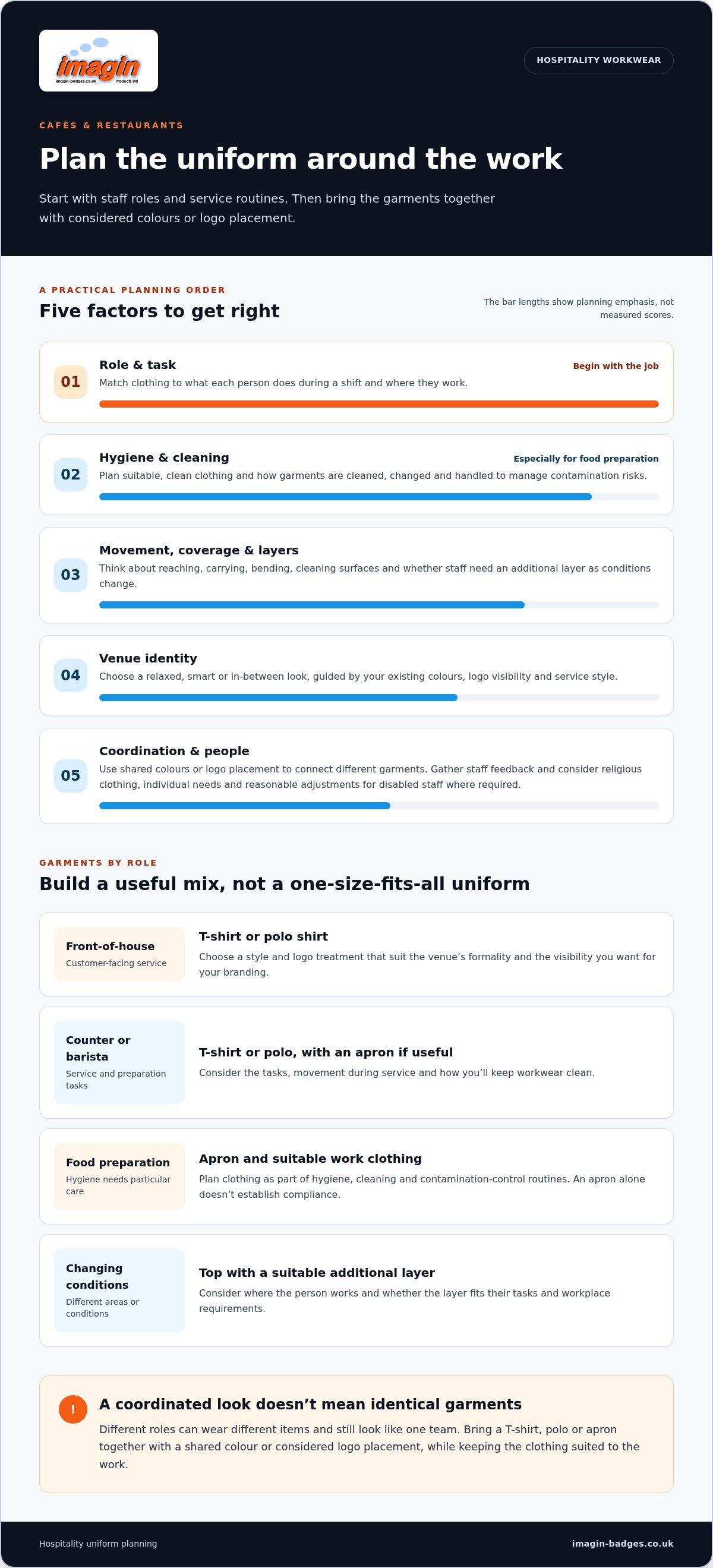
Different roles don’t need identical garments to look like one team. A shared colour palette or considered logo placement can bring a polo, T-shirt and apron together. The concept of a uniform includes both work clothing and a shared organisational identity.
Start with the venue’s service style and brand
Decide whether you want the overall look to feel relaxed, smart or somewhere between. Use your existing identity as a guide: consider the colours customers associate with your venue, how visible the logo should be, and which garments suit the way your team serves.
Rather than selecting unrelated items one at a time, sketch a simple garment plan. For example, you might choose one style of top for customer-facing roles and an apron for tasks where it is useful, then connect the items through a shared colour or logo treatment.
Treat the uniform as part of the working day
Consider what each role involves across a shift. Staff may reach, carry, bend, clean surfaces or move between different areas. Think about movement, coverage and whether people need an additional layer as conditions change. A garment that looks right but gets in the way is unlikely to suit the job.
Food preparation needs particular care. The Food Standards Agency’s food hygiene guidance covers suitable, clean clothing and managing contamination risks. An apron can be part of a clothing plan, but it doesn’t establish compliance by itself. Include how clothing will be kept clean, changed when needed and handled in your venue’s hygiene procedures.
Before browsing garments, agree these points:
- Roles: Who needs a uniform, and what tasks does each person carry out?
- Venue identity: Which colours, logo treatment and level of formality suit your existing brand?
- Practical needs: What movement, coverage and layering do shifts call for?
- Cleaning: How will clothing support your hygiene and contamination-control routines?
- Coordination: Which shared details will make different garments look like one team uniform?
Writing down these decisions gives you a clear starting point for comparing garments. If you have questions about turning your visual identity into a coordinated workwear plan, our real customer service means you can talk to us rather than machines.
Which branded garments suit front-of-house, café and restaurant roles?
Choose garments according to what staff do, where they work and how your venue runs service. A customer-facing team might share branded tops, while staff handling particular tasks may also need aprons or a suitable extra layer. The aim is a practical mix, not one garment that everyone must wear regardless of role or individual needs.
Plan garments around front-of-house and counter service
For front-of-house, counter and café service, T-shirts or polo shirts can provide a coordinated top for your venue’s branding. Aprons are another option where they suit the tasks and cleaning routines. Decide which roles need each garment rather than issuing an apron or top automatically to the whole team.
| Role or task | Garment options | Practical point |
|---|---|---|
| Front-of-house service | T-shirt or polo shirt | Choose a style and logo treatment that suit the formality of the venue and how visible you want the branding to be. |
| Counter service or barista duties | T-shirt or polo shirt, with an apron if useful | Consider the tasks, movement during service and your approach to keeping workwear clean. |
| Food preparation | Apron and suitable work clothing | Plan clothing as part of hygiene, cleaning and contamination-control routines. An apron alone doesn’t establish compliance. |
| Staff working across changing conditions | Top with a suitable additional layer | Consider where the person works and whether the layer fits their tasks and workplace requirements. |
Compare branded T-shirts and polos as part of the same garment plan. A shared colour or consistent logo placement can connect different roles without requiring every team member to wear exactly the same item.
Account for food preparation, layers and individual needs
Food-preparation clothing needs to support your venue’s hygiene and cleaning practices, including how you manage contamination risks. An apron can be one part of that plan, but it doesn’t by itself demonstrate that clothing or working practices meet food-safety requirements. Consider the tasks and the full routine for wearing, cleaning and changing garments.
Uniform choices should also take account of the people wearing them. Ask staff for feedback before settling on a style, and consider religious clothing, individual needs and reasonable adjustments for disabled staff where required. One cut or style won’t suit everyone, so check that the chosen garments work for different team members and their duties.
For protective garments, use the product’s stated information and assess its suitability for the workplace. Don’t assume clothing is protective equipment simply because it has a logo or is worn during a particular task. Match garments to the role and take staff feedback into account before ordering.
Embroidery or full-colour printing: which suits your hospitality uniform?
Neither embroidery nor full-colour printing is automatically right for every garment or logo. For branded uniforms for cafes and restaurants, weigh up the clothing, the detail in your artwork and the finish you want. A simple logo on a polo may call for a different treatment from a larger, multi-colour design on a T-shirt.
Consider these factors together before choosing:
- Garment: Is the item a polo, T-shirt, apron or another type of workwear?
- Artwork: Does the logo include small lettering, fine lines, close-set details or several colours?
- Scale and position: How large should the design appear, and where will it sit?
- Finish: Would a textured stitched result or a printed, full-colour appearance better suit your venue?
We offer embroidery and full-colour printing on workwear, including T-shirts, polos and aprons. The right choice depends on the specific garment and artwork, so don’t choose a method based on garment category alone. Our branded workwear range is a starting point for considering garments alongside their intended decoration.
When embroidery may suit the garment and design
Embroidery adds a textured finish and suits many workwear garments, depending on the item and design. It can be a good option when you want stitched detail to form part of the garment’s appearance. Check the artwork at its intended size before deciding. Small lettering, fine lines and crowded details need particular attention because their clarity depends on how the design translates at that scale.
Embroidery can affect a garment’s care requirements. Check the garment label alongside any additional instructions supplied with the decoration, and use a cleaning method suitable for both the fabric and embroidery. If instructions conflict, ask the supplier.
When full-colour printing may suit the artwork
Printing can suit detailed, larger or multi-colour designs, depending on the garment and the appearance you want. It may work well when several colours or intricate elements are central to the logo. Consider design size and placement too, so the result remains clear on the chosen garment and works with the rest of your uniform.
Share the final logo version and your brand colour references when preparing the order. A screen image alone can’t guarantee an exact colour match. If you’re unsure how your design might translate, our team offers real customer service, so you can talk to us rather than machines. Visual artwork and embroidery files serve different purposes, so consider the decoration method as well as the design.
How to prepare a cafe or restaurant uniform order
Preparing role requirements, sizes and artwork in advance makes it easier to order coordinated branded uniforms for cafes and restaurants. Work through the decisions in sequence and keep one order list as details are agreed.
Gather the information needed for a coordinated order
- Agree who needs what. List the roles, tasks and garments required. Ask staff for feedback early, including comments about fit, religious clothing and individual needs or adjustments. Involve employee or trade union representatives where relevant.
- Choose garments and colours. Decide which garment types and colours suit each role, then use current product information to compare options. Don’t assume a particular cut, colour or specification applies to every item.
- Set out artwork details. Prepare the final logo version and note your preferred branding method and placement. For embroidery, include the garment reference and colour, preferred dimensions, placement from the wearer’s perspective and brand colour references.
- Build a size and quantity list. Record each team member’s size against the garment they’ll wear, then total quantities by item, colour and size. Check the list with staff before ordering.
- Agree uniform responsibilities. Decide who will buy, clean and replace ordinary uniforms before rollout. Make sure the team understands how clothing fits into your usual cleaning routines.
Review quantities, dispatch and the final checkout details
Check that your quantities match the team plan. Bulk pricing discounts apply, with the final amount depending on the selected items and order. Review the options carefully before completing checkout.
Clothing and workwear orders are generally dispatched within 10 working days. This is a dispatch estimate, not a delivery date. Timing depends on stock availability, artwork approval and production schedules, and delivery time is additional. If you have a deadline, contact us before ordering to discuss the current dispatch estimate. Rush orders can also be discussed, but aren’t guaranteed.
Before paying, review your selected options, any applicable discounts, VAT, delivery charges and final total. Check that the order reflects the agreed garments, artwork and size breakdown.
Create a coordinated branded uniform with Imagin Products
Once you’ve mapped garments to roles and settled on a branding approach, bring those decisions together in an order that suits your venue. Imagin Products offers embroidered or full-colour printed aprons, T-shirts and polo shirts, alongside other workwear. Choose a useful combination for your team rather than putting everyone in an identical outfit regardless of their work.
Choose a practical combination from the workwear range
Start with the core garments in your plan. You might choose branded tops for customer-facing staff and aprons for roles where they suit the tasks and cleaning routine. A shared colour or consistent logo treatment can connect the pieces, even when staff wear different items. Explore our branded workwear range to consider garment options alongside embroidery or printing.
If your team needs an additional layer, hoodies and sweatshirts are also options. Think about where each garment will be worn, what the shift involves and whether the layer suits the workplace. Note which roles need each item, how many are required and how the logo should appear. This gives you a clear basis for preparing the order.
We offer embroidery and full-colour printing on workwear. The right method depends on the garment, artwork and finish you want, so a method that suits one item won’t necessarily suit every part of the uniform. If you’re planning several garment types, consider how the branding will look across the set. Our approach is simple: Your logo || your style || your choice.
Make the next step straightforward
Bring your garment list, size and quantity breakdown, final logo artwork and preferred placement together before ordering. Include any brand colour references and make sure you’re using the logo version intended for the team. Clear information makes it easier to review garment and branding choices before placing your order.
Check that the decoration, placement and overall look work together. If you’re weighing up options, compare them against the tasks each garment needs to suit and the appearance you want across the team.
Set a clear standard for future uniform orders
Use your first order to establish a reference for future replacements and new starters. Keep a record of the garments selected for each role and the approved logo treatment, so later orders can follow the same plan. If service routines or team needs change, review that reference before changing the garments.
A clear record helps maintain a consistent appearance without treating the uniform as fixed forever. It also gives whoever manages future orders a useful starting point. Your branded uniforms for cafes and restaurants can reflect your venue while adapting to the team’s needs.
Frequently Asked Questions
Can I have a logo embroidered on a café apron?
Yes, Imagin Products offers embroidered aprons. The right approach depends on the apron and design, so share the final logo and preferred placement when preparing your order. Check how the logo looks at the intended size, especially if it contains small lettering or fine detail.
Can I mix embroidered and printed garments in one team uniform?
Yes. You could choose embroidered polos for some roles and printed T-shirts for others, then connect them through shared colours and consistent logo artwork. Consider how each garment will look alongside the rest of the uniform, as different methods won’t necessarily produce an identical finish. Imagin Products offers workwear with embroidery or full-colour printing, depending on the garment and design.
Does a branded apron by itself meet food hygiene requirements?
No. A branded apron alone doesn’t establish that food hygiene requirements are met. Clothing is only one part of managing hygiene and contamination risks in a food business. Consider how staff keep garments clean, when they need changing and how clothing fits into your food-handling procedures. The Food Standards Agency’s food hygiene guidance provides information for businesses on hygiene practices.
How much do branded uniforms for cafes and restaurants cost?
The total depends on the garments selected, the branding method and the quantities in your order. Compare options for your team and review the order details before paying, including VAT and delivery charges. Bulk pricing discounts apply; ask us about quantity pricing for your chosen garments.
Can different staff roles have different branded uniform garments?
Yes. Choose garments to suit the work rather than requiring every role to wear the same item. For example, a venue might select tops for customer-facing staff and aprons for roles where they suit the tasks. Shared branding can connect the team while allowing for different garments, fit requirements and individual needs.
How long does a branded workwear order take?
Clothing and workwear orders are generally dispatched within 10 working days. Timing depends on stock availability, artwork approval and production schedules, and delivery time is additional. If you’re working to a particular date, contact us before ordering to discuss the current dispatch estimate. Rush orders can be discussed, but aren’t guaranteed.
Explore our workwear range to choose garments for your café or restaurant uniform.

Article by
Team Imagin :)
Team Imagin helps businesses look their best with quality name badges, photo ID cards, lanyards and branded workwear. Based in Kirkcaldy, Scotland, we combine friendly, personal service with professional printing and embroidery to bring your branding to life. From small teams to large organisations across Scotland, the UK, Europe and America, we help you boost your brand and build connections.
Disclaimer
This article provides general guidance only. Information was correct to the best of our knowledge when published, but product details, prices and regulations may change. Check current specifications and official guidance before making decisions.