
Branded Lanyards: 2026 Professional Identity Guide

That little strip of fabric around an attendee's neck is doing far more work than most event organisers realise. Branded lanyards for events aren't just a way to hold an ID card; they're the single most visible piece of your brand identity that every delegate carries from the registration desk to the closing keynote. Get them right, and they reinforce professionalism at every handshake. Get them wrong, and a pixelated logo or a scratchy nylon strap quietly undermines the impression you've worked so hard to create.
If you've ever dealt with lanyards that arrived days after your event started, colours that bore no resemblance to your brand guidelines, or materials that left red marks on delegates' necks by lunchtime, you already know the frustration. These aren't minor inconveniences; they're avoidable problems with the right supplier and the right specification from the start.
This guide walks you through everything you need to make a confident, informed decision: choosing the right material and printing method for your budget, understanding safety requirements, navigating lead times, and sourcing lanyards that work seamlessly alongside your name badges and ID cards.
Key Takeaways
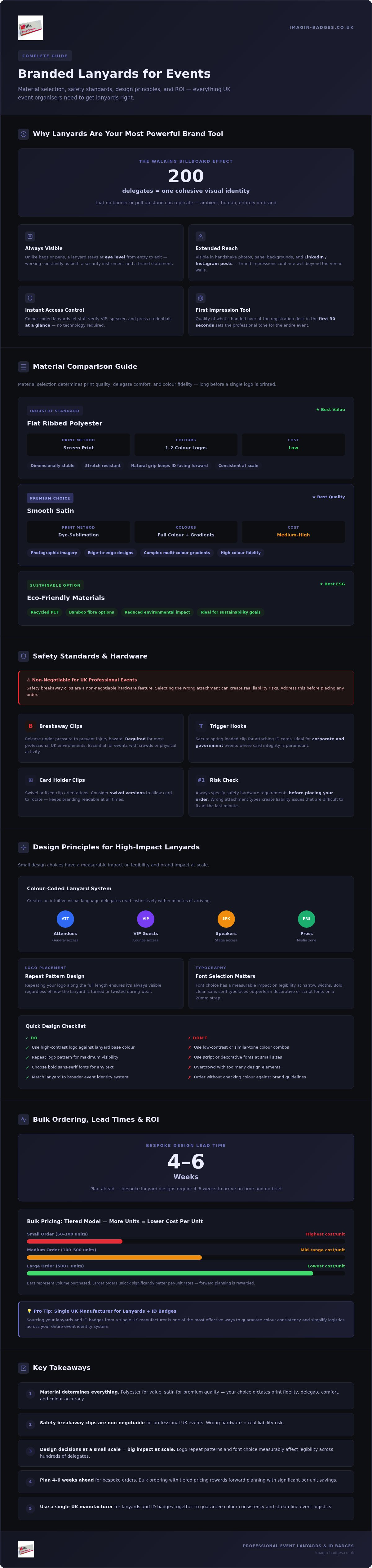
- Choosing the right material for branded lanyards for events — from durable polyester to premium dye-sublimated satin — directly determines print quality, delegate comfort, and how faithfully your brand colours are reproduced.
- Safety breakaway clips are a non-negotiable hardware feature for most professional UK event environments, and selecting the wrong attachment can create real liability risks you'll want to address before placing your order.
- Design decisions like logo repeat patterns and font selection have a measurable impact on lanyard legibility and brand impact — small choices that make a significant difference at scale.
- Bulk ordering follows a tiered pricing model that rewards forward planning, and bespoke designs typically require a 4–6 week lead time to arrive on time and on brief.
- Sourcing your lanyards and ID badges from a single UK manufacturer is one of the most effective ways to guarantee colour consistency and simplify logistics across your entire event identity system.
Why Branded Lanyards are Essential for Professional UK Events in 2026
A branded lanyard is the single physical touchpoint that every attendee wears, carries, and is seen wearing for the entire duration of your event. That distinction matters more than it might initially seem. While a delegate bag gets tucked under a chair and a branded pen disappears into a pocket, a lanyard stays visible at eye level from the moment someone enters the venue to the moment they leave. It's working constantly, and in two distinct ways: as a security instrument and as a brand statement.
The 2026 event landscape has accelerated the importance of both functions. As professional networking becomes increasingly intentional and identity-led, attendees and organisers alike expect a polished, coherent visual environment from the outset. First impressions are formed at the registration desk, and the quality of what's handed over in those first thirty seconds sets the tone for everything that follows.
Colour psychology plays a practical role here too. Using distinct lanyard colours to differentiate attendee categories, staff, speakers, and press isn't just a logistical convenience; it creates an intuitive visual language that delegates read instinctively within minutes of arriving. The result is a smoother, more professionally managed event floor without the need for constant verbal direction.
Security and Access Control Benefits
Effective access control doesn't require elaborate technology when your visual system is well designed. Colour-coded lanyards allow security personnel and staff to verify credentials at a glance, identifying who belongs in a VIP lounge, a restricted speaker area, or a press zone without slowing the flow of the event. When paired with photo ID cards, the combination creates a robust, immediately legible identity system that's particularly valuable at corporate summits, government conferences, and high-profile trade events. The lanyard becomes the frame; the ID card becomes the proof.
Maximising Brand Visibility Above the Fold
No other item in your event collateral generates the same volume of brand impressions. Consider the journey of a single lanyard: worn through a conference centre, visible in every handshake photograph, present in the background of panel discussions, and captured repeatedly in the attendee selfies that populate LinkedIn and Instagram after the event closes. Branded lanyards for events extend your reach well beyond the venue walls without any additional spend.
That 'walking billboard' effect compounds when you're running events at scale. A room of two hundred delegates wearing consistently branded lanyards creates a cohesive visual identity that no banner or pull-up stand can replicate. It's ambient, human, and entirely on-brand, provided the print quality and colour accuracy are there to support it.
Choosing the Right Materials: Polyester, Satin, and Eco-Friendly Options
Material selection is where the quality of branded lanyards for events is truly decided, long before a single logo is printed. The substrate you choose determines not just how your design looks on day one, but how it holds up through eight hours of wear, a second day of networking, and the rigours of a busy exhibition floor. Getting this decision right from the manufacturer's perspective means understanding what each material actually does under pressure, not just how it looks in a product listing.
Flat ribbed polyester is the industry standard for good reason. It's dimensionally stable, resistant to stretching, and accepts screen-printed inks cleanly along its textured surface. For straightforward one or two-colour logos with strong contrast, it delivers consistent, cost-effective results at scale. The ribbed weave also provides a degree of natural grip, which prevents the lanyard from twisting and keeps your ID card facing forward throughout the day.
Smooth satin is the material of choice when your brand identity demands more. Its tight, flat weave is specifically engineered for dye-sublimation printing, which allows complex multi-colour gradients, photographic imagery, and edge-to-edge designs to be reproduced with a fidelity that ribbed polyester simply can't match. If your logo contains subtle tonal variations or your event identity uses a detailed repeating pattern, satin is the only substrate that will do it justice.
Eco-conscious event organisers now have genuinely viable alternatives. rPET lanyards, made from recycled plastic bottles, offer comparable durability to standard polyester with a measurably reduced environmental footprint. Bamboo fibre lanyards provide a softer, more natural handle and are a strong fit for sustainability-led conferences and green-certified venues. Both materials accept printed branding effectively and signal your organisation's values without any compromise to presentation quality.
Width is a decision that's often underestimated. As a practical guide:
- 10mm: Slim and discreet; suits minimalist designs or events where the badge takes visual priority.
- 15mm: The most versatile option, balancing logo legibility with a clean, professional profile.
- 20mm: Provides a noticeably larger print area for multi-element designs or dual-language text.
- 25mm: Maximum impact; ideal for high-profile events where brand visibility is the primary objective.
The Science of Lanyard Printing Methods
Screen printing applies ink directly onto the ribbed polyester surface through a fine mesh stencil. It's precise, durable, and cost-efficient for simple, high-contrast artwork with defined colour separations. Each colour requires a separate screen, so it's best suited to designs with one to three solid colours rather than graduated tones.
Dye-sublimation works differently. Heat and pressure convert solid dye into a gas that permanently bonds with the satin substrate at a molecular level, rather than sitting on top of it. The result is a print that won't crack, peel, or fade, with colours that are genuinely part of the fabric. This is the method that makes full-colour, photographic-quality event lanyards possible.
Woven lanyards take a third approach entirely. The design is built into the fabric structure itself during manufacture, creating a tactile, embroidered-style finish with real depth and texture. The production cost is higher, but for premium corporate events or annual conferences where lanyards are kept as keepsakes, the result is unmistakably superior.
Durability and Comfort Factors
Neck comfort over a full event day comes down to material finish and width in combination. Narrow, stiff polyester on a hot venue floor is a reliable recipe for irritation by mid-afternoon. Wider satin and rPET options distribute weight more evenly and sit more softly against the skin. For multi-day exhibitions, it's worth specifying materials that can be lightly wiped down or hand-washed without affecting print integrity; dye-sublimated satin handles this particularly well, since the colour is embedded rather than surface-applied.
Material strength matters most at the attachment point. Lanyards carrying heavier rigid badge holders need a substrate with sufficient tensile strength to resist fraying at the metal crimp or stitched loop. Reinforced stitching at the join is a detail worth confirming with your supplier before production begins. Sourcing your lanyards and ID cards together from a single UK manufacturer like Imagin Products means the hardware specifications are matched from the outset, removing one of the most common causes of on-site failure.
Navigating Safety Standards and Hardware: Breakaway Clips to Trigger Hooks
Hardware is where branded lanyards for events either earn their keep or quietly create problems. The strap itself gets the attention during the design process, but the clips, buckles, and safety mechanisms attached to it are what determine whether your event runs smoothly and, more critically, whether you've met your duty of care to every delegate wearing one.
A safety breakaway clip is a small plastic connector built into the lanyard that releases under sudden directional force, typically between 2kg and 4kg of pull, allowing the lanyard to detach instantly if it becomes snagged or caught. That single sentence describes a mechanism that prevents a cosmetic accessory from becoming a strangulation or entrapment hazard. In most professional event environments, specifying a breakaway is simply the right call. In some, it's essential.
UK Health and Safety Compliance for Events
The Health and Safety at Work Act 1974 places a general duty on employers and event organisers to ensure, so far as is reasonably practicable, the safety of everyone on site. While no specific regulation names lanyards by type, the Act's principles apply directly when lanyards are worn in environments with moving machinery, vehicles, or high-footfall areas where snagging is a realistic risk. Industrial exhibitions, manufacturing open days, and warehouse-based trade events all fall into this category. In those contexts, a standard fixed-loop lanyard isn't just a poor choice; it's a liability.
Multi-break lanyards, which incorporate two or three release points along the length rather than one, offer an additional layer of protection in higher-risk settings. They're worth specifying when delegates are moving through environments where a single breakaway point might not release quickly enough given the angle of a snag. For standard conference and exhibition environments, a single central breakaway remains the appropriate and widely accepted standard.
Selecting the Right Clip for Your Badge
Once the safety specification is confirmed, the attachment clip is the next decision. Each type serves a distinct purpose:
- Trigger hooks (lobster clasps): The most secure option for heavier rigid badge holders and ID card wallets. The spring-loaded gate holds firmly under the weight of a card and resists accidental release during normal movement.
- Crocodile (bulldog) clips: Grip directly onto a garment or thin card without requiring a pre-punched hole. Useful for events where badge holders aren't used, though they can mark delicate fabrics.
- Dog clips (swivel clips): A versatile mid-point option that rotates freely, reducing the tendency for the badge to twist and keeping printed information facing forward.
The plastic versus metal question comes down to three factors: weight, aesthetics, and your event's sustainability commitments. Plastic clips are lighter and, where recycled materials are specified, can align with green event certification requirements. Metal clips project a more premium finish and suit corporate events where the overall identity leans formal, but they add measurable weight to the lanyard assembly, which matters over a full conference day.
Double-ended lanyards, which attach at two points on the badge holder rather than one, are a practical solution to badge flip. When a single-point attachment rotates, your delegate's name disappears behind a blank card back. A dual attachment keeps the badge stable and legible throughout the day, which matters considerably when your access control system relies on staff reading credentials at a glance.
Specialist hardware options, including quick-release buckles for frequent badge removal, mobile phone loops for tech-forward events, and retractable reel attachments for access card environments, are available and worth discussing with your supplier at the specification stage. Getting the hardware right from the outset, rather than retrofitting solutions on-site, is where the experience of a manufacturer who handles both lanyards and ID cards in-house makes a genuine difference.
Design Principles for High-Impact Event Lanyards
A well-specified material and the right hardware get you to the starting line. What happens next, in the design stage, is where branded lanyards for events either become a genuine brand asset or a wasted opportunity. The constraints of fabric printing are real and unforgiving: you're working with a narrow, flexible substrate that moves, folds, and sits against clothing in unpredictable ways. Understanding those constraints before you submit artwork is what separates a lanyard that looks polished at scale from one that looks like an afterthought.
Logo placement on a lanyard follows a simple principle: repetition creates consistency. A 'step and repeat' pattern, where your logo tiles at regular intervals along the full length of the strap, ensures your brand remains visible regardless of how the lanyard falls or folds. A single centred logo, by contrast, can easily tuck behind a badge holder or twist out of view entirely. For most event applications, a step and repeat at 80mm to 100mm intervals strikes the right balance between brand presence and visual breathing room.
Typography behaves differently on fabric than it does on screen or paper. At 15mm width, the usable print area is roughly 11mm to 13mm once safe zones are accounted for. Sans-serif typefaces, clean geometric letterforms without decorative flourishes, hold their legibility at that scale far better than serif alternatives. Thin serifs and fine strokes in ornate typefaces fill in or blur during printing, particularly on ribbed polyester. If your brand typeface uses a delicate serif, your designer needs to know this before artwork is finalised rather than after the first proof arrives.
Pantone Matching System (PMS) references are non-negotiable for brand-critical orders. RGB and CMYK values shift unpredictably across different substrates and printing methods. A PMS reference gives your manufacturer a fixed, verifiable target that holds consistent whether the lanyard is screen-printed polyester or dye-sublimated satin. Always supply PMS references alongside your artwork files, and confirm that your supplier works to them as standard.
The safe zone is the area of the lanyard that sits clear of stitching, crimps, and hardware attachment points. As a practical rule, keep all critical text and logo elements at least 5mm from any edge and 10mm from the attachment point at the top. Artwork that bleeds into these zones will be obscured or distorted in the finished product, and no amount of post-production correction can fix it.
Avoiding Common Design Mistakes
The 'upside down' problem catches more designers than you'd expect. A lanyard worn around the neck displays artwork in two orientations depending on which end hangs down. Logos and text should be oriented to read correctly from the wearer's perspective when the lanyard hangs naturally, not from the perspective of someone reading the packaging flat on a desk. Confirm the orientation explicitly with your supplier and check it on the physical proof before approving production.
Contrast failures are another avoidable problem. White logos on pale or mid-tone backgrounds, yellow on white, light grey on silver, disappear under the bright overhead lighting typical of conference and exhibition venues. If your brand palette is predominantly light, introduce a contrasting background band or a dark outline to anchor the logo against the fabric. The same principle applies in reverse: very dark logos on black or near-black lanyards are equally illegible. Test your artwork at actual size before signing off.
Overcrowding is the most common mistake of all. A 20mm lanyard offers roughly 16mm of usable width. That's enough for a clean logo and a short URL or event name, but not a logo, event name, date, website, and social handle. Every element you add reduces the impact of every other element. The lanyards that photograph best and read most clearly at a distance are almost always the simplest ones.
The Role of Complementary Creative Assistance
Uploading a logo file and hoping for the best is how pixelated, distorted lanyards happen. Professional digitisation means your artwork is assessed for fabric compatibility before production begins: line weights checked, colour separations confirmed, and resolution verified for the specific printing method being used. A logo that looks sharp at 300dpi on a printed flyer may need reworking before it holds up on a 15mm polyester strap.
A physical or digital proof before bulk production isn't a luxury; it's the point in the process where problems are cheap to fix. Reviewing a proof at actual size, ideally against your other event materials, reveals contrast issues, safe zone breaches, and orientation errors that are invisible on screen. It's also the moment to confirm that your Pantone references have translated faithfully to the chosen substrate.
If you're designing both lanyards and badges for the same event, the design decisions connect directly. The same typography, colour accuracy, and safe zone principles apply to your badge artwork, and getting both right from a single brief is considerably more efficient than managing them separately. The Ultimate Guide to Custom Name Badges covers the badge side of that equation in detail, and it's worth reading alongside this guide before you finalise your event identity artwork.
Working with a manufacturer who offers genuine creative support, not just a file upload portal, means these issues are caught and resolved before they reach production. Talk to the Imagin Products team about your event artwork before you commit to a bulk order, and you'll arrive on the day with lanyards that actually do justice to the brand behind them.
Maximising ROI: Bulk Ordering and Integrating Lanyards with ID Systems
Unit price is only part of the story. The real economics of ordering branded lanyards for events are found in the tiered pricing structure that rewards forward planning: the cost per lanyard drops meaningfully as quantities increase, and the savings at the 500-unit mark compared to a 100-unit run are substantial enough to influence your entire event budget. Ordering at the right quantity, rather than the minimum viable quantity, is where the return on investment is actually made.
Lead times are the variable that catches most organisers out. Bespoke dye-sublimated lanyards require artwork approval, production scheduling, and quality checks before they leave the facility. Building in four to six weeks from brief to delivery for a fully customised order isn't overcautious; it's the timeline that keeps options open. Compress that window and you're choosing between rushing production or accepting a standard design that doesn't fully represent your brand. Neither is a good trade-off when the lanyards are the first thing every delegate touches.
Sustainability deserves a practical plan, not just a policy statement. Specifying rPET or bamboo fibre materials is a strong start, but the end-of-event question matters too. High-quality lanyards, particularly dye-sublimated satin, are durable enough to be collected at exit points, laundered, and reused at future events. Some venues and event organisers run formal collection programmes for this purpose. The alternative, a single-use polyester lanyard in a bin bag at the end of day two, is increasingly difficult to justify to sustainability-conscious clients, delegates, and sponsors.
The Manufacturer Advantage
Buying direct from a UK manufacturer like Imagin Products Ltd removes the transit variables that third-party resellers introduce. There's no intermediary handling your artwork, no additional leg in the delivery chain, and no ambiguity about who's accountable if something arrives wrong. Colour consistency across your full event identity, lanyards, photo ID cards, premium name badges, and embroidered staff polo shirts, is only achievable when a single production facility is working from the same verified Pantone references throughout. That's the practical value of one-stop sourcing: not convenience, but precision.
Post-Event Utility and Reusability
The lanyards that attendees keep are the ones worth designing well. A clean, premium-finish lanyard becomes an office key holder, a daily carry item, a quiet brand ambassador long after the event closes. That extended lifespan is only possible when the material quality and print durability are there from the outset. It's also the most effective argument against cutting corners on specification: a lanyard in a drawer six months later is still working. One in a bin on the way out isn't.
Contact Imagin Products Ltd today for a bespoke lanyard quote and get your event identity right from the first handshake to the last.
Your Next Event Starts at the Registration Desk
Branded lanyards for events are doing serious work long before your opening keynote begins. From material selection and print method through to safety hardware and bulk ordering strategy, every decision in this guide connects back to the same outcome: a polished, coherent event identity that holds up under real-world conditions and reflects well on the organisation behind it.
The details that matter most are the ones that compound. Colour accuracy builds brand trust. Comfortable materials keep delegates focused rather than fidgeting. Hardware specified correctly from the start means no on-site fixes. And sourcing lanyards alongside your ID cards and name badges from a single UK manufacturer means everything arrives consistent, on time, and ready to use.
Imagin Products Ltd brings in-house UK manufacturing, expert design assistance included with every order, and genuine specialism in integrated lanyard and ID badge systems. You get a safe pair of hands from first brief to final delivery.
Design your custom event lanyards with Imagin Products Ltd and give every delegate something worth wearing.
Frequently Asked Questions About Branded Lanyards for Events
What is the standard length and width for an event lanyard?
The standard finished length for an event lanyard is 450mm per side, giving a total loop of 900mm when worn around the neck. This sits the badge comfortably at mid-chest height for most adults. Width options typically run from 10mm through to 25mm, with 15mm being the most widely specified for professional events. It balances a clean visual profile with enough print area to carry a logo and short supporting text legibly.
What is a safety breakaway clip and is it required by law in the UK?
A safety breakaway clip is a plastic connector built into the lanyard that releases under sudden force, typically between 2kg and 4kg of pull, so the lanyard detaches instantly if it snags. No specific UK legislation names breakaway clips by type, but the Health and Safety at Work Act 1974 places a general duty on event organisers to manage foreseeable risks. In practice, specifying a breakaway is considered standard professional practice for most event environments, and essential in any setting involving machinery, vehicles, or high-footfall areas.
Can I have a different design or colour for different types of event attendees?
Yes, and it's one of the most effective ways to manage access control without additional technology. Ordering distinct lanyard colours for delegates, speakers, staff, and press creates an immediately readable visual system that your team can verify at a glance. Each category can carry the same base branding with a different strap colour, or you can vary the design entirely. Most manufacturers, including Imagin Products, handle multi-variant orders as a single coordinated brief rather than separate jobs.
What is the minimum order quantity (MOQ) for custom branded lanyards?
MOQs vary by manufacturer and printing method. Screen-printed polyester lanyards typically carry a lower MOQ than dye-sublimated satin, because each production method has different setup costs. As a general guide, bespoke orders often start from 100 units, with pricing structured in tiers that reward higher quantities. If your event is smaller, it's worth discussing your requirements directly with your supplier, as some manufacturers can accommodate lower runs for specific materials or straightforward designs.
How do I ensure my logo colours look correct on dyed polyester?
Always supply Pantone Matching System (PMS) references alongside your artwork files, rather than relying on RGB or CMYK values alone. Colour behaviour shifts across different substrates and printing methods, and a PMS reference gives your manufacturer a fixed, verifiable target to work to. Confirm that your supplier works to PMS as standard, and always review a physical or digital proof at actual size before approving bulk production. This is the single most reliable way to catch colour drift before it reaches your event floor.
How long does it take to manufacture and deliver custom lanyards in the UK?
For fully bespoke branded lanyards for events, a 4 to 6 week lead time from artwork approval to delivery is a realistic and sensible planning benchmark. That window covers artwork assessment, production scheduling, quality checks, and national delivery. Compressing the timeline by ordering late typically forces a choice between a rushed production run or a simplified design that doesn't fully represent your brand. Building the lead time into your event planning from the outset keeps all options open.
What is the difference between screen printed and dye-sublimated lanyards?
Screen printing applies ink onto the surface of ribbed polyester through a mesh stencil. It's precise and cost-effective for designs with one to three solid colours and strong contrast, but it can't reproduce gradients or photographic detail. Dye-sublimation uses heat and pressure to bond dye permanently into smooth satin fabric at a molecular level, producing full-colour, edge-to-edge designs with no risk of cracking or peeling. Screen printing suits straightforward brand marks; dye-sublimation is the right choice when your identity demands colour fidelity and design complexity.
Can lanyards be recycled after the event is over?
It depends on the material. Standard polyester lanyards aren't straightforwardly recyclable through household collections, but rPET lanyards, made from recycled plastic bottles, are produced with a lower environmental footprint from the outset. High-quality dye-sublimated satin lanyards are durable enough to be collected at exit points, laundered, and reused at future events, which is the most practical sustainability outcome. If end-of-event collection is part of your plan, it's worth confirming material washability with your supplier before placing your order.