
Bamboo Lanyards in the UK: Styles, Prices and Printing

Choosing bamboo lanyards in the UK involves more than picking a material. The strap should suit how people will wear and use it, while the design should keep identification clear and reflect your organisation’s style. Consider the quantity you need, your deadline and the budget for the complete order.
Environmental wording deserves the same care as the design. A claim about one material doesn’t necessarily describe every part of a finished lanyard, so it helps to understand what the description covers before making a purchasing decision. Compare product details carefully and consider the lanyard as a complete item, including its fittings and intended use.
This guide covers the choices involved in bamboo lanyards in the UK, from printing and colours to materials, environmental claims, order quantities and price comparisons. Use these practical points to prepare an artwork brief, compare what quotes include and choose an option for your event or team. A clear brief makes it easier to move from an initial idea to an informed order.
Key Takeaways
- Compare width, base colour and print colours to find a look that suits your logo and event.
- Allow for the fact that bamboo-fibre straps may still include metal or plastic fittings.
- Use the minimum order and quantity breaks to understand how order size affects the per-lanyard price.
- Read biodegradability and compostability claims with the whole product, including its fittings, in mind.
- For coordinated event identification, Imagin Products offers Conference Badges and other badge styles to suit different needs.
Custom printing and colour options
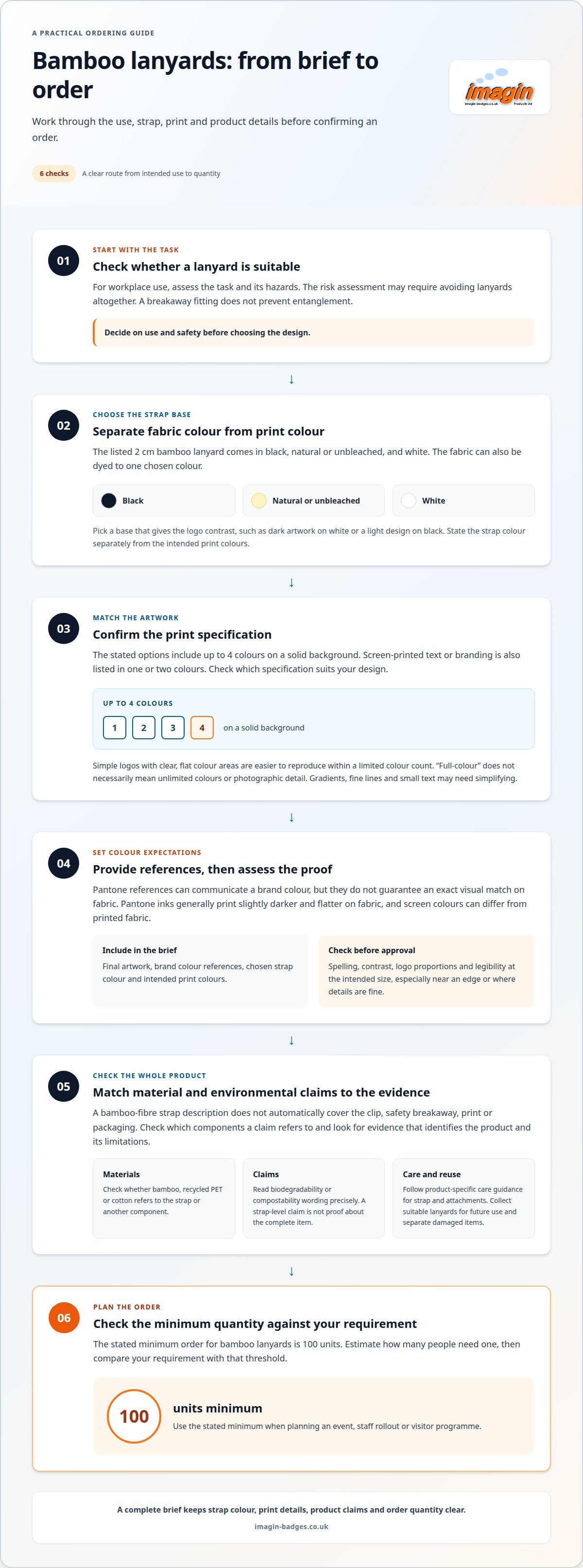
For workplace use, decide whether to wear a lanyard based on the risk assessment. It may require avoiding lanyards altogether, and a breakaway fitting does not prevent entanglement. Consider the task and its hazards rather than assuming one option suits every workplace.
For the design, first separate the strap’s fabric colour from the printed colours. The 2cm bamboo lanyard is listed in black, natural or unbleached, and white. The fabric can also be dyed to one chosen colour. Select a base that gives the logo enough contrast, such as dark artwork on white or a light design on black.
Print specifications describe up to 4 colours on a solid background. Screen-printed text or branding is also listed in one or two colours. These options suit different artwork, so confirm which specification fits the design. A simple logo with clear, flat colour areas is easier to reproduce within a limited colour count than artwork relying on subtle gradients or many shades.
Pay close attention to what “full-colour” means in a custom printing quote. It doesn’t necessarily mean unlimited colours or photographic detail, so check the stated printing method and artwork requirements. If a logo contains gradients, fine lines or small text, simplify it where needed. Keep the essential shapes and wording, then review the proof at its intended size.
Pantone references can communicate a brand colour, but they don’t guarantee an exact visual match on fabric. Pantone inks generally print slightly darker and flatter on fabric. Provide the reference alongside your chosen strap colour, then assess the proof against your design requirements. Colours can also look different on screen and on printed fabric.
- Choose the base: select black, natural or unbleached, white, or one dyed fabric colour.
- Check colour limits: ensure the design suits the stated print option, including up to 4 colours on a solid background.
- Review the proof: check spelling, contrast, logo proportions and legibility before approval.
For printed lanyards, send the final artwork and brand colour references together. Clearly specify the strap colour and the intended print colours. This gives the design stage a consistent brief and helps prevent confusion between strap and ink colours. Review the layout before approving production, especially where text is close to an edge or a logo has fine details.
Assess workplace risks and hazards before using a lanyard. A breakaway fitting does not prevent entanglement, and some tasks may require avoiding lanyards altogether.
Bamboo lanyard material and environmental claims
Assess a bamboo lanyard as a complete item, not just by its strap label. Before choosing, compare the stated materials, fittings, care instructions and evidence supporting environmental claims.
Lanyard materials and fittings
Bamboo, recycled PET and cotton refer to different strap materials. Compare the stated composition and intended use rather than assuming a material label proves a lower impact. For example, a recycled PET claim should say which component contains recycled material. A cotton description should likewise make clear whether it refers to the strap or the finished lanyard.
When buying bamboo lanyards in the UK, look for a supplier whose product description identifies the material and components. Check that the product suits your intended use, then compare its environmental information with your organisation’s purchasing criteria. A broad “eco” label alone doesn’t explain what the lanyard contains.
Follow the care guidance for the specific product. Apply it to the strap and attachments together, rather than using instructions intended for cotton or recycled PET on bamboo fibre. If the lanyard becomes marked, check the guidance before cleaning it. Store clean, dry lanyards between events, and separate damaged items from those intended for reuse.
Descriptions of bamboo lanyards may include biodegradable or compostable claims, including claims about biodegradation in soil. Read the precise wording: a claim about the strap doesn’t automatically apply to the clip, safety breakaway, print or packaging. The word “compostable” alone also doesn’t explain how to dispose of the complete item.
Verified sustainability credentials
A supplier’s sustainability claim is easier to assess when supporting evidence identifies the exact product and the components it covers. Look for documentation rather than relying on promotional wording. If the evidence applies only to the bamboo-fibre strap, describe the claim that way. Don’t present a strap-level statement as proof that every part of the lanyard is biodegradable.
For a purchasing comparison, record each product description, its supporting evidence and any stated limitations. Apply the same questions to bamboo, recycled PET and cotton options. This helps separate material claims from evidence about the finished item, without treating a plant-derived fibre as proof of an overall environmental benefit.
- Match claim to component: note whether the wording covers the strap, fittings or whole product.
- Compare evidence: check what documentation supports each supplier’s specific claim.
- Follow care guidance: use product-specific instructions when cleaning or storing lanyards.
- Plan reuse: collect suitable lanyards after an event for future use.
Minimum order quantity
The stated minimum order for bamboo lanyards is 100 units. That threshold matters when planning a conference, staff rollout or visitor programme. Start by estimating how many people need a lanyard, then allow for the way the supplier sells them. A headcount alone may not match the order unit, especially where products are packed in fixed quantities.
Pack size affects how you translate a minimum into an order. One product listing states that each pack contains 10 lanyards. If that pack format applies to the 100-unit minimum, the arithmetic is 10 packs. Check that the minimum and pack description refer to the same product and specification before using this calculation.
Keep the unit clear when comparing listings. “Per pack” and “per lanyard” describe different bases, so don’t compare them as though they were interchangeable. For a pack of 10, divide the pack charge by 10 to calculate its unit equivalent. Then compare like with like, including the lanyard width, material, print and fittings.
Quantity discounts work through price breaks: a lower unit rate may apply once an order reaches a stated quantity. The supplied market information says orders of more than 2,000 bamboo lanyards can qualify for bulk discounts. “More than 2,000” is not the same threshold as “2,000 or more”, so check which bracket your required quantity enters.
Before requesting a quote, set out the number of finished lanyards, pack size and artwork specification. For example, an order of 100 personalised units differs from an order of 100 plain units if printing changes the quoted price. Also identify whether every lanyard uses the same design and colour. Multiple versions can affect how an order is grouped and priced.
- Confirm the minimum: use 100 units as the stated minimum for the bamboo lanyards described here.
- Check the pack maths: one listed pack contains 10 lanyards, so verify whether that format applies to your chosen item.
- Compare the same basis: distinguish the cost per pack from the cost per lanyard.
- Review quantity breaks: orders above 2,000 may qualify for bulk discounts, according to the stated market information.
Compare the total order with the quantity you expect to distribute. A larger order may qualify for a lower unit price, but surplus lanyards still need to be stored and managed. Match the quantity to expected attendance, staff numbers or planned replacements, then compare the resulting unit cost with the print and material specification.
Biodegradability and environmental impact
Bamboo lanyards may be described as biodegradable or compostable, with claims that they biodegrade in soil. These describe end-of-life properties, not the lanyard’s full environmental impact. Read them alongside the complete construction, intended use and disposal instructions.
Start by distinguishing the strap from its attachments. Bamboo-fibre material is cellulose from bamboo plants, but a finished lanyard may also include a metal clip and plastic safety breakaway. One described breakaway uses recycled thermoplastic called POM, while the metal clip is zinc alloy. A biodegradable strap claim doesn’t mean these fittings share the same property.
“Compostable” and “biodegradable” don’t mean that every part of a product disappears in any setting. The stated description refers to compostability and biodegradation in soil. Use that wording precisely, and don’t extend it to the clip, breakaway, print or packaging without supporting evidence. The claim alone also doesn’t specify how to dispose of the complete item.
For a purchasing decision, ask what evidence supports the environmental wording and which components it covers. Match documentation to the exact lanyard specification instead of applying a general bamboo claim to every version. Look for clear descriptions of the fibre, fittings, print and any breakaway. This makes for a more useful procurement comparison than a broad “eco-friendly” label.
Consider how the lanyard will be used before assessing end of life. One distributed for a single event has a different planned use from one issued to staff for repeated identification. Choose a design suited to its purpose, and organise collection or reuse if your event process allows. Reuse keeps an item in service, but doesn’t change its material claims or prove a lower overall impact.
When reviewing claims, keep these distinctions in view:
- Biodegradable: identify the component the claim describes, such as the bamboo-fibre strap.
- Compostable: read the stated context, including the soil biodegradation description.
- Recycled: distinguish recycled POM in a safety break from the strap’s fibre composition.
- Complete product: account for attachments, print and packaging separately.
A practical comparison records the exact product, its components, the environmental claim and its supporting evidence. This helps prevent a bamboo-fibre strap from being described as a wholly biodegradable lanyard when it also has metal and plastic parts. Keep the supplier’s wording accurate in purchasing records, event materials and public sustainability statements. Component-specific descriptions make clear what each claim covers.
Bamboo lanyard price
Bamboo lanyard prices depend on the full specification, order quantity and quote terms. Compare the same design and quantity before judging one unit price against another. A headline figure alone won’t show whether personalisation, fittings, delivery or VAT are included.
Quantity is a key cost factor. Suppliers commonly quote in quantity bands, so the unit price can change when an order moves into a different band. Compare the total for the quantity you need, not just the lowest displayed unit price. A lower unit rate on a larger order still means paying for more lanyards.
Printing also affects the comparison. A plain strap and a customised strap aren’t the same specification. Print colours, coverage and whether the fabric is dyed can all affect the quote. For a fair comparison, provide each supplier with the same artwork, strap colour, print details and quantity. Otherwise, the prices may refer to different products.
Fittings matter too. Check which attachment hardware and safety breakaway the quote includes. If one listing specifies a metal clip and another doesn’t, their prices aren’t directly comparable. Confirm that the quoted product suits your intended use instead of assuming every bamboo lanyard has the same components.
- Quantity: confirm the number of finished lanyards and any quantity band.
- Unit basis: check whether the figure is per lanyard or per pack.
- Personalisation: compare the same print colours, coverage and fabric colour.
- Included components: identify the clip and any safety breakaway.
- Order total: establish whether delivery and VAT are included.
Take care when comparing pack prices. If one quote is for a pack and another is for individual units, calculate the price per lanyard for each. Then compare the full amount payable. This helps avoid mistaking a pack total for the price of a single lanyard.
VAT and delivery can affect the final budget. Check whether each quote includes VAT and whether delivery is charged separately. For a UK organisation working to a fixed event budget, record the item total, additional charges and final amount payable together. This makes approval easier and helps avoid surprises at checkout.
Ask for a written quote based on your final design and delivery requirements. When comparing bamboo lanyards in the UK, use identical specifications and assess the total cost alongside the materials and fittings. The key is to compare like for like, then decide whether the quantity suits actual demand.
Imagin Products: Standard Name Badges
Imagin Products can help complete an identification setup when your lanyards need to display staff or attendee details. Choose Standard Name Badges for straightforward name display, or compare Premium Name Badges and Reusable Name Badges when your requirements differ. For events, Conference Badges provide an option designed around delegate identification.
Pairing a lanyard with a badge brings names and event information together in a visible format. Consider who will wear each badge, what information it needs to show and whether those details change between events. This gives you a practical starting point for choosing a badge style to go with your lanyard.
Contact Imagin Products to discuss which badge option suits your identification needs.
Plan your next identification order
For organisations choosing bamboo lanyards in the UK, consider how each item will fit into your wider identification setup. Decide what staff or attendees need to display, how names will be shown and whether details change between events. This keeps the choices focused on the people using the lanyards.
Imagin Products offers Standard Name Badges, Premium Name Badges and Reusable Name Badges. Pair a suitable badge with your lanyards when staff need to display their names clearly. Reusable badges suit situations where displayed details need to change. A consistent approach helps workplace or event identification feel considered, while allowing you to tailor the lanyard’s material and print to your needs.
Before taking the next step, note who will wear the lanyards, what information the badges should show and how the items will be used. A clear brief is a practical starting point for bringing the design together. Your identification can be distinctive, useful and suited to the people who rely on it.
Frequently Asked Questions
What styles are available?
Bamboo lanyards are available in different widths, including 15 mm, 20 mm and 25 mm options. The 2 cm style is listed in black, natural or unbleached, and white. Choose a narrower strap for a discreet look, or a wider one when the printed design needs more space. Fabric can also be dyed to one chosen colour, depending on the product specification.
How much do bamboo lanyards cost in the UK?
There isn’t one price for every bamboo lanyard order. The total depends on quantity, strap specification, printing, fittings and any delivery or VAT charges. Compare quotes for the same design and finished quantity, and check whether each figure is per lanyard or per pack. This gives you a more useful budget comparison than relying on a headline unit price.
What materials are used in bamboo lanyards, including the clip and fittings?
The strap is described as bamboo cellulose fibre, but the complete lanyard may contain other materials. One listed version has a zinc-alloy metal trigger clip and a plastic safety breakaway. The breakaway may use recycled thermoplastic called POM. When assessing a product, distinguish the fibre from the clip, breakaway and other fittings, as they don’t necessarily share the strap’s material properties.
Are bamboo lanyards biodegradable or compostable?
Some bamboo lanyards are described as biodegradable and compostable, with product descriptions stating that they biodegrade in soil. Read these claims as applying only to the identified components, not automatically to every part. For example, a lanyard with a metal clip and plastic breakaway has attachments made from different materials. Don’t assume the complete item belongs in a particular disposal route without product-specific instructions.
Can UK suppliers print custom logos on bamboo lanyards, and what printing options are available?
Yes, custom logos can be printed on bamboo lanyards. Listed specifications include printing in up to four colours on a solid background, while screen-printed text or branding is offered in one or two colours. Before approving artwork, check that small wording will be readable at the strap’s actual width. Simple shapes and clear lettering are easier to assess than fine details or gradients.
What are the minimum order quantities and lead times for custom bamboo lanyards in the UK?
The stated minimum order is 100 units. Lead times depend on the order specification, artwork approval and production schedule, so plan around those stages rather than treating dispatch and delivery as the same event. Confirm the required arrival date when arranging the order, especially if the lanyards are for a fixed event. Allow time to review the artwork proof before production begins.
Are bamboo lanyards available with safety breakaway clasps?
Yes, bamboo lanyards are listed with a safety breakaway fitting at the back of the neck. This is a product feature, not a guarantee against entanglement. Consider where the lanyard will be worn and follow the workplace risk assessment. In some settings, the assessment may mean avoiding lanyards altogether, even when a breakaway fitting is present.
Where can I buy bamboo lanyards in the UK?
Buy from a UK supplier whose product description identifies the bamboo material and the lanyard’s components, including its fittings.
Article by
Team Imagin :)
Team Imagin helps businesses look their best with quality name badges, photo ID cards, lanyards and branded workwear. Based in Kirkcaldy, Scotland, we combine friendly, personal service with professional printing and embroidery to bring your branding to life. From small teams to large organisations across Scotland, the UK, Europe and America, we help you boost your brand and build connections.
Disclaimer
This article provides general guidance only. Information was correct to the best of our knowledge when published, but product details, prices and regulations may change. Check current specifications and official guidance before making decisions.