
Affordable Workwear Packages for Startups: Buying Guide

An affordable workwear package starts with the jobs your team does, not a standard set of garments. For startups, affordable workwear packages for startups should reflect what staff will actually wear, whether that’s a T-shirt for hands-on work, a polo for customer-facing roles or a jacket for time outdoors.
It’s sensible to be cautious about ordering too much while your team and roles are still taking shape. A considered selection can give staff a consistent branded look without filling your order with items they won’t use. You can choose from workwear such as T-shirts, polos, hoodies, jackets, aprons and hi-vis safety wear, then decide which pieces need branding.
This guide explains how to match garments to day-to-day tasks, balance your selection with your budget and choose between embroidery and full-colour printing. You’ll also find out what to prepare before ordering, including your logo artwork, garment choices, sizes and quantities. That gives you a clearer starting point for building a practical workwear package around your business.
Key Takeaways
- Build affordable workwear packages for startups around the tasks your team actually does, rather than buying a fixed set of garments.
- Choose everyday tops and extra layers according to each role, working conditions and how often staff will wear them.
- Compare embroidery and full-colour printing against your garment, logo detail, design size and preferred finish.
- Before ordering, settle garment choices and quantities, prepare your final artwork, and review the options for each item.
- For hi-vis, choose ISO certified hi-vis workwear suited to the job, and keep any branding within the garment manufacturer’s instructions.
What makes an affordable workwear package practical for a startup?
A practical workwear package is a considered selection of branded garments, not a fixed bundle. For affordable workwear packages for startups, affordability means choosing items that match real tasks and the people currently doing them. It doesn’t guarantee a particular price or saving. It helps you avoid adding garments simply because they appear in a standard set.
Start by separating what staff need to do their jobs from what would be useful only occasionally. A consistent look might come from one shared everyday garment, with extra layers or spares added only where there’s a clear reason. For background on the broader meaning of work clothing, see this history and definition of workwear.
Start with the work your team does
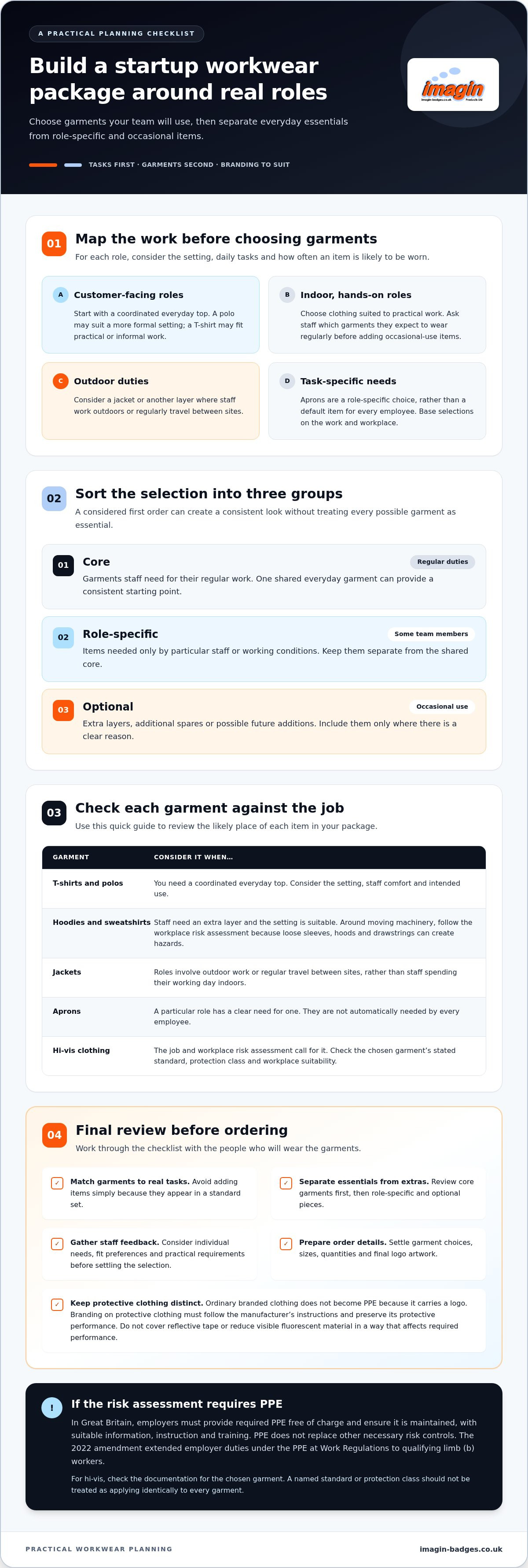
Map each role to its setting and tasks. Customer-facing staff may need a coordinated everyday top, while indoor hands-on roles may call for clothing suited to practical work. Outdoor duties could make a layer useful. Ask staff which garments they expect to wear regularly before adding occasional-use items.
Keep ordinary branded clothing distinct from protective clothing. If a risk assessment identifies a need for PPE, select clothing appropriate to that risk. In Great Britain, employers must provide required PPE free of charge and ensure it’s maintained, with suitable information, instruction and training. PPE doesn’t replace other necessary risk controls. The 2022 amendment extended the employer duties under the PPE at Work Regulations to qualifying limb (b) workers. Read the HSE guidance on PPE. For hi-vis, check the chosen garment’s documentation for its stated standard, protection class and suitability. “ISO certified hi-vis workwear” shouldn’t be treated as a blanket description of every garment.
Set a sensible first-order scope
Plan for your current roles and staff, rather than an assumed team size. Decide which garment will create a shared appearance across the team, then list optional pieces separately. This makes it easier to review the core selection without treating extra layers or spare garments as essential.
- Core: garments staff need for regular duties.
- Role-specific: items needed only by particular staff or working conditions.
- Optional: occasional-use layers, additional spares or possible future additions.
Consider individual needs and gather staff feedback before settling the selection. That can help you spot differences between roles, fit preferences or practical requirements early. A planned selection of branded workwear garments gives you room to establish a coherent look now, then add to it as your team and day-to-day needs develop.
Which garments belong in a startup workwear package?
Choose garments according to each role, working environment and how often staff will wear them. A customer-facing team might need coordinated everyday tops, while outdoor or hands-on roles may need extra layers or task-specific clothing. The aim is a useful mix, not one of everything. Affordable workwear packages for startups should reflect the working week your team actually has.
Choose a useful core of tops and layers
T-shirts and polos can form the everyday core when staff need a coordinated branded top. Consider what suits the setting: a polo may fit a more formal customer-facing environment, while a T-shirt may suit practical or informal work. These are starting points, not rules. Staff comfort, workplace expectations and the garment’s intended use should guide your choice.
Add hoodies or sweatshirts if staff need a layer and the setting suits them. For work around moving machinery, follow the workplace risk assessment, since loose sleeves, hoods and drawstrings can create hazards. Jackets make more sense for roles involving outdoor work or regular travel between sites than for staff who spend their working day indoors. Aprons are a role-specific choice, rather than a default item for every employee.
Before adding a garment, ask whether it will be worn regularly, by which roles and in what conditions. If only some team members need an item, keep it separate from the shared core. This helps you avoid ordering occasional-use clothing as though everyone needs it.
Decide whether hi-vis belongs in the selection
Include hi-vis when the job and workplace risk assessment call for it, not simply to make a uniform look more work-focused. Ordinary branded clothing does not become PPE because it carries a logo. If a garment is required as protective clothing, check its stated standard, protection class and suitability for the workplace. The phrase “ISO certified hi-vis workwear” shouldn’t be taken to mean that ISO itself certifies garments or that every option has identical certification.
Branding on protective clothing must follow the garment manufacturer’s instructions and preserve its protective performance. Don’t cover reflective tape or reduce visible fluorescent material in a way that affects the garment’s required performance.
Workwear bundles can be a convenient way to consider coordinated garments, but they aren’t a standard startup package. Check that each item suits your roles, and leave out pieces your team won’t use. You can compare options in our workwear collection as you refine your selection.
How should startups choose embroidery, printing and garment combinations?
Choose decoration by considering the garment, your logo artwork, its size and detail, and the appearance you want. Embroidery and full-colour printing create different finishes and suit different designs. Neither is automatically better or longer-lasting in every situation.
For a lean first order, consider whether each garment needs the same treatment. A compact logo may suit embroidery on a polo, while a larger, detailed or multi-colour design could be better suited to printing on a T-shirt. You can keep the overall look consistent by using the same approved artwork and colours across garments, even if the decoration method varies.
When embroidery may suit the garment and artwork
Embroidery adds a textured finish and can work well on many polos, hoodies and jackets. Before choosing it, look at the logo at the size and position intended for the garment. Fine lines, small lettering and closely packed details need careful assessment at that scale. There’s no single text size or logo dimension that suits every design and garment.
A visual logo file and an embroidery stitch file are different. Vector or bitmap artwork can be used to start digitising, but changing a file’s extension doesn’t turn it into a usable stitch file. Share the final logo version, intended garment and placement so the design can be assessed in context.
When full-colour printing may be a better fit
Printing can suit artwork with several colours, fine visual detail or a larger layout. T-shirts and hoodies are potential options, depending on the garment, design and intended appearance. If you’re considering layered clothing, compare suitable hoodies and sweatshirts with your team’s working conditions and dress expectations.
Use this comparison to shortlist a combination, then assess the actual artwork and garment before deciding:
| Garment | Decoration to consider | Potential fit | Practical check |
|---|---|---|---|
| Polo shirt | Embroidery | A compact logo with a textured finish | Review fine details at the intended size and position |
| T-shirt | Full-colour printing | Larger or multi-colour artwork | Consider how the design will look on the chosen garment |
| Hoodie or jacket | Embroidery or printing | Depends on the artwork and finish you want | Assess each garment and placement separately |
This is a guide, not a fixed rule. For affordable workwear packages for startups, choose the decoration that suits each garment and logo rather than applying one method by default.
What should you prepare before ordering startup workwear?
A little preparation makes it easier to turn your garment choices into a clear order. Work through the decisions in sequence: confirm roles, select garments, prepare artwork, review the options and then place the order. This helps keep the selection aligned with your current team and makes it easier to spot missing sizes, quantities or branding details before production begins.
Prepare staff, sizing and artwork details
Start with the people who need workwear now. Note each role, the garment chosen for it, the required sizes and quantities. If your team may change, base the first order on current requirements rather than estimating for future starters. You can plan possible additions separately.
For each garment, have these details ready:
- Garment reference and colour: identify the chosen item and shade.
- Sizes and quantities: check requirements with staff before finalising the count.
- Final logo artwork: use the approved version, not an old draft.
- Decoration details: specify embroidery or full-colour printing, the position from the wearer’s perspective and the preferred dimensions in millimetres.
- Colour references: provide your brand colour references, especially for embroidery. Thread is selected from available colours and may not match a screen image exactly.
- Required arrival date: include the date you need the garments to reach you.
Check the artwork at the intended size and position. Small lettering, fine lines and crowded details need particular attention for embroidery. A visual logo file is not the same as a finished embroidery stitch file, so the artwork needs to be prepared for the selected decoration method.
Review order details and timing
Once the garments and branding are settled, review every item against your notes. Check that each role has the right garment, size, quantity, colour and decoration. Bulk pricing discounts apply. Ask us about quantity pricing for your chosen garments.
Review your selected options, any applicable discounts, VAT, delivery charges and final total before paying. If your team is still growing, keep the order focused on current needs and note which garments you might add later, rather than adding unconfirmed quantities to this order.
Workwear orders are generally dispatched within 10 working days. Timing depends on stock availability, artwork approval and production schedules, and delivery time is additional. Dispatch is when an order leaves us, not when it arrives. If you have a deadline, contact us before ordering so you can discuss the timing of your branded workwear order.
How Imagin Products Ltd can help create a startup workwear package
Once you’ve settled which roles need branded clothing and what each garment needs to do, you can build a selection that feels joined up without relying on a fixed bundle. At Imagin Products Ltd, our workwear range includes T-shirts, polos, hoodies, sweatshirts, jackets, aprons and hi-vis safety wear. Garments can be embroidered or full-colour printed, giving you options to suit different designs and uses.
Build a selection around your team
Think of your package as a set of choices by role. For example, a customer-facing team might share branded polos, whilst staff working outdoors could need a suitable jacket. Aprons or hi-vis garments should be included where the job calls for them, rather than automatically issued to everyone. This approach lets you create a consistent look while keeping the selection relevant to the work.
Decoration doesn’t have to be identical across every item. Embroidery can give a textured finish on suitable garments, while full-colour printing can accommodate detailed or multi-colour artwork. The best combination depends on the design, garment, placement and appearance you want. For protective clothing, any branding must follow the manufacturer’s instructions and preserve the garment’s protective performance. If you’re considering ISO certified hi-vis workwear, assess the specific garment’s stated standard, class and suitability rather than assuming all options have the same certification.
Our customer service is personal, so you can talk to us rather than machines as you shape the selection. That can be useful when you’re weighing up how different garments and decoration choices work together. There’s no need to treat the package as a preset bundle or add items simply to make every staff member’s clothing identical. Keep your choices tied to actual roles and everyday requirements.
Take the next step with clear expectations
Before placing an order, bring together the details that make each choice clear: garment references and colours, staff sizes, quantities, your final logo artwork, decoration method, placement and preferred dimensions. Brand colour references are useful for embroidery; thread is selected from available colours and may not exactly match a colour shown on screen. Check artwork at the intended size so you can assess fine details and overall appearance before approval.
Workwear timing depends on stock availability, artwork approval and production schedules. If you have a required arrival date, contact us before ordering so you can discuss your deadline. Once you’re ready, you can explore the workwear range and put together a branded selection suited to your startup, with room to adapt it as roles and requirements develop.
Let your workwear grow with your team
Your first order can establish a recognisable look without locking every future role into the same uniform. Treat affordable workwear packages for startups as a starting point, then review the selection as your team’s tasks and needs become clearer. A consistent brand identity can carry across different garments, even when you choose different decoration for each one.
Our workwear is available as embroidered or full-colour printed, so the finish can suit the garment and artwork. And if you’d rather talk through your choices with a person, our customer service means you can speak to us rather than a machine. We’re here to help you shape a practical selection that feels right for your team, without pressure to add garments you don’t need.
Start with the look you want staff to share, then choose the garments that support the work they do. You can refine and build on that look as your startup develops.
A clear, well-chosen first step is enough to get your team looking the part.
Frequently Asked Questions
Is branded workwear worth it for a startup?
It can be worthwhile if it helps your team present a consistent appearance in the settings where they work. Start with garments staff will use regularly, rather than ordering a broad uniform selection before roles are settled. For affordable workwear packages for startups, judge the value by how well each item suits the job and your team’s needs, not by assuming branded clothing will produce a particular financial return.
Can a startup combine embroidered and printed workwear in one order?
Yes. You can choose decoration according to the garment and artwork, rather than applying the same method to every item. For example, a small logo on a polo might suit embroidery, while a larger, multi-colour design on a T-shirt could suit full-colour printing. Make sure the final artwork and placement are specified for each garment, so the finished set looks considered even when the decoration differs.
How many workwear garments should I order for each employee?
There isn’t one number that fits every employee. Consider how often each person wears the garment, whether their role requires a change of clothing during a shift, and how frequently garments are cleaned. A staff member wearing a branded top occasionally may need a different allocation from someone wearing it throughout the working week. Confirm sizes and quantities with your current team, then keep future recruitment separate from the first order.
How long does branded workwear take to dispatch?
Workwear orders are generally dispatched within 10 working days, though timing depends on stock availability, artwork approval and production schedules. Dispatch means the order has left us, so allow additional time for delivery. If you’re working towards a launch, event or opening date, contact us before ordering to discuss your deadline. We can’t guarantee a particular arrival date, so build in time for artwork decisions and delivery.
Can hi-vis workwear be branded?
Yes, provided the branding follows the garment manufacturer’s instructions and preserves its protective performance. For ISO certified hi-vis workwear, assess the specific garment’s stated standard, class and suitability for the job, rather than assuming every option has identical certification. Branding must not cover reflective tape or reduce visible fluorescent material in a way that affects the garment’s required performance. Treat hi-vis as protective clothing only when it retains that performance.
Do bulk pricing discounts apply to startup workwear orders?
Bulk pricing discounts apply. The amount depends on the chosen garments and quantities, so don’t assume every combination is priced in the same way. Compare the options you’re considering and check the order total before paying, including any applicable discounts, VAT and delivery charges. Ask us about quantity pricing for your chosen garments, particularly if you’re planning a coordinated selection across several garment types or staff roles.
Article by
Team Imagin :)
Team Imagin helps businesses look their best with quality name badges, photo ID cards, lanyards and branded workwear. Based in Kirkcaldy, Scotland, we combine friendly, personal service with professional printing and embroidery to bring your branding to life. From small teams to large organisations across Scotland, the UK, Europe and America, we help you boost your brand and build connections.
Disclaimer
This article provides general guidance only. Information was correct to the best of our knowledge when published, but product details, prices and regulations may change. Check current specifications and official guidance before making decisions.